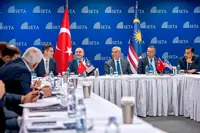
KUALA LUMPUR: Malaysia has picked Türkiye as its preferred supplier of an alternative missile system for the navy’s Littoral Combat Ships (LCS) after Norway failed to issue the export licence needed for the naval strike missiles (NSM).
Defence Minister Datuk Seri Mohamed Khaled Nordin said the government would begin negotiations with Türkiye to finalise the proposed replacement after evaluating alternatives from four countries.
He said Türkiye was selected based on several factors, including price, delivery timelines and initial costs.
“The countries we invited to submit proposals were Türkiye, Germany, France and Italy. Following our evaluation, we identified Türkiye as the best option to replace the NSM missiles from Norway.
“We will now engage with the Turkish side for further negotiations before making a final decision,” he told reporters after the ministry’s 2026 Innovation Day celebration on Thursday (Nov 12).
Mohamed Khaled said Malaysia had accepted that it would not receive the NSM missiles despite having made payments and fulfilled its obligations under the procurement agreement because the Norwegian government had not issued the necessary export licence.
He said the government was now pursuing the contractual dispute resolution process, which involves several stages before the matter can proceed to arbitration.
“The first stage, involving amicable negotiations between both parties, has been completed without a resolution.
“Malaysia will now proceed with the establishment of a dispute resolution committee,” he said.
If the second stage also fails to resolve the dispute, Malaysia will proceed to arbitration, which can be held in Kuala Lumpur under the terms of the contract, he added.
“However, all these processes will take time, and we cannot predict when the matter will be resolved or when the Norwegian company will refund the money,” he said.
Mohamed Khaled stressed that Malaysia would not wait for the refund before securing an alternative missile system for its naval vessels.
He said the proposed Turkish system appeared compatible with the LCS and capable of being integrated with the vessels, although these aspects would be examined further during negotiations.
He also said the replacement would not require Malaysia to procure an entirely new stock of missiles because the same missile system had already been ordered for the navy’s Littoral Mission Ships (LMS).
“This would allow Malaysia to obtain an initial supply earlier, potentially by 2028, instead of waiting until 2029 if a fresh order had to be placed,” he said.
Mohamed Khaled said the missile had a surface-to-surface range of 240km and was considered competitive in terms of its capabilities.
He said Malaysia would mainly incur additional costs for launchers and integration work rather than having to purchase an entirely new stock of missiles.
“If we had to order new missiles from scratch, the cost could be between US$700mil and US$900mil.
“We do not need to spend that amount now because the missiles have already been ordered for the LMS,” he said.
Mohamed Khaled said the negotiations would be conducted through a government-to-government arrangement involving the relevant Turkish government agency rather than directly with a private company.