PETALING JAYA: Middle-income taxpayers could save about RM300 to RM500 from Budget 2027’s tax-rate cuts, while the increase in basic individual tax relief to RM12,000 offers additional room to absorb rising living costs, say experts.
Associated Chinese Chambers of Commerce and Industry of Malaysia treasurer-general Datuk Koong Lin Loong estimated that taxpayers with a chargeable income of RM70,001 to RM100,000 could save about RM300, while those in the RM100,001 to RM150,000 band could save around RM500 following a one-percentage-point reduction to 18% and 24% respectively.
He said the increase in basic individual tax relief from RM9,000 to RM12,000 is long overdue, after remaining unchanged since 2010.
“It’s a very good move that was long overdue,” he said in an interview yesterday.
“The 33.3% increase was right, especially against a backdrop of rising prices with inflation climbing about 34% between 2020 and 2025, according to figures from the Statistics Department.”
He also called for tax relief for renters, noting that many young families could not afford to buy a home and needed help managing their household costs.
Policy specialist and economist Dr Geoffrey Williams said the higher relief would be welcomed by higher-income earners, although its impact would be less significant for other groups.
“Personal tax reliefs should be adjusted regularly in line with income growth to prevent taxpayers from moving into higher tax brackets simply because of modest salary increases.
“This tax-creep becomes a burden and a form of ‘hidden taxation’,” he said.
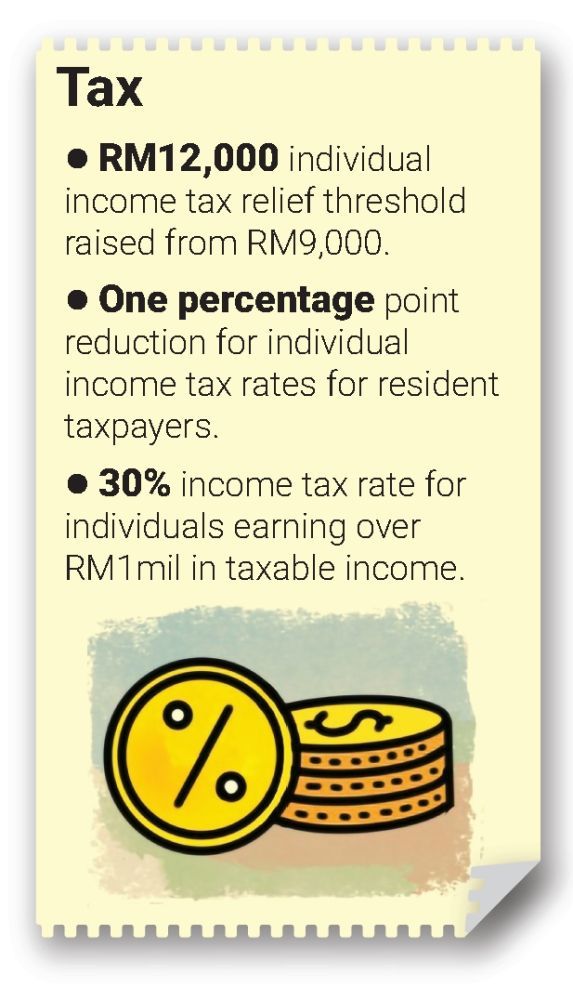
Tax expert Datin Christine Koh said the potential RM1,600 increase in disposable income was the maximum benefit rather than a guaranteed amount for every taxpayer.
“Tax relief is not a direct cash payment or tax rebate. The actual savings depend on an individual’s chargeable income, applicable tax rate and eligibility for the various reliefs.”
She said personal tax reliefs should be reviewed periodically to keep pace with inflation, changing family structures and household spending needs.
Koh also pointed to the RM2,000 relief for each child below 18, which she said was relatively minimal given the cost of raising children today.
Federation of Malaysian Consumers Associations chief executive officer Dr Saravanan Thambirajah said tax relief alone would not address the financial pressures faced by all households.
“A RM1,000 tax relief does not mean a consumer receives RM1,000 in cash,” he said, noting that the actual savings depends on the taxpayer’s applicable tax rate.
He said lower-income households that do not pay income tax would receive little or no direct benefit from personal tax reliefs, making targeted assistance and subsidies important in complementing the measures.