



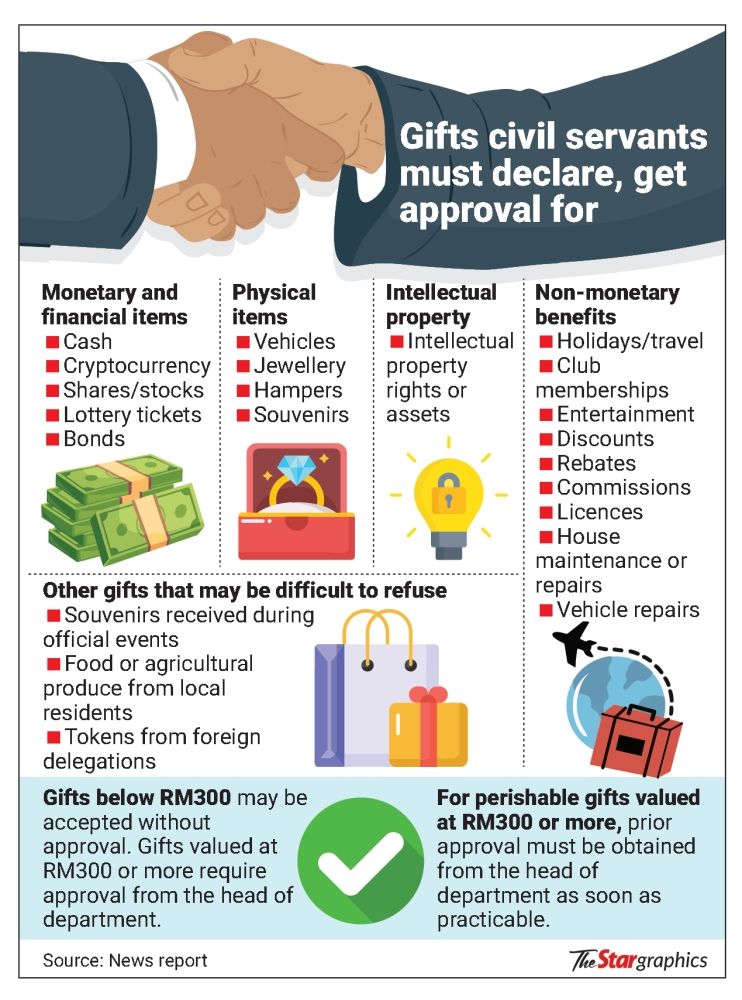
PETALING JAYA: The inclusion of cryptocurrency, shares and lottery tickets under new rules governing gifts to civil servants is a timely move to close new loopholes, says Malaysia Integrity and Governance Society president Datuk Seri Akhbar Satar.
He said the revised guidelines introduced by the Public Service Department were a positive step towards strengthening integrity, transparency and accountability in the public service.
“Digital and financial assets can easily fall outside traditional gift rules, yet they may carry substantial value and create opportunities for undue influence,” he added.
Akhbar said the perception of a conflict of interest could be as damaging as an actual conflict.
“Corruption can start with something as simple as a gift which may gradually create expectations, obligations or undue influence.
“Heads of department must closely monitor compliance while leadership should lead by example regardless of rank,” said the criminologist.
However, he said the policy’s effectiveness would ultimately depend on consistent, impartial and strict enforcement.
Transparency International-Malaysia president Raymon Ram said the move towards a cumulative monthly threshold addressed a weakness in the previous framework by making it harder for a series of smaller gifts to escape scrutiny.
However, he cautioned against treating the RM500 or one-quarter-of-emoluments threshold as defining what constituted an acceptable gift.
“The more important questions are: who gave it and why? What dealings does the giver have with the government? And could it create an obligation, expectation or perception of influence?”
Raymon said another challenge was detecting attempts to circumvent the rules, including benefits spread across different months or routed through intermediaries and related parties.
Repeated benefits from the same contractor, supplier or other interested party should also attract scrutiny even when individual monthly amounts remained below the threshold, he said.
“The real safeguard is not simply the number. It is whether the system can identify patterns of influence, conflicts of interest and deliberate attempts to circumvent the rules,” he said.
Raymon proposed a digital “gifts and hospitality register” across the public service to record details such as the giver, recipient, nature and value of the benefit, and any dealings with the department.
He said this should be backed by risk-based reviews in procurement, licensing, enforcement and regulatory areas, with consequences for deliberate non-declaration.
Meanwhile, the Centre to Combat Corruption and Cronyism (C4 Centre) said gifts to civil servants could inadvertently create bias in the execution of their duties.
It said that apart from family members and individuals in close relationships, civil servants should exercise caution when receiving gifts or hospitality from third parties.
C4 Centre said there was no need to establish a new body to oversee gift declarations, but called for external oversight to ensure the system remained transparent and accountable.
