



PETALING JAYA: More than 80,000 human-wildlife conflict complaints were logged nationwide over the past six years as habitat fragmentation forced animals into closer contact with communities.
Data from the Wildlife and National Parks Department (Perhilitan) showed that 80,710 complaints were recorded between 2020 and 2025, with cases rising from 11,818 in 2020 to a peak of 15,492 in 2024 before easing slightly to 13,885 last year.
Long-tailed macaques accounted for the most complaints, with 48,539 cases over the six years, followed by wild boars (10,473), elephants (6,230), Asian palm civets (4,231) and pig-tailed macaques (2,497).
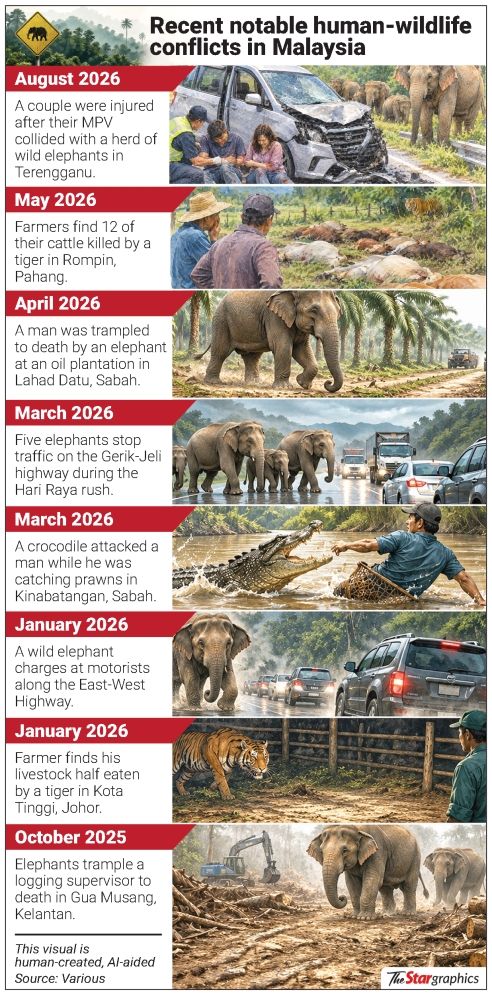
Human-wildlife conflicts have increasingly drawn public attention following several recent fatal encounters.
Last month, a 69-year-old man was believed to have been trampled to death by a wild elephant in Sabah.
In March, rescuers recovered the dismembered body of a man who was attacked and dragged away by a crocodile at a river in Sabah.
Earlier in January, cattle breeders in Felda Penggeli Timur, Johor, discovered a half-eaten cow carcass after a tiger was spotted roaming an oil palm plantation and believed to have mauled the animal.
Perhilitan said habitat fragmentation remained among the main causes of human-wildlife conflict.
“Forest corridor fragmentation forces wildlife to cross human settlements in search of food sources.
“Habitat fragmentation also forces wildlife to pass through areas of human activity to move between neighbouring habitats,” it said.
The department added that poor food waste management near forest fringes was also attracting opportunistic wildlife such as monkeys and wild boars into residential areas.
“Increased human settlements near natural wildlife habitats have also contributed to the issue,” it said.
Perhilitan said it had activated several high-impact mitigation measures to reduce conflicts and improve public safety.
These included installing elephant electric fence systems to prevent animals from entering plantations and villages, as well as constructing wildlife crossings such as the Gerik-Jeli East-West Highway viaduct to maintain habitat connectivity.
The department also conducts capture-and-relocation operations involving elephants, primates and civets.
Public concern on wildlife safety intensified further after several elephant roadkill incidents were reported in Peninsular Malaysia over the past five years.
Perhilitan advised the public not to approach, feed or provoke wild animals during encounters.
“Do not make sudden loud noises that could trigger aggressive ‘fight or flight’ reactions from wildlife. It could be dangerous for both humans and the animals themselves,” it said.
The department urged the public to immediately report wildlife sightings or conflicts through official Perhilitan channels to enable prompt action.
