



PETALING JAYA: An N95 respirator is recommended during haze as it provides better protection against fine particulate matter than regular surgical masks, say public health specialists.
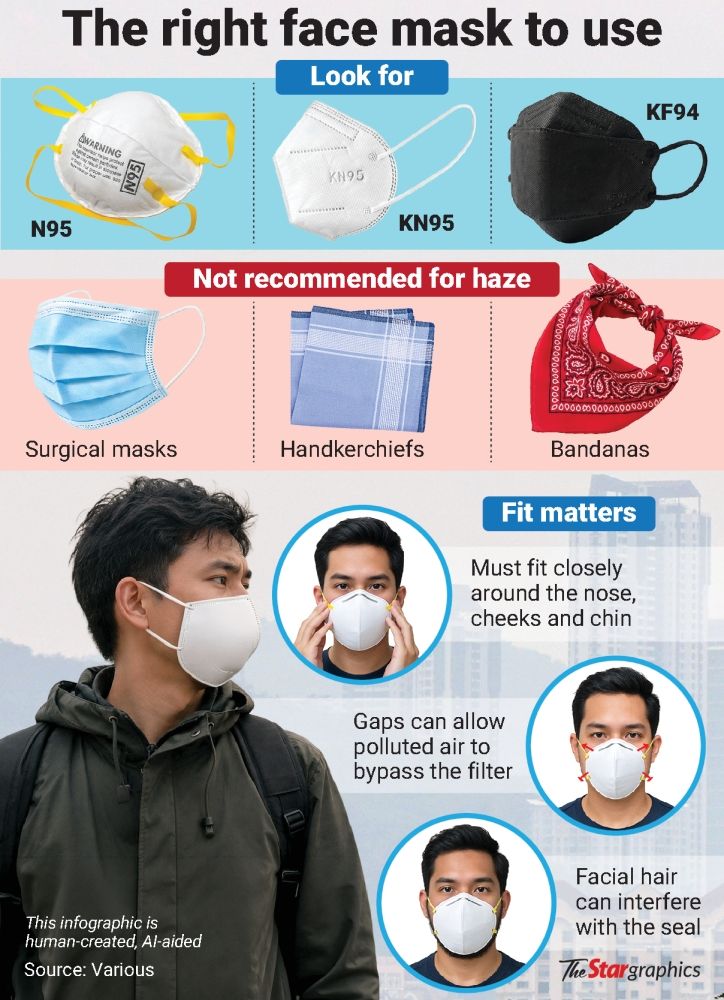
Universiti Kebangsaan Malaysia public health specialist Prof Dr Sharifa Ezat Wan Puteh said the public should use N95, KN95 or KF94 respirators that are genuine, appropriately certified and properly fitted.
“Many people wear surgical masks during haze. But regular surgical masks do not form a tight seal around the nose, cheeks or chin.
“They may not filter PM2.5-sized particles and below effectively, as they are not designed to provide the same level of protection as particulate respirators,” she said when contacted.
She said N95, KN95 and KF94 respirators could filter at least 94% to 95% of very fine airborne particles when properly fitted.
“A surgical mask may still have other uses, but it should not be considered equivalent to an N95, genuine KN95 or other appropriately certified particulate respirator for haze,” she said.
Dr Sharifa said handkerchiefs and bandanas were also ineffective in protecting against haze because fine particles could pass through loose fabric, although a damp handkerchief could be used in an emergency.
She advised the public to avoid areas with high air pollutant index readings, stay cool and drink enough water.
Haze particles can trigger coughing, sore throat, rhinitis, breathing difficulties and eye irritation, she added.
Universiti Malaya occupational health and public health medicine specialist Prof Dr Victor Hoe similarly said a well-fitting N95, KN95 or KF94 offered better protection than a surgical mask.
“The loose fit in surgical masks allows contaminated air to enter from the sides. They should not be considered equivalent to a properly fitted respirator for haze protection,” he said.
Dr Hoe stressed that a proper fit was crucial, as gaps around the mask could allow polluted air to bypass the filter.
“The respirator should fit closely around the nose, cheeks and chin. Facial hair can interfere with the seal,” he said.
However, he said masks were only one part of haze protection, advising the public to reduce unnecessary outdoor activities and exercise, spend more time indoors in cleaner environments and minimise indoor sources of air pollution.
“Respirators increase breathing resistance and may feel uncomfortable or make breathing more difficult, particularly for some people with respiratory conditions,” he said, adding that those who had to remain outdoors for prolonged periods, such as delivery riders and other outdoor workers, should seek appropriate advice from a respiratory physician or occupational health doctor.
Explaining the importance of haze protection, Dr Hoe said PM2.5 particles were 2.5 micrometres or smaller – about 30 times smaller than the diameter of a human hair – allowing them to penetrate deep into the lungs and potentially enter the bloodstream.
Exposure can cause wheezing, chest tightness and breathlessness, and worsen existing respiratory and cardiovascular conditions.
Children, older adults and people with heart or lung disease are particularly vulnerable, he said.
