PETALING JAYA: Settling the RM50mil fine as a condition for his house arrest does not mean former prime minister Datuk Seri Najib Razak will be released from prison immediately, says a criminal lawyer.
According to lawyer Ridha Abdah Subri, Najib’s conditional pardon comes with specific conditions that would ultimately determine how his house arrest is implemented.
He said settling the fine is part of the financial condition that must be fulfilled before the rest of the house arrest process can proceed.
“The Registrar would first need to confirm that the fine had been paid, following which the relevant authorities would have to verify the payment and carry out the necessary administrative arrangements for his transfer,” he explained.
Ridha said these arrangements would likely include confirmation of the approved residence and conditions covering supervision, movement, reporting and security.
On Saturday, Attorney General Tan Sri Mohd Dusuki Mokhtar said that the former prime minister would first have to pay the RM50mil fine at the Kuala Lumpur High Court Registrar’s Office before the house arrest process could proceed.
On where the proceeds of the fine would end up, Ridha said an official receipt would be issued and the payment recorded before it would be handed over to the government.
“Since this is a fine imposed by a Federal Court, the money would ordinarily be treated as government revenue and paid into the Federal Consolidated Fund.
“It would not go to SRC International or another private party as compensation unless there is a separate court order or legal provision,” Ridha pointed out.
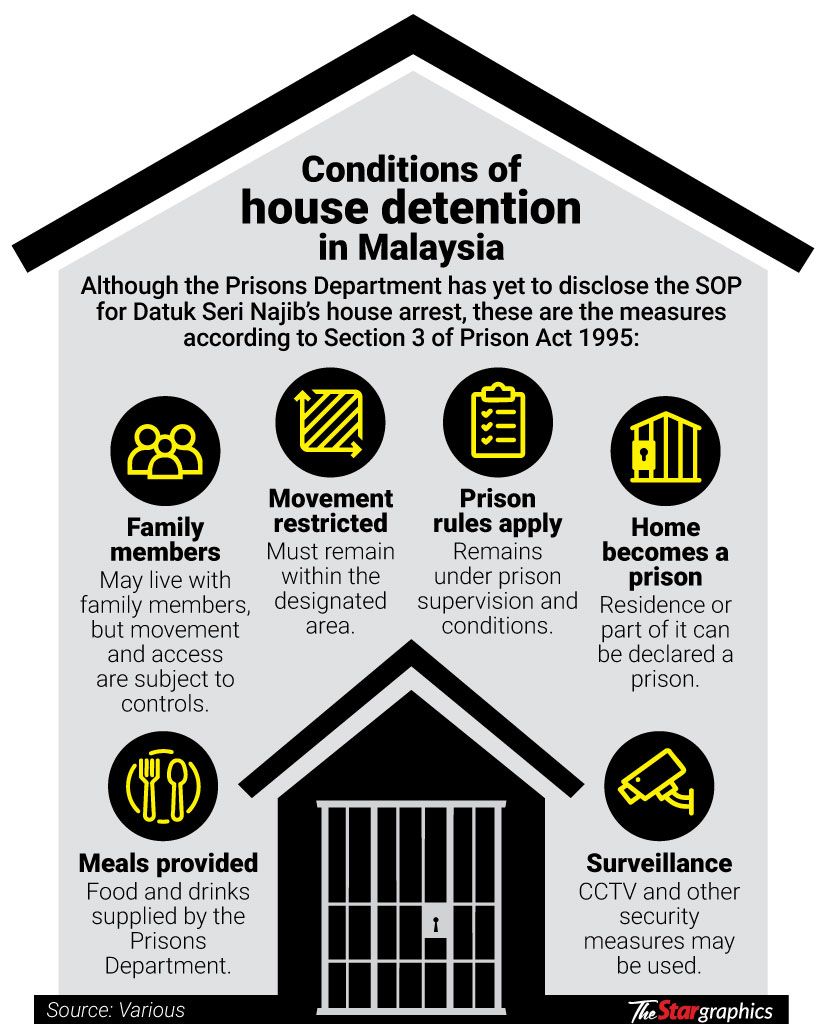
Another criminal lawyer, Tripatjit Singh, said Najib’s house arrest would still amount to imprisonment as there would be restrictions on his movement and visitors.
He said Najib’s movement would generally be restricted to the designated premises, while leaving the residence would require approval.
“Visits by outsiders could also be restricted, although the position of family members or other people already living at the residence would depend on the conditions imposed by the Prisons Department,” Tripatjit added.
He said the installation of CCTVs, fencing or other security measures at a privately owned residence would also have to be addressed.
“If CCTVs were to be installed in a private residence that is also occupied by other family members, this could infringe their privacy and personal rights,” he noted.
Tripatjit added that the authorities would need to clarify whether the residence had formerly been declared a prison under Section 3 of the Prisons Act 1995 and what would constitute a breach of the house arrest conditions.