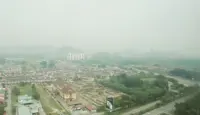
SIMPANG PULAI: There has been no increase in haze-related illnesses reported in Perak, says state health, human resources and indian community affairs committee chairman Datuk A. Sivanesan.
He said the Perak Health Department would continue to monitor the situation although it remained under control.
“Although the situation is currently under control, with no increase in haze-related illnesses reported, strengthening the dissemination of information and health advice is critical to prevent unwanted incidents as we face this haze phenomenon,” he told reporters after a site visit to a quarry in Mukim Sungai Raya, Keramat Pulai, Kampung Kepayang here on Friday (Sept 18).
Sivanesan said that as of 11am on Friday, the Air Pollutant Index (API) readings at five stations in Perak recorded moderate readings with Tasek, Ipoh (185), Seri Manjung (180), Pegoh, Ipoh (160), Taiping (156) and Tanjung Malim (154).
He added that epidemiological surveillance for haze-related illnesses was carried out throughout the year at national, state and district levels.
“The Health Ministry monitors the number of haze-related illness cases receiving treatment at its haze sentinel facilities.
“These facilities comprise selected hospitals and health clinics based on the locations of air quality monitoring stations operated by the Environment Department,” he said.
In Perak, the haze sentinel facilities are Raja Permaisuri Bainun Hospital, Ipoh, Simee Health Clinic (KK), Menglembu Health Clinic, Kamunting Health Clinic, Sitiawan Health Clinic and Tanjung Malim Health Clinic.
He added that the Health Ministry and Perak Health Department would continue to raise public awareness about haze-related illnesses and preventive measures through radio announcements, infographics on the department’s website and social media platforms.
He advised the public to reduce outdoor activities, particularly physical activities such as exercising, when the API reaches unhealthy levels.
He also advised the public, especially motorcyclists, outdoor workers and high-risk groups, to wear suitable masks such as N95 or P100 when exposed to haze or dusty areas.
“Wash your face and exposed skin with clean water immediately after returning indoors and drink plenty of plain water, with at least eight glasses a day.
“Use air-conditioning when travelling in vehicles. High-risk individuals should continue taking their medication according to their doctor’s advice and be prepared to leave the area if the haze reaches hazardous levels,” he said.
He also urged the public to recognise the early signs and symptoms of haze-related illnesses, heat exhaustion and heatstroke, and seek medical attention promptly if necessary.