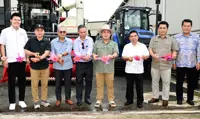
KOTA KINABALU: A total of 75 units of various agricultural machinery have been given to the Sabah Padi and Rice Board (LPBS) as part of the state’s efforts to modernise and restructure the state's rice farming industry.
Agriculture, Fisheries and Food Industry Minister Datuk Jamawi Jaafar said the tractors and harvesters would help motivate farmers to continue cultivating padi in the state and boost production.
"With the assistance of these 75 tractors and harvesters, I am confident it will provide encouragement for our farmers to continue padi cultivation," he told reporters after officiating the LPBS handover ceremony of the agricultural units at Kota Kinabalu Industrial Park (KKIP) here Friday (Sept 18)
He said the government was also aware that many padi farmers belonged to the older generation and were no longer physically capable of working their rice fields.
Jamawi thanked Sabah Chief Minister Datuk Seri Hajiji Noor for approving the special allocation to support the needs of the state's farmers and padi growers.
The state minister said the mini-estate scheme, introduced earlier this year to revive long-abandoned padi fields was shaping up.
"To date, we have identified six companies that have successfully signed memoranda of understanding (MoUs) with landowners and are cultivating the land under the Mini Estate system," he said, adding that his ministry was evaluating another 19 companies invited to select abandoned padi fields for cultivation.
"There are still about 6,100ha of padi land that were previously cultivated but have been left idle and uncultivated for the past eight to 10 years," he said.
Jamawi said that if these areas could be developed through the Mini Estate system, along with providing new machinery to active farmers, the government was confident Sabah's rice and paddy self-sufficiency level (SSL) could increase to at least 30% within five years.
"If we can increase the yield per hectare, the SSL could exceed 30%," he said.
According to him, six rice granary areas under LPBS had been identified to benefit from the mechanisation initiative, including two districts with sub-district divisions.
"The main focus area is Kota Belud because it has a large padi cultivation area of about 3,300ha. This will be our priority so that farmers there can receive more suitable mechanisation support," he said.
He added that the smaller districts would also receive part of the machinery, particularly in areas where farmers had demonstrated a commitment to increasing paddy production.
Jamawi said farmers seeking machinery assistance must first develop their farming areas systematically before aid could be considered.