



PETALING JAYA: Efforts are ongoing by the government to protect the orang utan, a prime species of the jungles of Sabah and Sarawak, with positive results already being seen.
A key protection effort for this critically endangered species is the Orangutan Diplomacy Programme, a joint effort between the government, plantation industry and conservation groups.
Plantation and Commodities Minister Datuk Seri Dr Noraini Ahmad said the programme is currently being implemented at the Sungai Pin Conservation Area (SPnCA) in Kinabatangan, Sabah.
She said the 2,632ha area was voluntarily designated as a High Conservation Value area by Sawit Kinabalu Group and supports a population of an estimated 55 orang utan.
As part of this programme, orang utan bridges installed within SPnCA are used to improve connectivity between fragmented habitats and provide safer passage across waterways.
She said the programme also supported the provision of equipment, such as a patrol boat, for wildlife rangers as well as training to strengthen not just monitoring but anti-poaching measures.
“The bridges are important in areas where rivers may pose risks to the orang utans, enabling them to easily move between the conservation area, adjoining forest fragments and nearby plantation zones.
“In addition, a two-year training programme is being conducted with the Danau Girang Field Centre to strengthen the wildlife rangers’ capabilities in wildlife monitoring, habitat protection and long-term conservation management.
“Meanwhile, the boat significantly improves the rangers’ wildlife monitoring and enforcement capability within SPnC,” she told The Star when contacted.
Noraini said Sawit Kinabalu had also limited or suspended plantation activities in sensitive areas where orang utan habitats are.
She said the programme, managed by the Malaysian Palm Oil Green Conservation Foundation (MPOGCF), has already allocated close to RM200,000 towards hands-on conservation projects from the palm oil industry.
However, Noraini said it was still too early to determine whether the orang utan population had increased, with an updated assessment expected after the ongoing Bornean Orangutan Population Survey.
She added that preliminary observations showed positive results with encouraging sightings of some orang utans living outside formally protected areas, including fragmented forests and high-conservation value areas within the oil palm landscapes.
“However, this does not mean that oil palm plantations can replace natural forests as orang utan habitat.
“Natural forests and connected forest corridors remain essential for their long-term survival.
“The ministry believes that coexistence is possible when conservation considerations are properly incorporated into landscape and plantation management,” she added.
She said future efforts would prioritise obtaining accurate data on orang utan populations, distribution and movements to identify priority habitats and strengthen wildlife corridors, as the world celebrates World Orangutan Day today.
Noraini also said that her ministry will continue to encourage other plantation companies to adopt conservation measures including habitat restoration, and adjustments to estate operations in sensitive areas.
“Conservation cannot be achieved by the government or conservation organisations alone as it requires the collective participation of the industry, local communities and the public.
“Let this World Orangutan Day remind us that protecting orang utans and their habitats is a shared responsibility,” Noraini added.
She also urged Malaysians to participate in the World Orangutan Day Fun Run 2026 on Sept 6 at Taman Botani Putrajaya, saying it would promote greater public support for orang utan conservation.
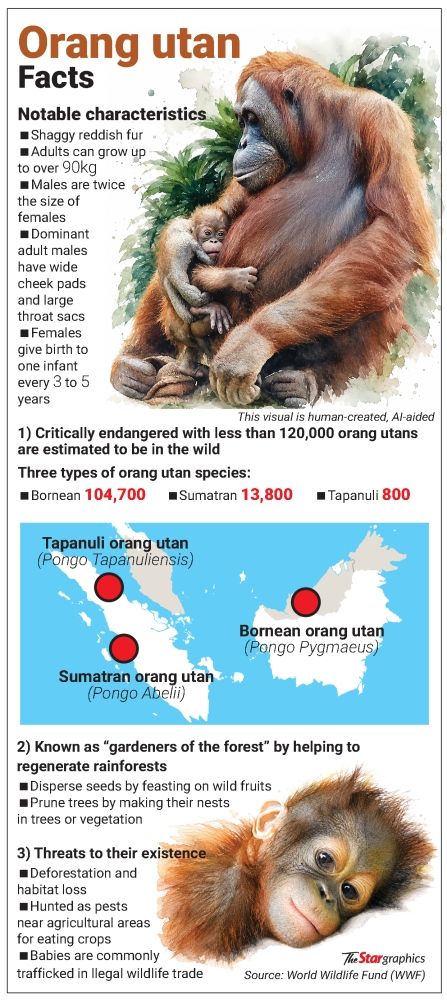
Currently, the number of orang utan in Malaysia is estimated to be around 2,000 in Sarawak, and over 10,000 in Sabah, as previously reported in 2024 by former Plantation Industries and Commodities Minister Datuk Seri Johari Abdul Ghani.
