
KUALA LUMPUR: Malaysia will draw from the experience of other countries to identify gaps in laws and measures needed to better address digital governance and online harm.
Communications Minister Datuk Seri Fahmi Fadzil said learning from other countries would be an important step in devising strategies.
“We are studying approaches adopted by other countries and adapting strategies that are suitable for Malaysia.
“Not every approach has proven successful, and we also do not want to send the message that Malaysia is against technology or investment. Instead, we want technology and investments that bring benefit while minimising harm,” he told reporters at the International Regulatory Conference (IRC) 2026, held here yesterday.

The minister expressed hope that discussions during the conference would lead to concrete follow-up action in Malaysia and abroad, adding that the outcomes would also be shared with the International Telecommunication Union (ITU), which Malaysia is a council member.
Fahmi advised anyone whose face or image had been manipulated without their consent to report the matter to the relevant platform as well as the Malaysian Communications and Multimedia Commission (MCMC).
He said this was an available avenue while the government worked on the proposed legislation to address fast-evolving technology, adding that a regulatory Bill to govern artificial intelligence was being drafted.
Fahmi said the government needed to counter challenges such as scams, online harm and the potential misuse of personal data.
“Although I have yet to receive reports about the spread of personal data directly related to AI, it could involve data leaks or the misuse of databases,” he said.
Fahmi said the proposed legislation would take time to finalise but regulators, including MCMC, would continue monitoring developments and intervene when necessary, especially when safety issues arose.
He cited the case involving Grok AI, when users generated inappropriate images, prompting the MCMC to engage with social media platform X to introduce additional safeguards.
“This case proves that although we do not yet have a specific law, the regulatory process is ongoing,” he said.
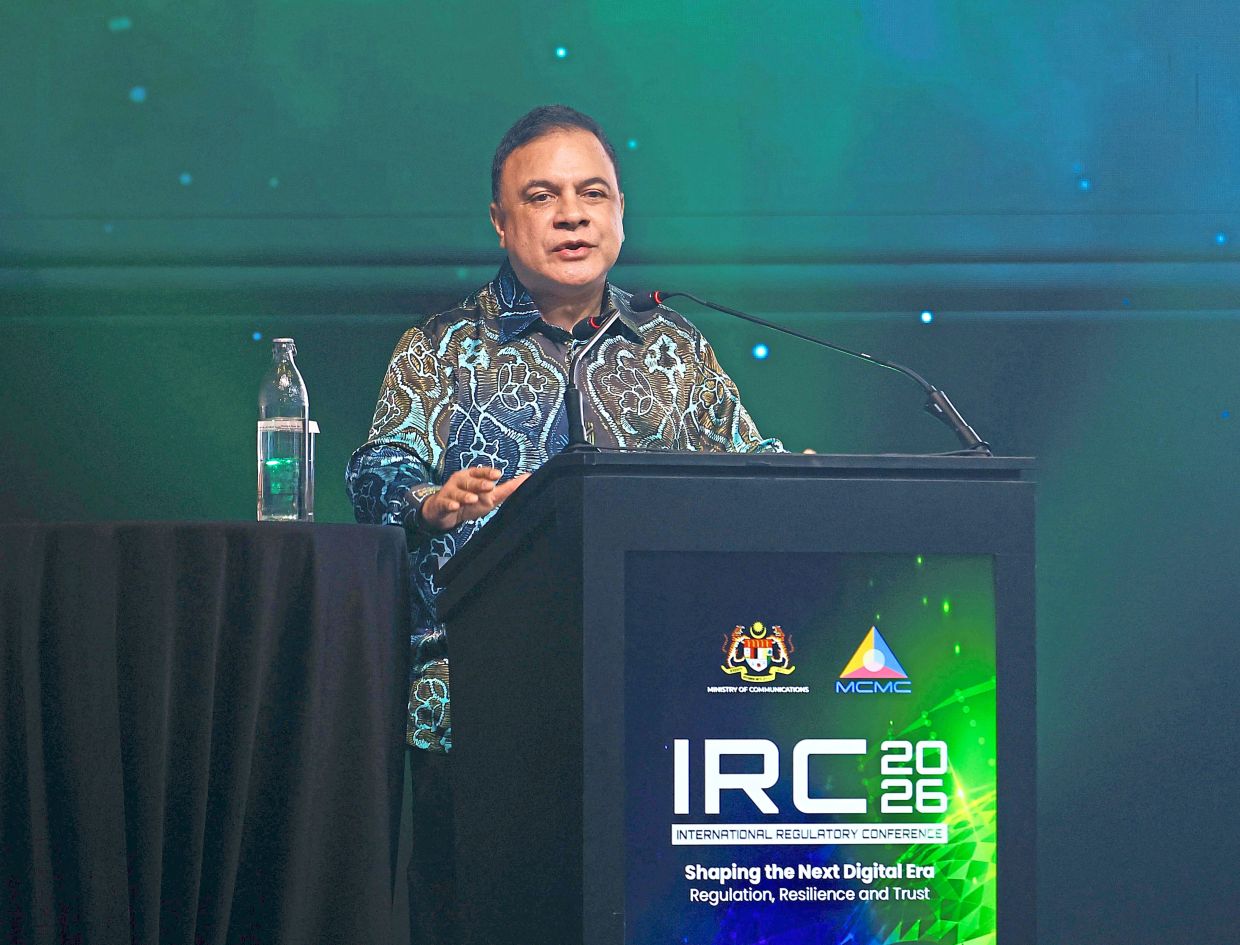
In his keynote address earlier, Fahmi said the third edition of IRC 2026 focused on online safety, data governance, AI, quantum communications, autonomous systems and the future of regulation.
These topics aim to translate dialogue into practical policy outcomes and stronger international cooperation.
He noted that the conference had evolved into a platform for regulators from different jurisdictions to exchange views on digital governance and collaborate on addressing online harm.
On the enforcement of social media age restrictions for users aged 16 and below, which took effect on June 1, Fahmi said social media platforms were currently adjusting their systems to comply with the new requirements.
MCMC commission member Derek John Fernandez, speaking at the conference, said criminals were now able to seize information and exploit people through highly convincing simulations.
“We have all heard about fraud cases where people believe they are in a live online conference with their chief financial officer, and follow instructions to transfer millions of ringgit only to discover the entire scene was fabricated,” he said.
He said it was impossible and complex to simply shut down all the problems in digital platforms, as there were two values competing with each other, namely protection and revenue for the company.
“The first value we compete for is the need to protect our citizens as regulators. The second is shareholder value for the companies providing these services,” he said.
“For many technology companies, revenue is important and trading data forms part of their business model.
“But to regulators, data falling into the hands of dishonest actors can lead to the weaponisation of information and facilitate crimes, particularly against vulnerable groups.”
He said digital laws must mirror physical laws, with strict verification and accountability to prevent abuse, particularly to children.
According to Fernandez, the MCMC receives two to three reports involving child sexual abuse material daily, and executes about 1,700 takedowns of harmful online content every day.
While regulators and industry players may hold differing views on how digital platforms should be governed, he said there should be no disagreement on the fundamental need to protect children.
“Just like how pubs check verification for underage drinking alcohol, such restrictions and verifications are needed in the digital world.
“The digital laws are much more lax, and it is easier to get away with it out of anonymity. So it is time today in that discussion, let us make the same set of laws,” he added.
The IRC saw an array of insightful sessions like “Online Safety by Design”, which centred around ensuring child protection in digital spaces.
Panellists spoke on holding platforms accountable for the safety of children.
Saskia Blume, chief of child protection with Unicef Malaysia, said: “We should equip children, young people and even adults to safely navigate the online space, but let me draw a comparison to road safety.
“We don’t only teach children how to cross the road safely, we also mandate seatbelts and make sure that cars are designed in a way that become more safe.
“So with online safety, it is the same. We should not just equip children and young people with knowledge, but look at the system overall to make them safer.”
She said there has been a regulatory convergence around ensuring safety by design, not just in Malaysia but internationally too.
Other areas touched on during the dialogue included balancing child rights and freedom of expression with safety, shared responsibility over the issue, and mechanisms to ensure readiness by both children and online spaces.
In another session on data sovereignty, panellists from telco, e-commerce and fintech discussed growing consumer expectations for stronger privacy protections.
One of the speakers said consumers increasingly based their purchasing decisions on trust, with poor data governance capable of driving users to competing platforms.
“Consumers do not read long privacy policies. But they do something much more direct, they vote with their wallets, and they vote with their attention. If you lose their trust overnight, they can easily switch to a platform,” he said.
A panellist from an e‑commerce company explained that ensuring privacy and security is complicated because it goes beyond just software or the app.
He said vulnerabilities could also arise in logistics, vendors and even consumers, meaning the overall experience was only as strong as its weakest link.
“Consumers are forcing us to be very self‑aware and be self‑motivated to improve our data governance. Because if we don’t, they will easily take that business elsewhere,” he said.
The two-day IRC 2026 gathered regulators, industry leaders and experts to share views and shape Malaysia’s digital future.