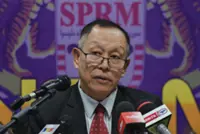
PUTRAJAYA: Placement of integrity officers at agencies under the Federal Territories Department will be based on risk assessment, says the Malaysian Anti-Corruption Commission (MACC) chief commissioner, Tan Sri Azam Baki.
He also said that MACC cannot "go around poking" at other departments without Cooperation Notes, unless information suggests possible corruption or an investigation requires their presence.
Azam said this to the media on Tuesday (Feb 3) after a Cooperation Note signing event here between the MACC and the Federal Territories Department, represented by Minister in the Prime Minister's Department in charge of the Federal Territories Department, Hannah Yeoh.
He also said that Cooperation Notes with government departments do not prevent the MACC from looking into past cases involving those departments.
"Criminal cases have no statute of limitations, even if the case was investigated and no evidence was found then. If there is new evidence or leads, MACC will investigate. It does not matter if you like it or not; we will investigate.
The placement of integrity officers in the Federal Territories Department will be based on risk assessments.
"We will only decide on how many officers will be placed at any department after a risk assessment. We will then decide whether an integrity unit is needed. There is no need for an MACC officer to be in that unit, as is currently the case in the ministries and most departments.
"Based on the risk evaluation, we will then propose whether an integrity unit is needed. I also cannot comment on which agencies within the Federal Territories Department are more prone to corruption and bribery, as this can only be determined after a proper risk assessment.
Azam also said that although MACC would now be working closely with the Kuala Lumpur City Hall (DBKL), the anti-graft body would not be approaching other local authorities without reason.
"We have to follow the engagements as stated under the MACC Act. Under Section 7, we can only intervene when there is information and, secondly, based on investigations.
"The Cooperation Note between the Federal Territories and MACC is for both sides to look at improving systems and procedures, as well as monitoring. For those departments (without Cooperation Notes), we do not just go there to look - that is not our job. I propose that heads of other departments look into their flaws in their systems and procedures and then report to us on their weaknesses (in stopping corruption)," said Azam.
Yeoh also said that, under the Cooperation Note, the standard operating procedures would be re-examined to further prevent bribery and corruption.
"We will look at grey areas, which are loopholes for bribery to take place. When these grey areas and loopholes are fixed, the public will know that there is a proper process and there will not be any opportunities for bribery to take place," said Yeoh.
She also urged the public not to offer bribes.
"The public must play its role. They must not feed the officers and then claim the officers are corrupted," said Yeoh.
Also present at the event were the Kuala Lumpur City Hall Mayor, Datuk Fadlun Mak Ujud and other heads of agencies under the Federal Territories Department.