
MEF stresses need for flexible approach under new workforce regulations
PETALING JAYA: Calling expatriates “enablers” of knowledge transfer, the Malaysian Employers Federation (MEF) says it supports efforts to strengthen the local talent pipeline under new expatriate rules from June, but urged a sector-specific, flexible approach to avoid unintended disruption and higher costs.
MEF president Datuk Dr Syed Hussain Syed Husman (pic) said Malaysia was not yet ready to replace expatriates wholesale in senior and highly-specialised roles without short- to medium-term risks to productivity and service quality.
“The challenge is not a lack of graduates, but gaps in depth, experience and readiness, particularly in niche and leadership roles.

“We have a growing pool of well-educated locals, but many senior and specialised positions require 15 to 25 years of global and sector-specific experience.
“That kind of exposure cannot be substituted overnight,” he said in an interview yesterday.
ALSO READ: From expat expertise to homegrown workforce
Syed Hussain said expatriates remain critical in areas such as advanced engineering, digital transformation, specialised finance, energy transition and high-end manufacturing, where the local pipeline remains uneven.
He cautioned that abrupt localisation driven by higher salary thresholds and fixed tenure limits could disrupt business continuity, especially for multinational companies and knowledge-intensive sectors.
ALSO READ: New employment policy for expats to be implemented in June, says Home Ministry
“Premature succession risks slower decision-making, weaker risk management and reduced innovation,” he said, adding that employers continue to face a skills mismatch rather than a skills absence.
While acknowledging the policy’s long-term aim of accelerating local talent development, he said a rigid rollout could raise costs and weaken competitiveness.
ALSO READ: Stakeholders to have their say before June 1 rollout of new expat work policy
“Doubling the salary threshold raises costs but does not automatically expand the local senior talent pool,” he said, warning that this could affect Malaysia’s attractiveness to high-value investments and make it harder for multinationals to place experienced leaders here.
“If employers cannot source the right quality and depth of talent, regional functions may relocate elsewhere,” he said.
Syed Hussain said localisation must be progressive and backed by succession planning and enforcement over realistic timelines of three to five years.
“Having expatriates is not a bad thing. They are here for a defined period to share knowledge and build local capability.
“Land, infrastructure and tax incentives are not enough. We also need talent, and many of these skills are only available globally,” he said, adding that localisation must be backed by succession planning and enforcement over realistic timelines of three to five years.
“Learning does not come only from textbooks. It comes from years of exposure.
“Expats give us that jump-start in knowledge transfer; they also bring a richness of perspectives, just as Malaysia itself is enriched by its diversity. If we want to move fast, we must learn from the best,” he added.
Tunku Abdul Rahman University of Management and Technology’s Centre for Business and Policy Research chairman Dr Foo Lee Peng said the effective implementation of the new expatriate policy would require close coordination between the government and private sector.
She said higher salary thresholds and fixed employment durations were meant to limit expatriate hiring to genuinely high-value roles while accelerating skills transfer to Malaysians through succession planning.
“While this can strengthen localisation and long-term workforce sustainability, it may also raise costs and reduce flexibility for firms facing real skills shortages,” she said, warning that Malaysia’s competitiveness could be affected relative to regional hubs such as Singapore and Hong Kong.
In the short term, Foo said uncertainty or restricted access to specialised talent could slow foreign professional inflows and innovation, particularly in advanced manufacturing, digital technology and specialised services where local talent depth is still developing.
To manage these risks, she said the government must provide clear and predictable rules and enforce outcome-based succession planning, while firms must take early ownership of talent development.
“Government sets the guardrails, but firms build the pipeline,” she said, adding that localisation must be effective, sustainable and not rushed.
Economist Prof Dr Mohd Nazari Ismail of Universiti Malaya said the policy could create more opportunities for Malaysians without significantly affecting foreign investment.
“As companies focus on hiring more local talent, they will see that the cost of employing Malaysians is often more affordable.
“This should encourage firms to actively seek skilled local workers for future positions, providing more opportunities for homegrown talent,” he said.
Mohd Nazari added that while highly-specialised or senior roles might still require expatriates, the overall attractiveness of Malaysia to foreign investors is unlikely to be impacted.
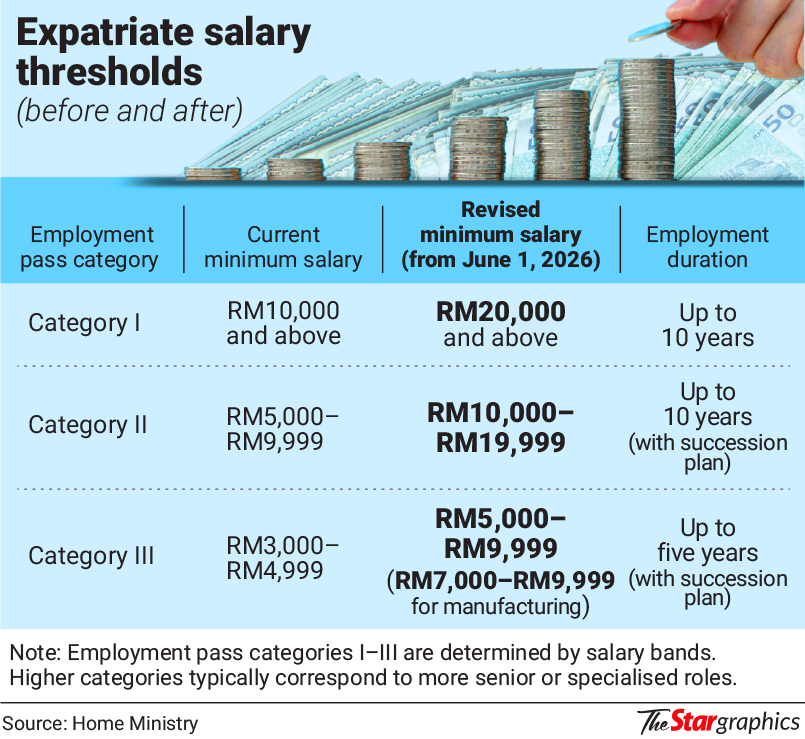
The government will raise minimum salaries for expatriates and limit the duration of their work passes from June 1, aiming to prioritise local talent.
The policy, approved by the Cabinet last October, restructures salary bands for Expatriate Employment Passes and sets defined employment durations, balancing foreign expertise with local workforce development.
Under the existing framework, which dates back to an Economic Council meeting on Dec 20, 2016, expatriate employment passes carried no formal tenure limits and were subject to lower minimum salary bands.
Expatriates, a very small share of the workforce, remain important for specialised roles.
Earlier data from the Malaysia Productivity Corporation showed expatriates contributed about RM75bil, or roughly 4.8% of GDP in 2024, largely through economic activities, taxation and spending, even though they make up only about 1% of the total workforce.