



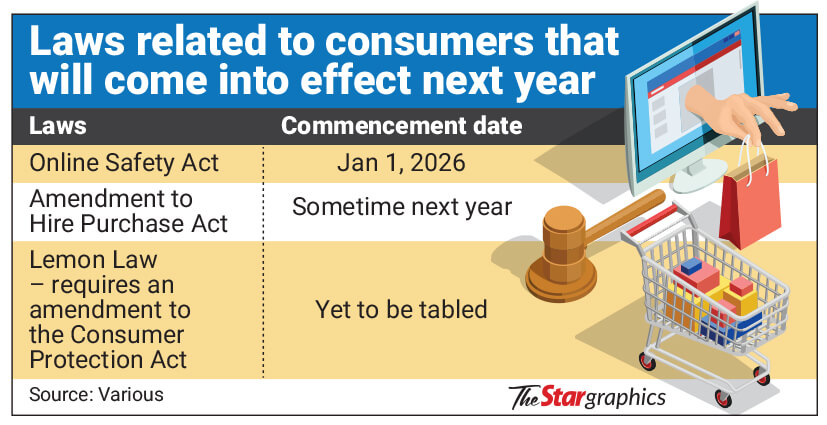
PETALING JAYA: A slew of new laws that will better protect consumers are set to come into effect next year.
According to the Federal Gazette, the Online Safety Act will come into effect on Jan 1.
The amendments to the Hire Purchase Act 1967, which abolishes Rule 78 in personal financing, is also expected to come into effect next year.
With the amendments, the long-criticised flat rate and Rule 78 interest methods will be replaced with the reducing balance system and effective interest rate calculation.
Under the old rule, borrowers effectively paid more interest at the start of the loan, leaving them with little benefit even if they settled it early.
The new reducing balance method, however, calculates interest only on the outstanding loan amount, making repayment fairer and more transparent.
Consumer groups are looking forward to these laws but they also want the Lemon Law to be implemented.
The Lemon Law is a statute that grants the purchaser of a car specific remedies if it has a defect that impairs or significantly affects its use, value or safety, and which cannot be repaired within a specified period. It was announced under Budget 2026.
National Consumer Complaints Centre (NCCC) senior manager Saral James Maniam said the new laws are a much-needed boost for consumer protection.
“Let’s start with the repeal of Rule 78. For decades, this outdated formula allowed lenders to front-load interest on hire purchase loans, so even if you paid off your car loan early, you still ended up paying most of the interest.
“Scrapping Rule 78 means consumers will finally be charged based on what they actually owe. It’s a move towards fairness and transparency,” she said.
Meanwhile, the Online Safety Act is a critical step forward, especially for vulnerable groups like children, persons with disabilities and the elderly, who are often the most exposed to online scams, cyberbullying, identity theft and harmful content.
Saral said the law could empower users with clearer rights, faster take-down mechanisms and stronger accountability for platforms that host or amplify harmful material.
It also opens the door to better digital literacy campaigns and complaint redress mechanisms, she added.
“But we must ensure that enforcement is swift, transparent and inclusive. Otherwise, the law risks becoming a paper tiger,” she said.
Saral said there should be no delays in the implementation of the Lemon Law, considering that the NCCC continues to receive a high number of complaints about new vehicles requiring major repairs within just six months of purchase.
“This isn’t limited to national brands. It includes well-known international marques.
“Consumers are often left in limbo, forced to negotiate with manufacturers or dealers who deny responsibility or delay action.
“A Lemon Law would shift the burden of proof, compel timely redress and raise the bar for product quality and after-sales service,” she said.
Together, these reforms show that Malaysia is moving towards a more mature, rights-based consumer landscape.
Federation of Malaysian Con-sumers Associations (Fomca) secretary-general Dr Saravanan Thambirajah said the Online Safety Act represents an important milestone in strengthening consumer protection in the digital space.
“For years, consumers have been exposed to online harms such as scams, impersonation, fraudulent advertisements, cyber harassment and the misuse of personal data, often with very limited avenues for redress,” he said.
Saravanan said if implemented and enforced effectively, the Act can improve consumer protection by compelling platforms to act more responsibly, respond faster to harmful content and take preventive measures.
“However, the law must not be treated as symbolic. Its success will depend on firm enforcement, regulatory independence and the willingness of authorities to hold platforms accountable,” he said.
On the abolishment of Rule 78, Saravanan said it was a long- awaited reform that directly addresses unfair financial practices that have disadvantaged consumers for decades.
“Under the previous rule, consumers who settled their hire purchase loans early often received disproportionately low rebates.
“This calculation method primarily benefited financial institutions,” he said.
Saravanan said the change is the outcome of persistent engagement by consumer groups and NGOs, who raised concerns about inequitable interest calculations and the imbalance of power between lenders and borrowers.
“These legislative changes mark a significant shift in the government’s approach to consumer protection.
“They demonstrate an increasing willingness to address structural issues that have long placed consumers at a disadvantage,” he said.
Saravanan also said the true measure of success lies not in the passing of laws but implementation.
“These protections must be applied consistently, supported by accessible complaint mechanisms and strong consumer education efforts to ensure that people understand and can exercise their rights,” he added.
Saravanan said the government should expedite a Lemon Law as consumers continue to face difficulties when purchasing defective vehicles that results in prolonged disputes with manufacturers or dealers with limited legal protection and high financial risk for consumers.
“Delaying this law only prolongs consumer hardship and weakens trust in the market,” he added.
Another law that is expected to come into effect is the amendments to the Countervailing and Anti-Dumping Duties Act.

