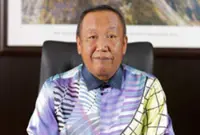
KUALA LUMPUR: The late Tunku Abdul Rahman Putra Al-Haj was a visionary leader who captured the hearts of all races, as his message of unity in diversity was consistent throughout his era, says Prime Minister Datuk Seri Anwar Ibrahim.
He said that although Tunku entrenched the pillars, which may have been controversial for some when he founded the nation, he ensured that all the other races and religions were also included and that no one was left behind.
Anwar said this at a memorial held at the Tunku Abdul Rahman Memorial here on Monday (Feb 17), coinciding with the 122nd birth anniversary of Malaysia’s first Prime Minister.
“One cannot capture such a great statesman who had such a great vision to create an independent Malaya and Sabah and Sarawak.
“He not only cleverly negotiated for the independence of Malaya (from the British in 1957) but he also managed to convince Sabah and Sarawak that their future would be better off in this region as part of a federation in those times of unstable geopolitics as well as a cold war.
“To me, only a leader with visionary leadership would look to the future. God has kindly granted us with Tunku as that leader,” said Anwar.
ALSO READ: Tunku’s granddaughter remembers his vision of inclusivity
He said that although in his younger days, he may not have agreed with Tunku on some issues, he could never deny the personality of Tunku which unified all races.
“I could never deny that this man’s personality had been able to win over the hearts of all races in this country. It is difficult to replace him as a leader who touches the hearts of all races.
“This is because he was consistent when he spoke of the unity of the country, whether in Malaya, Sabah, or Sarawak, and the harmony of all races and cultures—be they Malays, Chinese, Indians, Kadazan, Dusun, or Murut—that the Malaysia we have today forces us to accept that harmony in diversity.
“He was also the one who had placed the pillars of the country - Bahasa Malaysia as the official language, Islam as the official religion, the rights of the Malays and the sovereignty of the Malay Rulers - he had upheld these but he ensured all races and religions were included as the interests of the country overruled everything else.
“I call upon the younger generation that these pillars were upheld as principles from the very start but accepted that there were different cultures and races but the spirit of unity raised Malaysia as a united country to be the developed country it is today,” said Anwar.
He pointed out that although the special status given to Bahasa Malaysia, Islam, Malays and the Malay Rulers was criticised at times, the majority of the country has accepted the reality.
“There are those who, even though we have been independent for this long (since 1957), have yet to accept that this country is standing on its uniqueness and speciality and has accepted that some of the main policies were enshrined in the constitution with diversity,” said Anwar.
He said that although differences can divide and break a nation, Tunku saw that the diversity of the Malaysian people would be its strength.
“Generations take these realities for granted but the basis was promoted by Tunku. Although democracy in this country had evolved, the basis was placed by Tunku.
“Our responsibility today is to give meaning to our independence so that this country maintains on the right runway and raises the dignity of this country.
“I missed Tunku's birthday on February 8, but as soon as I remembered, I asked for a memorial to be held before the fasting month.
“This is to remind the people of the meaning of struggle, unity and the ambition to build a country,” said Anwar.
Tunku’s granddaughter, Datin Seri Sharifah Menyalara Hussein, who also spoke at the event, presented Anwar with a memento: a photograph of Tunku and his wife taken in Tokyo.