



PETALING JAYA: It’s a topic that all too often makes headlines, but little is known about the behind-the-scenes efforts in dealing with the problem of child abuse.
Among other initiatives, the Women, Family and Community Development Ministry has reached out to key ministries and agencies so that there would be greater collaboration in preventing children from becoming victims.
Minister Datuk Seri Nancy Shukri spoke to The Star, detailing the work in getting everyone on board and how the ministry’s staff would go to the ground even past midnight to find out about any such incident.
Q: You have repeatedly pointed out the need for a concerted effort to address the issue of child abuse in the country. How has the process been since you took office?
A: When I first came in, I was unsure how to begin, but I realised that at present, we lack values.
There is a lot of influence from social media and gadgets, so children are mostly on their own with busy, working parents.
We observed that a lot of parents are unaware of what their kids are doing.

I am not trying to be the boss, but somebody needs to lead, so we decided to bring in the National Unity Ministry, Higher Education Ministry, Education Ministry, Youth and Sports Ministry, Health Ministry, and the Rural and Regional Development Ministry.
We’ve held meetings of the National Social Council headed by Deputy Prime Minister Datuk Seri Dr Ahmad Zahid Hamidi, with each ministry reporting on issues.
My ministry requested again for collaboration with various ministries to continue our work because we cannot work in silos.
I told them I could not solve the problem alone, especially in understanding the issue of child abuse in the country.
I requested the National Unity Ministry use its Rukun Tetangga (neighbourhood watch programme) to have talks.
The Education and Rural and Regional Development ministries have kindergartens under them, so we want to make sure proper teachers are selected.
Programmes and events in schools can also include sex education, which is already part of their module.
However, I was told that some teachers were apprehensive to talk about it as they are afraid of the topic being labelled indecent or a taboo subject.
ALSO READ: Call for help, stop child abuse
Q: Recently, you launched a pilot project called the Community Based Organisation (CBO) programme in Sepang, Selangor, as a way to tackle child abuse as well as other issues. How can this help address target groups?
A: We need to localise it. When you talk about child abuse, we want the community to be on board.
The CBO involves community heads and leaders as well as village chiefs.
These people are the closest to the community, so they must make sure people know they are available and update them on the latest information.
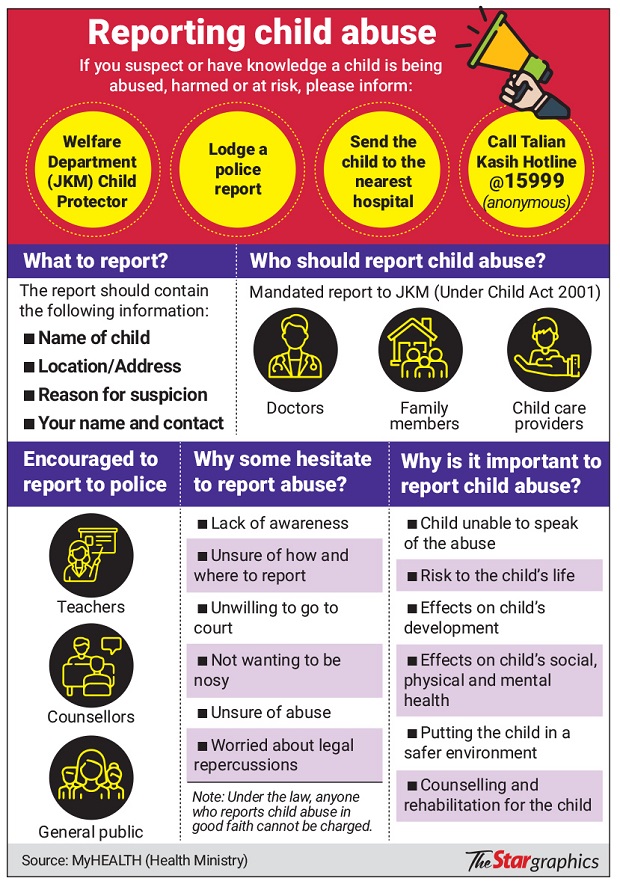
We have given (the people) the numbers of those they can contact in case something occurs.
We launched a directory at the CBO Sepang with a list of numbers that people can contact should they face problems.
The directory is very localised because if you have one for the whole country, it can be too much and irrelevant. It is best to have it district-based. The plan is to have similar directories all across the country.
But this is where we are left in limbo because sometimes, the village chiefs are unaware of what is happening in the local community. There are communities that have a certain system to disseminate information while others take it upon themselves to empower themselves by showing interest in the matters affecting the community.
In Sarawak, all the community heads know where to go. We have district officers, and they are directed to go to the police.
So now it is all up to them on how they implement what has been laid out.
Q: In terms of empowering children, do you think it is time we equip children themselves with the knowledge about what is abuse and how they can seek help?
A: Children nowadays are very much exposed to gadgets, the Internet and social media.
Normally, children speak the truth, so with that in mind, we started the Child Protection Advocacy Programme to empower children.
It is carried out together with the police and other agencies that come in as speakers.
Our intention is to get the speakers to talk about sexual abuse while explaining what are safe and bad touches.
So the children are empowered with information, knowledge and contact numbers.
During the talk, they are given examples – this is where they are able to visualise what is meant as safe and bad touches.
It’s not so much on sex but the manner in which it happens.
That is why we collaborate with the Education and other ministries, the police, the National Anti-Drug Agency, the National Population and Family Development Board, and Yayasan Kebajikan Negara.
This programme was launched on Sept 18 at SK Seri Tasek, Selangor and SK Malawa, Kota Kinabalu. Even students from secondary schools, parents and parent-teacher associations were present.
We have received requests to move to other schools, but we have to plan it properly.
This programme will be expanded. Basically, the advocacy has gone to the schools directly.
Q: The police have also been leaning towards community empowerment and involvement, and you have repeatedly mentioned your collaboration with the authorities. So how has this partnership shaped up?
A: We work closely and rely on the police as we need their feedback. For us, before we act on some cases, we have to get the police.
There was a case involving two kids locked inside their homes and there was a fire.
But we could not wait too long, so our child protection officer has the authority to go in and take children away, but in many cases, we still have to refer to the police.
The police have their own non-governmental organisation, and very soon they will be working with us in a bigger capacity.
We want people to know the police are not just handling criminal cases, they are working with us on issues like child abuse and domestic violence. This has been in the planning for a long time, with police officers attending our programmes as well.
They are well aware of the topics at these talks. We need to have this close collaboration and visibility with them.
Q: What has been the greatest resistance you have faced in doing your job with such a wide portfolio involving children, women and families?
A: I wouldn’t want to use the word ‘resistance.’ They have been there for so long, it’s business as usual because they know what they’re doing.
I feel that I have a bigger role to play, and I want to make sure that everything is okay.
And for me, when you talk about children, it’s like they are my own children. I don’t want to see children being abused, I don’t want to see women being abused.
Some men are also being abused, but they don’t show it. ‘Business as usual’ is not something I should accept.
But having said that, the staff when you work with them, they are very committed.
Some of them leave home very early in the morning or they start work by going to the streets until late at night or midnight just to witness for themselves what’s going on.
There are calls coming in at odd hours. That’s why I said when I texted Welfare Department director-general Norazman Othman, he responded to me at 2am about a case.
This goes to show how they are working, but sometimes we take them for granted. They would even go out in the middle of the night to see what was happening on the ground.
Already a subscriber? Log in
Get 20% OFF The Star Digital Access
Cancel anytime. Ad-free. Unlimited access with perks.
