
PREVENTING climate change and reducing its effects are the main targets in the fourth strategic thrust of the 11th Malaysia Plan.
Referring to the massive floods in the peninsula last December, the report admitted that climate change has caused an increase in the “frequency and intensity of natural disasters”.
As a remedy, the Government’s plan for the next five years is to discard the “grow first, clean up later” mentality and to pursue development in a more sustainable manner right from the start.
Of all the goals set, two exceptionally ambitious ones stand out: to reduce greenhouse gas emission intensity of GDP by 40%, and to protect more than twice the number of those who live in flood-prone areas compared to the standards achieved in the previous Malaysia Plan.
To realise the plan to reduce carbon footprints, the Government will provide incentives in the form of carbon tax, green tax and green bonds.
Businesses will be encouraged to adopt newer forms of renewable energy and by 2020, it is expected to contribute to 7.8% of the total installed energy capacity in the peninsula and Sabah.
As for flood mitigation plans, a combination of awareness programmes and a disaster risk management framework will be used to achieve the target of protecting two million Malaysians from floods.
The framework will comprise programmes to reduce the impact of natural disasters and to speed up response time to communities that are prone to natural disasters.
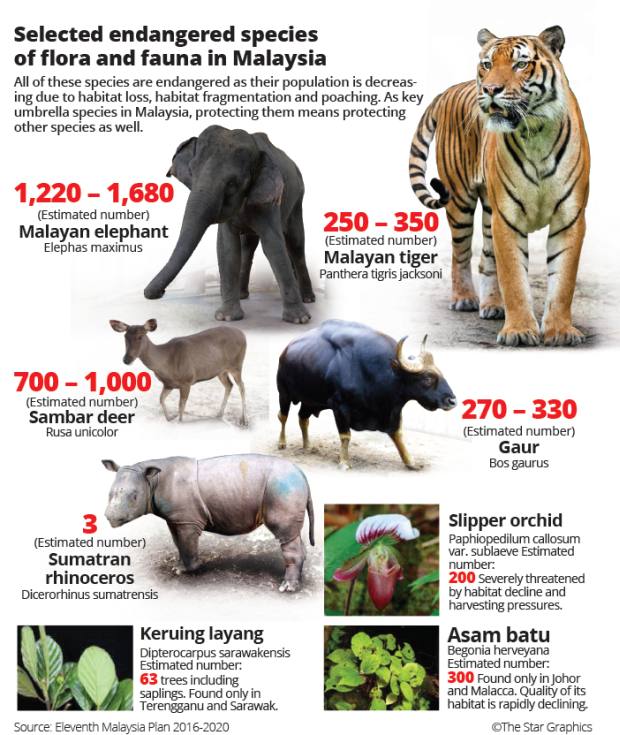
Restoring jungles and protecting endangered animals and plants from extinction are some of the plans that the 11th Malaysia Plan has in store for the environment.
The Government promises to conserve Malaysia’s biodiversity so that future generations can have access to the same resources today.
Advance reproductive technology will be used to help increase the numbers of several species, including the tiger, sambar deer, elephant and gaur as well as plants such as slipper orchid and asam batu.
The health of Malaysian rainforests, being the natural habitat of the above species and which act as important water catchment areas, are the primary concern of the Forestry Department.
The department solicits the help of the orang asli to protect forest reserves by providing them with alternative ways of earning money.
It was reported that the department managed to lift the indigenous people of the Kelawat Forest Reserve out of poverty.
With training programmes on language and entrepreneurship, the orang asli managed to increase their household incomes by 80% through the sale of rubber latex and fruits in 2014.
Already a subscriber? Log in
Get 20% OFF The Star Digital Access
Cancel anytime. Ad-free. Unlimited access with perks.