
ONCE you see a snake in Bangkok, the snakiest capital in the world, you see snakes everywhere.
Loops of electrical wire look like snakes. Gas pump hoses look like snakes. Vines, green and vibrant, look like snakes.
There are also, as Pinyo Pukpinyo knows, a lot of actual snakes.
In Bangkok each year, about 30,000 snakes are caught by fire and rescue personnel. On an average half-day shift, Pinyo, the top snake catcher in Thailand’s capital, wrangles more than 20 snakes, the reptiles secreted in sewers, curled in flowerpots and toilets, enmeshed in recycling and pressed against branches ready to snack on geckos and tree shrews.

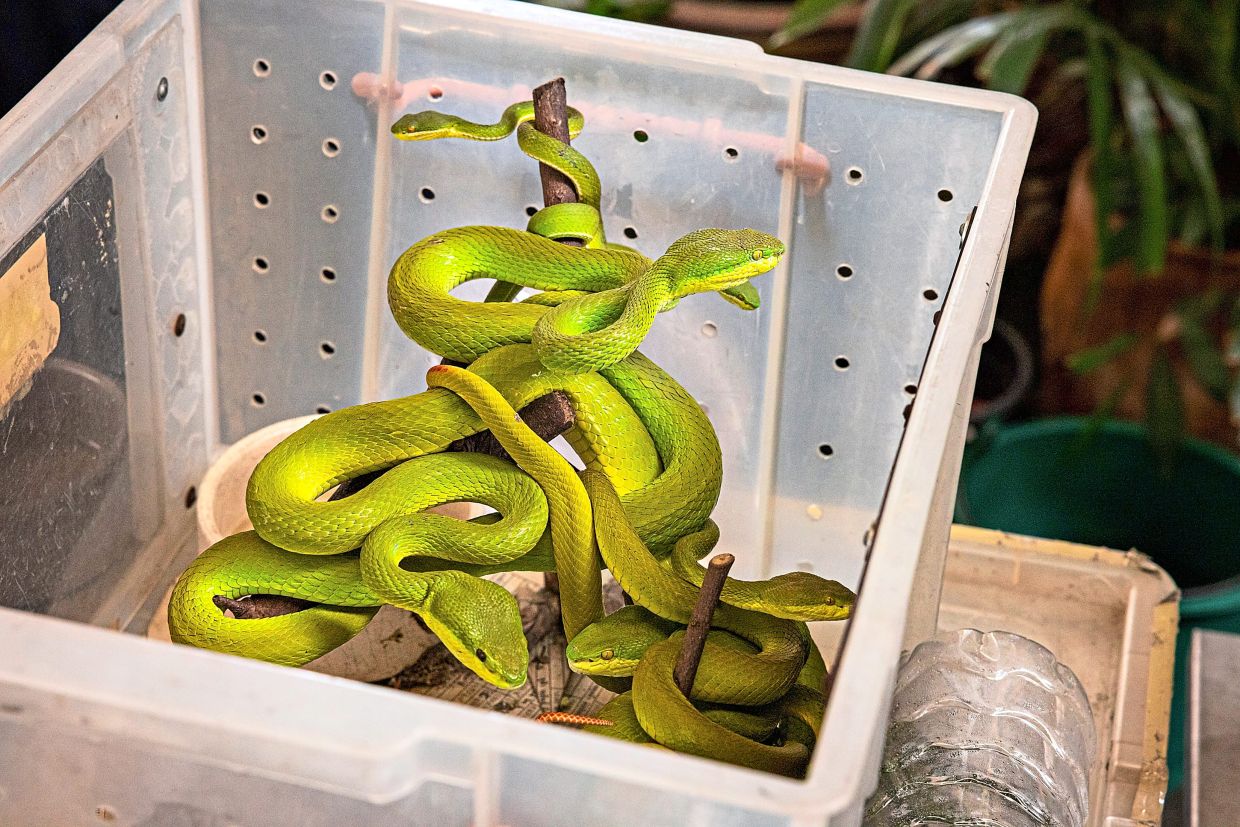
He catches cobras, pythons, kraits and pit vipers. Those are the scary snakes.
Harmless species, at least to humans, include tree snakes, rat snakes, kukris and sunbeams.
Pinyo, 56, who joined Bangkok’s fire department at 18 only to discover that firefighters here do a lot more snake catching than firefighting, wants one thing known above all else: he does not kill the snakes he catches.
Part of it is his Buddhist faith.
But mostly it’s that it’s not the snakes’ fault that we humans have spread our urban jungle into actual jungle.
It’s not the snakes’ fault that Bangkok floods during the monsoons, drowning their cozy habitats and forcing them to swim past malls and condominiums.
“They deserve to return to nature,” Pinyo said. “They only bite when they’re forced to defend themselves.”
This principled ban on snake extermination has left Pinyo with a problem, one that has multiplied in the months since his Bang Khen fire station in northeastern Bangkok, now under renovation, moved to a few prefab structures squeezed under an elevated monorail.
Pinyo has way too many snakes.
He is not sure how many, but it’s more than 200. Or it could be 300. It’s definitely 70 cobras. At least.
In his concrete cavern of a fire station, the sun blocked by the Skytrain’s tracks, nearly every tub, every water bottle, every sack, every plastic container that might otherwise hold shoes or bedsheets, is home to a snake, sometimes multiple snakes. Some of the pythons measure five metres long.
Every few months, Pinyo drives out of Bangkok and unloads a horror movie tangle of snakes in a national park or forest.
Then he starts again, catching and collecting snakes until it’s time for another rural pilgrimage.
Feeding all of these snakes costs about US$300 a month, money that comes out of Pinyo’s pocket.
His wife and daughter do not like snakes. His father, who died this year, was so upset by all of the venomous snakes that he refused to visit Pinyo when he was hospitalised with the inevitable snakebite.
But snakes, Pinyo said, chose him. It is his karma.
“My father used to say that I’m stubborn, like a cobra,” Pinyo said. “Maybe it’s true. I had to learn everything myself and stick to it because no one taught me how to catch snakes.”
Pinyo’s father, a hotel limousine driver, wanted his son to land a stable government job, and Pinyo passed the police examination.
But a chronic shortage of firefighters meant he was assigned to that career instead.
Pinyo’s starting base salary was less than US$100 a month. (He now makes about US$1,500.) He admits he was terrified when dispatched, without any training, to catch his first python, armed only with a stick and a hook at the end.
“I wanted to catch bad guys like in the movies, not catch snakes,” he said.
Pinyo learned fast on the job. He studied books like The Manual of Practical Management of Snake Bites and Animal Toxin Injury.
Along the way, he discovered that as much as he liked divining the personalities of snakes – the way a cobra mimics a human’s movement or the way a baby python practises its bite – what he really enjoyed was the reaction of humans newly relieved of snakes in their homes or offices.
“They offer me many prayers and good wishes,” Pinyo said. “It’s better than what money can buy.”
Like a doctor at a dinner party burdened with the ailments of fellow guests, Pinyo is constantly called upon for his expertise.
Luckily, he is generous.
I shared my snake stories.
In 2019, I had put a Post-it note on the door of my home office in Bangkok, warning the boys not to bother me because I was on a call.
My husband had done the same. Our younger son, then nine, rapped anyway.
“Mama,” he said, “I’m sorry, but there’s a pit viper in the dining room.”
Our son was right: there was a snake in our living room, a flash of fluorescent green.
I disregarded my husband’s Post-it note, and he grabbed a bucket and pasta tongs.
The snake, though, exited onto the balcony on its own.
I showed Pinyo a photograph of my husband, armed with the tongs, ready to tackle the snake.
He praised my husband’s choice of tool but said our son had been wrong.
It was not a pit viper. There was no streak of red near the tail.
“Only a tree snake,” he said. “No danger.”
Recently, Pinyo and his deputy snake catchers conducted a training at a Movenpick hotel in Bangkok, the lobby carpet plush and the garden lush.
Like anywhere in Bangkok, there were snakes, and everyone, from the concierge to duty manager, spa therapist and room cleaner, needed to be prepared.
The firefighters had brought 50 live snakes with them, and believable scenarios unfolded in the underground garage.
Let’s say there’s a small cobra and all you have is a small water bottle.
With differing levels of terror, the hotel workers caught small cobras in small water bottles. They caught medium-size cobras in medium-size water bottles.
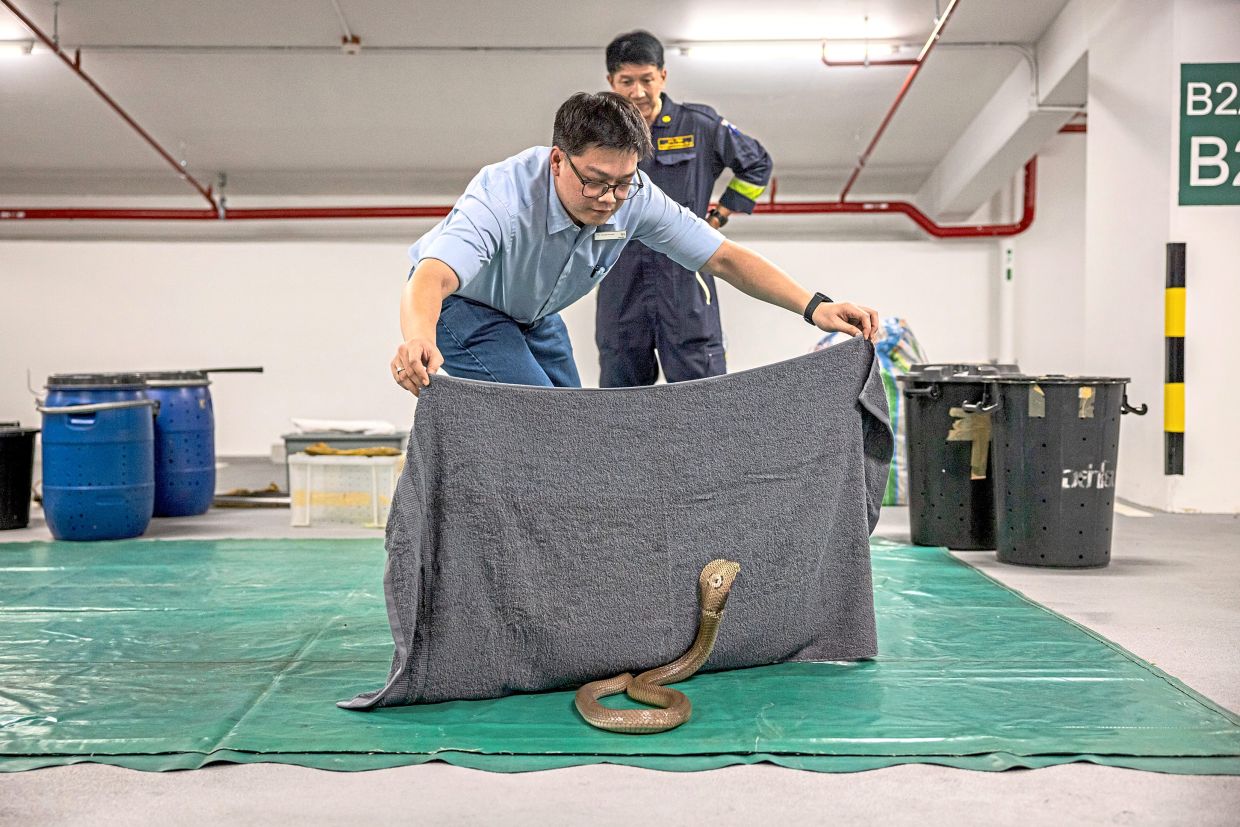
They simulated a situation in which a snake lurks in the shower and all there is to work with is a towel. (“Please don’t open your towel and scare the snake,” Pinyo joked.)
The workers took turns as impromptu matadors, gently laying the towels on cobras with their hoods raised, ready to strike.
By the end, it felt perfectly natural to think that we could all be snake catchers.
My colleague Muktita Suhartono had refused to touch a snake, but under Pinyo’s supervision, she coolly decanted a golden cobra into a plastic bottle, screwing on the lid after checking that the animal’s head was nowhere near the spout.
Still, there’s a reason there are snake professionals.
Pinyo has been hospitalised four times for near deadly snakebites, the last time for two months.
He insists he can’t even remember how many times he’s been bitten in total.
I mentioned that my husband was bitten by a pit viper last year.
After an emergency room stay, he was on crutches for weeks.
Pinyo made a sympathetic noise, but then said he never seeks medical care for something as trifling as a pit viper bite.
Yet, a younger colleague of his became functionally paralysed after a cobra bite during a training not so different from the one we attended.
One day in October, Pinyo sat on a plastic stool underneath the train tracks at the makeshift fire station.
Occasionally, a sack shifted ominously.
A hiss or rattle emanated from a box.
Then the calls came: a snake in a recycling pile, a snake in a hollow bathroom door, a snake at a medical clinic.
We pulled up to the clinic, where young people were standing on a ramp at the entrance. They scattered when Pinyo asked if this was the place with the snake under the ramp.
He pulled up the ramp to find a reticulated python twisted into a misshapen pretzel.
The python went into a sack, and we drove back to the fire station, with one more snake to feed and release into the wild.
“Circle of life,” Pinyo said, his fingers forming a loose loop like a python at rest. — ©2026 The New York Times Company
This article originally appeared in The New York Times