Asia doesn’t need an October Surprise


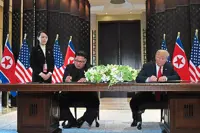
Election ploy: Early speculation was on Trump seeking a popularity bump with another summit with North Korean leader Kim Jong-un. — AFP

RECENTLY, as the United States aircraft carriers Nimitz and Ronald Reagan conducted war games in the South China Sea to strong protests from Beijing, Indian newspapers were reporting what appears to be a limited pullback by Chinese troops who had entered the disputed Galwan Valley in the Ladakh Himalayas in June, causing a fierce clash that saw the first loss of lives on the Sino-Indian border in more than three decades.

The relief that Asia’s two most powerful militaries seem to be de-escalating was mixed with an uneasy sense of deja vu: On July 15,1962, headlines in the Indian media had similarly proclaimed a Chinese withdrawal from Galwan Valley. Reams of newsprint were exhausted on praising the valour of Indian soldiers and some thought that then Prime Minister Jawaharlal Nehru’s “forward policy” of moving up Indian border posts had paid dividends.

Less than a hundred days later, the People’s Liberation Army (PLA) attacked, inflicting a military defeat on India that rankles to this day on the Indian psyche.

Following that event, New Delhi, a pillar of the Non-Aligned Movement that tilted towards the Soviet Union, facilitated the US Central Intelligence Agency’s attempt to plant a nuclear-powered listening device in the Himalayas to monitor Chinese activity in Tibet.

History moves in circles far too often. In 1971, when the late Indira Gandhi embarked on a war with Pakistan, which enjoyed the status of a “major non-Nato (North Atlantic Treaty Organisation) ally” of the US, then President Richard Nixon ordered the US 7th Fleet into the Bay of Bengal to pressure Mrs Gandhi to stay her hand. It didn’t work because Mrs Gandhi accomplished her mission in 13 days, creating a new nation of Bangladesh from former East Pakistan.

Today, America’s ties with India come close to where Pakistan-US relations were in that era, the two big democracies conjoined by a host of military agreements, including logistics exchange and communications sharing. What’s more, much of the equipment operating on the China border is of US origin, including M777 lightweight howitzers, Apache Longbow attack helicopters and C-17 transporters.

A pointed message to Beijing

US Secretary of State Mike Pompeo recently said the US is reducing troop numbers in Germany to deploy them in other places to “face the Chinese threat to India and South-east Asian nations”.

The aircraft carriers operating in the South China Sea, therefore, are meant to send a message to Beijing on both India and South-east Asia, where several states are rattled by its assertive behaviour, just as Mr Nixon sought to do with India in an earlier era.

Indeed, earlier this month, the US had three flat tops operating in 7th Fleet waters.

Before the war games with the USS Ronald Reagan, the Nimitz and the USS Theodore Roosevelt had paired up. Navy experts say the last time three US carriers sailed together in Asia was off the Korean peninsula in 2017, when the perceived threats from Pyongyang were at a high.

Now with the PLA Navy doing extended sail-arounds of the Senkaku/Diaoyu islands, tensions are rising as the Chinese air force repeatedly enters Taiwan’s airspace and the US puts the squeeze on China over Hong Kong, Tibet and Xinjiang. Multiple flashpoints are presenting on the Asian landscape, of which the Sino-Indian border happens to be the most fraught.

Even as the Galwan semi-withdrawal is taking place in the Western Himalayas, heavy “spider excavators” have been spotted deployed by PLA soldiers on the east side of the Tibetan plateau alongside the Yarlung Tsangpo River, which Indians call Brahmaputra, as Chinese troops dig in. The footage was released last week by the PLA’s Tibet Military District, which handles the frontier with India.

On July 4, the Chinese Ministry of Foreign Affairs issued a statement to some media outlets highlighting three separate areas of disputed territory with Bhutan, in essence, adding an additional eastern sector that hadn’t been part of two dozen rounds of border talks between the two.

Bhutan’s foreign policy is closely aligned with India and the two nations are the only ones with which China has unresolved land disputes. The fresh claim relates to area that abuts India’s Arunachal Pradesh state, which is claimed in its entirety by China.

The latest claim, which involves about a tenth of Bhutanese territory, underscores not just a pattern of Chinese assertiveness everywhere, but also a hardening view on India amid sinking Sino-US ties. Beijing seems convinced that New Delhi is all too willing to be America’s cat’s paw in the Indo-Pacific region.

While such talk leaves New Delhi and Washington bemused - noted US strategist and former envoy to New Delhi Robert Blackwill recently said in a webinar hosted by Institute of South Asian Studies director C. Raja Mohan that India will simply not countenance signing on as a full US ally – Beijing is not so sure. A recent commentary in Global Times even suggested that India craved to be America’s ally.

The evidence, however, suggests a more nuanced approach. Then, even as the US proclaimed visa sanctions on Chinese officials over Tibet, there was no announcement that Prime Minister Narendra Modi had wished the Dalai Lama on his 85th birthday, which fell on July 6 – His Holiness’ presence in India always having been a red rag to Beijing.

Likewise, the Modi government has also dragged its feet on signing Beca, the Basic Exchange and Economic Agreement that would complete the three “foundational agreements” for full military cooperation with the US. And New Delhi, despite pressure from Tokyo, has been loath to invite Australia to the annual Malabar exercises it conducts with the US and Japanese navies.

That said, it is undeniable that several nations with difficult ties with China are coming together in a speedy way. Japan and India have stepped up their military engagement several notches and, late last month, held their 15th bilateral maritime exercises.

A retired Indian vice-admiral who heads the National Maritime Foundation sought to project the war games as an exercise in “strategic communications”, even suggesting that “the Chinese know there is a direct ladder of escalation between Japan and the United States”.

Japan and Australia

However, the Japanese themselves have been far more circumspect on their messaging, saying there was “no specific scenario” to the war games. Still, the Japanese have been significantly more forthcoming on Galwan than in previous Sino-Indian border skirmishes. As Japanese envoy to India Satoshi Suzuki tweeted recently, while hoping for a peaceful resolution through dialogue, “Japan opposes any unilateral attempt to change the status quo”.

In tandem with the US, Japanese rhetoric on China’s assertion of security control over Hong Kong also has taken on an increased stridency, observers note.

Defence Minister Taro Kono, tipped as a future prime minister, has all but signalled that Chinese President Xi Jinping would not be welcome in Japan this year, while Chief Cabinet Secretary Yoshihide Suga has called the Chinese move on Hong Kong “regrettable” (ikan), the second-strongest word in the Japanese diplomatic vocabulary behind “hinan” or “to denounce”.

Show of might: Japan Maritime Self-Defence Force training ships ‘JS Kashima’ and ‘JS Shimayuki’ conducting a passing exercise with Nimitz-class nuclear-powered aircraft carrier ‘USS Ronald Reagan’ in the South China Sea on July 7. — Reuters

Japanese and Australian officials also have reportedly concluded negotiations on a reciprocal access agreement. Under negotiation for six years, it paves the way for the Japan Self-Defence Forces to operate in and around Australia, and for the Australian Defence Force to do the same in Japan. Once signed, it would be Japan’s first agreement covering foreign military presence in its sovereign territory since the 1960 Status of Forces Agreement with the US.

Much depends on whether Beijing chooses to aggregate these threats or to deal with them as separate issues to be seen off.

The hawkish Chinese analyst Li Su was recently quoted as saying that China’s enemies are a group of dragons without a head. Likewise, Beijing-based military expert Wei Dongxu told the Global Times that the strategic encirclement of China is “quite weak”.

Yet, other Chinese analysts are not so sanguine. As Senior Colonel Zhou Bo of the PLA wrote in The Straits Times recently, the only common ground between Beijing and Washington these days seems to be a desire to avoid military conflict “and, even then, the US Navy’s high-pitched freedom of navigation operations in the South China Sea are raising the risks of miscalculation”.

The geopolitical calendar

The next four months are crucial ones in the Asian geopolitical calendar as the US presidential election looms.

In the past, some American presidents have gained by what has come to be known as the October Surprise, an event that takes place or is staged to influence the Nov 3 election.

Thus far, speculation about an October Surprise has been about Donald Trump seeking a popularity bump with another summit with North Korean leader Kim Jong-un. However, faced with an unpredictable US President who did not hesitate to countenance using the army against his own civilians, China will need to calculate if Trump, trailing in opinion polls, would risk a firefight with China to shore up his dwindling popularity.

India’s PM Modi is seething silently, his prestige lowered at home and abroad by the China tensions. The high mountain passes in the Himalayas begin closing after mid-September, helpful cover for India if it sees an opportunity to push back Chinese troops from positions where they are perceived to have advanced too much. Also, New Delhi has invested way too much in the Trump presidency and would probably see a Joe Biden ascent as a nettlesome nuisance.

A hundred days from today would take us into the latter part of October. As the great tectonic plates of Asia crunch up against each other, the rest of us, stuffing in the sandwich, can only hope and pray that no nasty surprises await.

Seventy years ago this month, General Douglas MacArthur was advising then President Harry Truman to expand the Korean War. This time, it could well be the US President who pushes USIndopacom (US Indo-Pacific Command) to see just how far it can go without sparking a wider conflagration. We need, somehow, to get past Nov 3. — The Straits Times/ANN

Ravi Velloor is Associate Editor at The Straits Times, a member of the Asia News Network (ANN), an alliance of 24 news media entities. The Asian Editors Circle is a series of commentaries by editors and contributors of ANN.

Get 20% OFF The Star Digital Access

Monthly Plan

RM 13.90/month

RM 11.12/month

Billed as RM 11.12 for the 1st month, RM 13.90 thereafter.

Best Value

Annual Plan

RM 12.33/month

RM 9.87/month

Billed as RM 118.40 for the 1st year, RM 148 thereafter.

Follow us on our official WhatsApp channel for breaking news alerts and key updates!
Asian Editors Circle

Next In Columnists

Make Penang AI plan a bridge for majority
Giants fall, England survive – World Cup quarter-finals take shape
Who shapes global AI rules: Asean-China cooperation role
Why the Johor election is good for Malaysian democracy
Confessions of a durian season sinner
Looming threat to social security
More predictable than the World Cup
America at 250
Coexistence with wildlife key for public safety
Jitters all round in Johor

Others Also Read