Higher education institutions (HEIs) must strengthen the pathway that turns university research findings into practical applications, with greater involvement from industry players, investors and intellectual property management experts, says Datuk Seri Dr Zambry Abd Kadir (pic).
The Higher Education Minister said research findings need avenues through which they can be tested, developed and put to use.
This, he added, is crucial to ensuring that work produced by Malaysian academics and researchers brings tangible benefits to the community.
Researchers, he stressed, must take their findings beyond the discovery stage.
“At the 2026 University Research and Innovation Investment Summit, I saw many high-impact research outcomes produced by local lecturers and researchers.
“Their creativity and perseverance strengthened my confidence in the capabilities of Malaysian academia,” he said, adding that valuable discoveries need opportunities to change lives.
Urging industry players, investors and intellectual property management and commercialisation experts to support researchers with opportunities to test and develop their work, Zambry said he hoped these ideas and innovations could be adopted in the real world.
He was speaking at the launch of the 2026 National Academia Day and Month Celebration at Universiti Malaya on Oct 5.
Themed “Synergy of Knowledge, Technology and Innovation in Academia”, the celebration, which drew more than 1,000 academics and students from HEIs nationwide, recognised academics’ contributions to higher education and reaffirmed the role of HEIs in advancing knowledge, research and innovation for the nation.
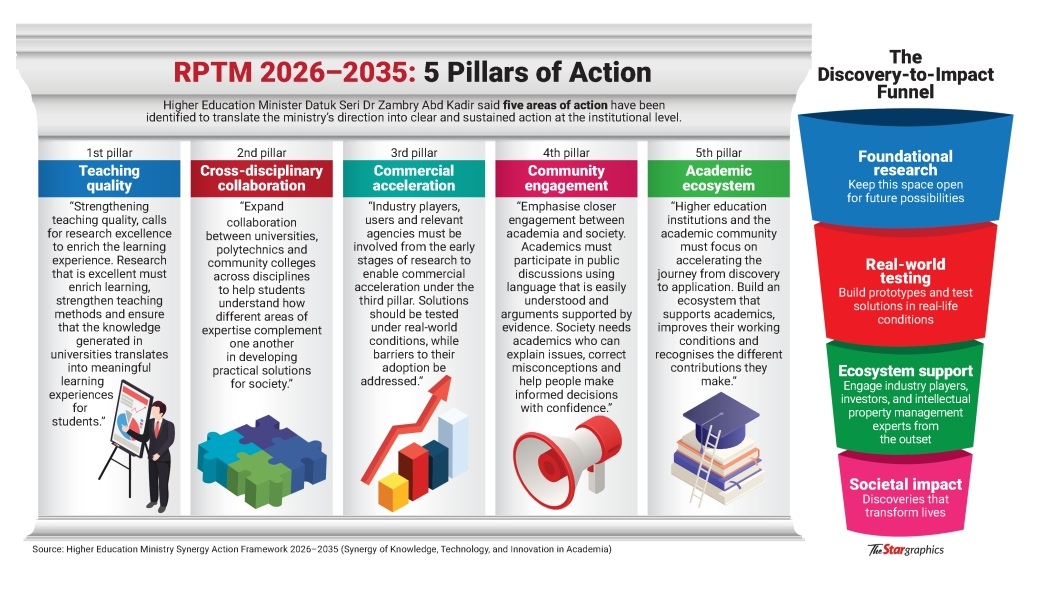
In his speech, Zambry said the five key pillars under the Malaysia Higher Education Blueprint (RPTM) 2026-2035 (see infographic) must be translated into clear and sustained institutional efforts as part of the country’s higher education development.
“At the same time, we must continue to make room for fundamental research that opens up new possibilities for the future,” he stressed.
Zambry explained the “Discovery-to-Impact Funnel” approach, outlining the four stages involved in creating societal impact through research findings (see infographic).
“This requires us to pay closer attention to the support available during the research and development process,” he said, adding that it is important to identify parties that can help bring discoveries into practical use.
Beyond commercialisation, Zambry also stressed the importance of narrowing the gap between academia and society by encouraging scholars to participate in public discourse, communicate complex knowledge in accessible language and present evidence-based arguments.
“Society needs scholars who can explain issues, correct misconceptions and help people make decisions with confidence,” he said.
Academic contributions, he added, should also be recognised through research that improves policies and services that transform community lives.
Calling on institutional leadership to review administrative workloads, reduce overlapping reporting requirements and simplify administrative processes, he said academics need time to read, think, guide students and conduct research to produce quality teaching and research.
“Career assessments should recognise different forms of academic contribution, including teaching that builds understanding and guidance that develops talent. Research that improves policies and services and transforms community life also deserves recognition.
“Stronger mentorship for young lecturers ensures the continued development of academic excellence,” he said.
The ministry’s goals are to ensure that academic expertise is given room to grow, talent is nurtured and knowledge is connected to national needs, he concluded.