MIDWAY up the steep, damp forest trail at KL East Park, Ismail Mamat freezes. High in the foliage, a flicker of movement has caught the eye of the Nature Sustainable Ecosystem Society (NEST) deputy president.
Behind him, the line of morning hikers halted; some raised binoculars to scan the wall of green, others strained to hear the specific call again as their eyes darted around, following Ismail’s gaze.
Nothing appears in the viewfinder. Unlike urban parks with low shrubs and clear sightlines, tall forest trees leave hikers spotting only fleeting rustles in the leaves, explained NEST committee member Nurhafidzah Shaiful Bahri.
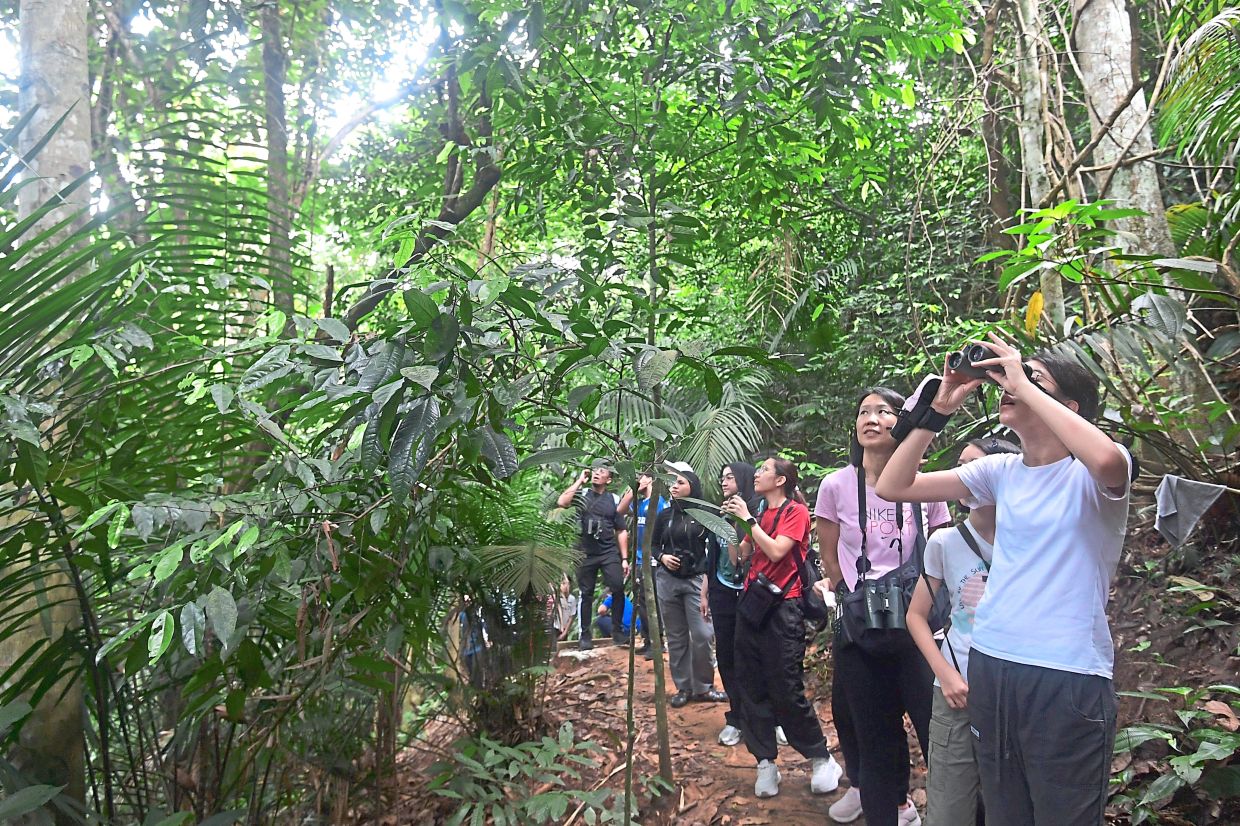
Seconds later, urgent whispers give way to a sigh as the tiny silhouette vanishes before a shutter can click. For first-time birders like Calista Neai Pui Yin, learning to tune in audibly changed how the forest reveals itself.
“Normally when we hike, we don’t really pay attention to the surroundings,” she said.
“This birdwatching event was great to just pause and really take a good look at your surroundings and notice the bird sounds. It was a very different experience for me personally.”

Organised as part of Sime Darby Property’s Urban Biodiversity campaign, this walk showed how shifting from relying solely on your eyes to listening unlocks a new perspective in KL East Park, where most feathery friends announce themselves long before they flit into view.
Nestled against the ecologically vital Gombak–Selangor Quartz Ridge, this 21.4ha (53-acre) regenerating forest has seen bird diversity increase sixfold since 2014. Sime Darby Property’s Canopy publication states that 166 bird species were recorded, including 20 classified as endangered, rare or threatened (ERT).
For Ismail, who has spent 37 years birding, the variety reflects the recovering canopy itself.
“Birds are bioindicators. If an area is in good condition, you will generally find a variety of bird species there.
“However, even if an area has been cleared or altered, the ecosystem itself will shift. When that happens, the habitat transforms and the species found will also change accordingly.”
As the trail climbs from shaded undergrowth toward higher canopy, three winged residents offer a snapshot of KL East Park’s birdlife.
Spectacled bulbul
Listen for a bright musical jingle and chirping notes, “pi-di-pi-pi-di-di”.
It feeds on fruits and insects (including caterpillars), and builds deep, open cup nests among foliage to protect against predators.
Look closely for a brown bulbul with a thin orangish eyering surrounding its deep-red irises.
Orange-bellied flowerpecker
A high-pitched, rapid “chit-it-chit-it-chit” reveals a small nine-centimetre bird that fits in your palm.
It darts among tropical plants to feed on nectar, fruits, insects and spiders, and it weaves a pocket-shaped nest of moss, plant fibres and spider webs, suspended from a twig.
Patience with binoculars will reveal a striking contrast of slate-blue upperwings and a bright orange lower belly.
Lesser green leafbird
This bird lets out a varied sequence of loud warbles. They have a diet consisting of arthropods, fruit and occasionally nectar, nesting high on outer canopy branches.
Because this near-threatened species blends into sunlit leaves, birdwatchers should scan for the male’s black throat mask and cobalt-blue jawline flash.
The fruiting shrubs, towering trees and native plants are what keep these winged species fed and sheltered on Kuala Lumpur’s edge.
None of these birds could thrive without the complex architecture of this regenerating forest.
On this morning’s hike, the bulbul and leafbird remained hidden, making the final, fleeting sighting of the orange-bellied flowerpecker near the trail’s end all the more rewarding.
For participant Revathiy Thamotharan, the walk left a lasting impression.
“I feel there’s more appreciation towards nature. We are so busy on a daily basis, we don’t really get to be close with nature, so this is a very good opportunity.”