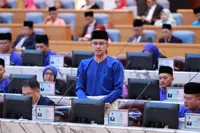
Datuk Asman Shah Abd Rahman is the 25th State Secretary of Johor, beginning his duties from July 1.
The career officer has been in the Johor Civil Service (JCS) for almost 30 years and served in at least 10 state departments and agencies prior to his appointment.
He was Deputy State Secretary prior to being promoted and taking over from Tan Sri Dr Azmi Rohani.
In an exclusive interview with StarMetro, Asman Shah shares his hopes and plans as the state’s top civil servant.
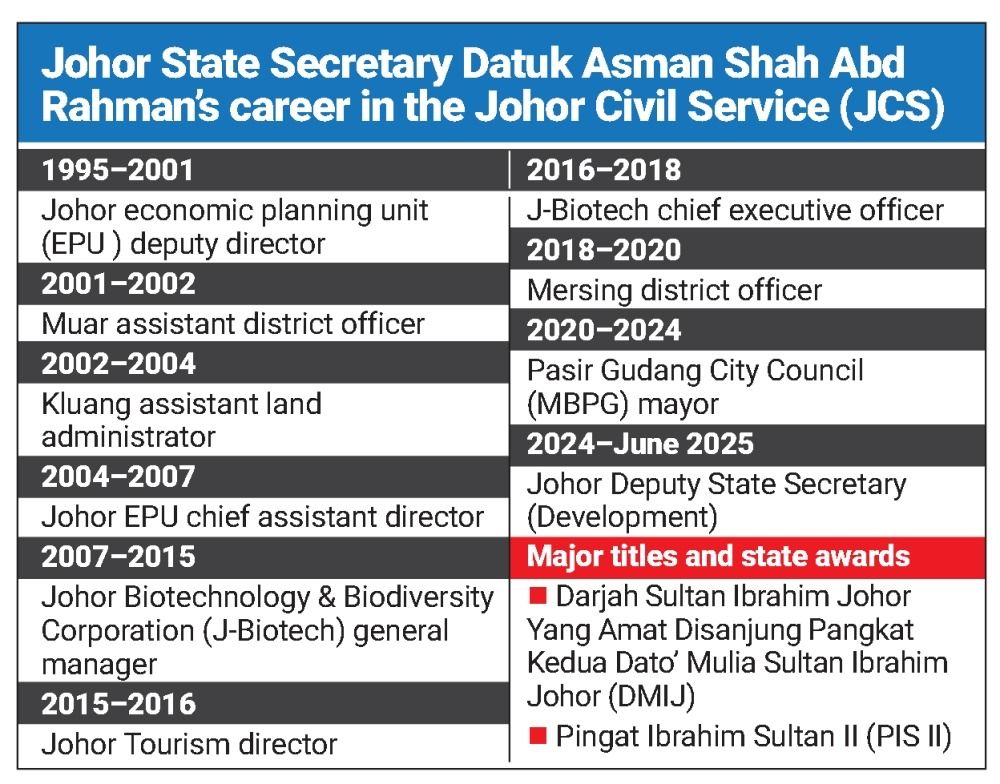
Can you elaborate about your background and how you rose up the ranks of Johor Civil Service to your appointment as State Secretary?
I was born on Feb 12, 1966 in Johor Baru and have spent most of my career here.
I graduated in 1990 with a degree in Law and Economics from Chiba University in Japan. I began my career in the JCS in the mid-1990s.
My July 1 appointment as the new Johor Secretary came as a shock; I never expected it.

Throughout my career, I have remained dedicated to driving Johor’s development agenda, promoting economic innovation and enhancing public service delivery.
I appreciate the confidence of His Majesty Sultan Ibrahim, King of Malaysia, and Johor Regent Tunku Ismail Sultan Ibrahim in placing me here.
I also thank Johor Mentri Besar Datuk Onn Hafiz Ghazi, and will do my best to serve the people of Johor.
Since my appointment, life has been hectic for me. I wake up as early as 4.30am and go to bed at about 11pm or midnight due to meetings or discussions.
During the course of your service, how many departments or state agencies were you involved in? Any agency that you enjoyed serving in, and why?
Throughout my tenure in the JCS, I have had the opportunity to serve in over 10 different departments and state agencies, each with its own strategic focus and operational challenges.
Each role has been instrumental in shaping my administrative outlook and enhancing my understanding in governance and macroeconomic planning.
One agency that I particularly enjoyed serving in was J-Biotech, a government-linked company, where I served both as the general manager and later as the chief executive officer.
The agency provided a unique platform to pioneer biotechnology-driven development, engage with industry players and position Johor as a competitive player in the bio-economy sector.
The role required a balance of policy development, industry collaboration and innovation strategy, which aligned well with my academic background in economics and law.
The Covid-19 pandemic was a major challenge as it changed how the state delivered services to the community.
Digitalisation in public administration and services became a necessity, including the use of Artificial Intelligence (AI).
That is also why the Mentri Besar had recently announced that JCS must also adopt AI into the system.
What are your plans since taking over as the top officer in Johor, especially your vision and mission for JCS? Do you have something close to your heart that you want to achieve as State Secretary?
Discipline is something important to me because I have been trained in Japan, and that includes being punctual.
You can buy anything with money but you cannot buy time, and that is why I always say to my staff that time is important and not to waste it because we cannot pay back people’s time with money.
Also having served in the JCS for three decades, I carry with me a deep understanding of its strengths, challenges and vast potential.
As State Secretary, my top priority is to drive a structured transformation agenda aimed at revitalising and future-proofing the state’s civil service.
My vision is to shape JCS into a dynamic, digitally driven and people-focused administration –one that upholds integrity, enhances service delivery and aligns with the aspirations of
both Bangsa Johor and the state government.
The three main focuses of my guiding vision will involve institutional empowerment, digital transformation as well as civic trust and public accountability.
An initiative especially close to my heart is repositioning and empowering the JCS as a professional corps – not merely as administrators, but as solution architects and agents of change.
I firmly believe that a strong, respected civil service must evolve with the times, embracing innovation while staying grounded in the core value of public trust.
Any memorable moments since joining as a JCS officer all these years?
Over the years, I have had the privilege to serve in diverse roles across the state – from district administration and economic planning to industry development and local government. Each phase has left a lasting impact and shaped my journey.
One of the most memorable and meaningful chapters of my journey was my time as the Mersing district officer.
Being on the ground, working closely with rural communities, and driving development in remote areas reminded me of the true essence of public service, which is to uplift lives.
Witnessing the real impact of our efforts, from improving basic infrastructure to responding during crises, was deeply fulfilling.
Another meaningful experience was serving as Pasir Gudang mayor, where I had the rare chance to lead the city council amid a phase of transition and fast-paced urban growth.
Managing reforms, working with diverse stakeholders and engaging with the community offered important lessons in effective leadership, empathy, and inclusive governance.
More than the positions held or projects led, what I treasure most is the sense of unity and dedication among my fellow JCS officers.
The bonds formed, the hurdles we overcame together, and our collective drive for Johor’s advancement have beendeeply rewarding.
These moments have shaped both my professional path and my leadership approach, which is anchored in humility, focused on people and committed to meaningful service.
What are the challenges you face as a JCS officer all these years and what is your personal motto?
One of the key challenges has been striking the right balance between policy goals and on-the-ground realities – making sure that strategic plans deliver real benefits to the rakyat.
Another ongoing challengeis navigating institutional change, where reforms can face resistance.
Leading such transformation while preserving the positive aspects of tradition demands thoughtful leadership, empathy and long-term dedication.
I have also felt the weight of expectations, particularly in high-impact roles like district officer, J-Biotech CEO and Pasir Gudang mayor.
These positions require more than just technical expertise – they call for active public engagement, strong leadership and personal resilience.
Through all these phases, what has kept me grounded is my personal motto: Serve with sincerity, lead with integrity and adapt with humility.
To me, challenges will always exist, but with a strong sense of purpose and a spirit of unity, I am confident our JCS will continue to rise above and deliver beyond expectations.
As State Secretary, you have to manage state civil servants and also requests from the Federal Government. You will also have to work with the state government and Johor Palace. How do you plan to manage this?
Indeed, the role of State Secretary lies at a crucial crossroads of state administration,federal coordination, and royal protocol.
It calls for more than administrative skills as it requires diplomacy, discretion and sound judgement.
My approach in navigating this complexity is anchored on three key principles:
1. Upholding constitutional integrity: The role of State Secretary needs to stay grounded in the spirit of the Federal Constitution. It is about respecting the state’s sovereignty while also working well with our federal partners to get things done effectively.
2. Bridging with balance: I see myself as a facilitator – making sure the state government’s goals are carried out smoothly, while also meeting federal expectations and respecting the customs of the Johor Royal Institution. It takes ongoing communication, clear processes and mutual respect at every level.
3. Institutional professionalism: I aim to enhance the professionalism of JCS to ensure it stays neutral, competent and responsive to all stakeholders. A strong and reliable civil service is the key to effective coordination across all sectors.
What gives me confidence is the deep respect I have for all these institutions – especially the Palace, state government, and federal administration.
My role isn’t to stand above them, but to serve between them – building trust, ensuring delivery and maintaining the harmony that defines Johor.
With humility and clear purpose, I believe this balance is not just possible – it is vital for Johor’s continued progress.
You have a reputation as a strict officer, especially when you were the Pasir Gudang mayor. There were some controversies at that time. How were you able to overcome them? What is the one trait that is important as a leader?
A: For me, strictness is subjective and sometimes necessary, especially when I have to make important decisions as the mayor.
However, my leadership style is more flexible as I actively listen to the views and ideas of Pasir Gudang City Council (MBPG) officers and base my decisions on those inputs.
As for the controversies involving MBPG, they stem from actions taken based on the laws and regulations that the council is mandated to enforce. I acted within the legal framework.
While some decisions might seem controversial at first glance, feedback from Pasir Gudang residents had been generally positive.
To tackle these issues, I held town hall sessions with key stakeholders and local residents.
Once the matters were clearly explained, people were generally more understanding and accepting.
This is why I believe every officer should approach their duties with a flexible and open mindset.
As a leader, it is crucial to stay adaptable and avoid making decisions based on emotion.
Emotion-driven choices often reflect personal interests and can overlook broader perspectives.
Johor is now a magnet for investments, especially through the Johor-Singapore Special Economic Zone (JS-SEZ). How can Johor civil servants play a role in reducing red tape and meet the demand of investors?
A: To support this momentum, JCS officers must become enablers of growth and not barriers.
And to achieve that, it is essential that we possess the right knowledge and experience to drive and lead the development of JS-SEZ. This include sending our officers to relevant courses and training.
As you may already know, last May we sent three of our officers to Harvard Kennedy School for a short course on negotiation strategies.
Strong negotiation skills are vital to secure strategic investments, manage cross-border collaboration and navigate complex stakeholder interests.
By equipping our officers with training in negotiation strategies, we strengthen our capacity to build win-win partnerships, resolve conflicts effectively and drive sustainable development within the JS-SEZ.
This aligns with the Johor Regent’s aspiration. He fully supports the continuous upskilling of our civil servants through training at Ivy League universities.
Apart from that, to support the growth of JS-SEZ, Johor Super Lane (JSL) was launched in November 2024 under Johor Budget 2025.
JSL is a fast-track platform designed to facilitate investment through streamlining and standardising approval processes within the JS-SEZ area – making Johor more business-friendly.
Its key elements include concurrent submission, a single
one-stop centre known as Invest Malaysia Facilitation Centre Johor (IMFC-J) and a dedicated fast-lane task force.
The timeline for investors under the JSL initiative, from the collection of data until licence issuance, has reduced from 134 days to 62 days,
According to data from IMFC-J, between January and June 15 this year, 63 potential investments – both local and foreign – have been identified, primarily in the energy, construction and digital economy sectors.
What do you hope to achieve in the next 100 days and how do you plan to engage with Johoreans to listen to their issues and complaints, especially on local council issues or matters involving the civil service?
A: In my first 100 days as the State Secretary of Johor, my main priority is to review the state’s overall administration under a special project called Project Glory.
The key is to ensure everything is in line with the ‘Maju Johor 2030’ agenda, as outlined by our Mentri Besar.
‘Maju Johor’ remains the guiding vision to push Johor forward on the global stage while ensuring inclusivity.
During this period, I will also begin drafting strategic plans for the state, including initiatives to support and advance the career development of civil servants.
This process will involve collaboration with key agencies such as local authorities, district offices and land administration departments.
Each year there is a huge transfer list of JCS officers. Sometimes it comes in batches involving more than 100 officers in a year. What is your advice to civil servants?
A: I always say that as leaders, we must all work together with our fellow JCS as colleagues and not as boss and subordinate.
As for the transfers, I will not have a major one like before. Presently we have 304 JCS officers.
Anyway, I view transfers as a norm as it is more like a dynamic movement and a part of Johor’s commitment to develop versatile, experienced and high-performing civil servants.
I prefer that the JCS can think outside the box and not to think about themselves.
We should say no to corruption and maintain a high level of integrity.
That is why I will try to expand our internal audit, governance and also integrity department.
Equally important is empowering our officers with AI and digital knowledge.
Also, the state is gearing up for Visit Johor 2026. Our Mentri Besar has announced certain infrastructure upgrading works and some tourism products.
So 2026 will be a very exciting year as a lot of programmes have been planned and lined up.