



Artists from around the world have tried to capture the scale of the Dec 26, 2004, Asian tsunami that claimed at least 216,000 lives. For Nirmala Dutt Shanmughalingam, the process of reliving the calamitous event on canvas was painful but introspective, writes NILUKSI KOSWANAGE.
FOR almost two years, Nirmala Dutt Shanmughalingam refused to watch the news on television or pick up a newspaper because she’d been emotionally affected by constant reports of physical atrocities committed towards women and children. However, the Asian tsunami changed all that for the 64-year-old, who devotes her art to social issues.
“I still felt strongly about issues related to women and children even though I had stopped looking at the daily news. But the tsunami was something I could not just put aside. I heard my maid watching TV on the first day of the tsunami and before I knew it, I was in front of the set, transfixed by that elemental force of destruction,” Shanmughalingam said.
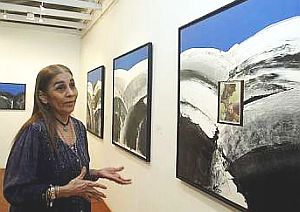 |
Nirmala Dutt Shanmughalingam chose to focus on the destruction wreaked by the tsunami. |
For seven days and nights, she made herself “experience” the horrors of the tsunami by constantly watching eyewitness accounts and commentaries aired on CNN. ”There were so many images, texts and voices of pain and destruction that it became surreal. I felt numb after immersing myself in that manner.”
Yet, interspersed within the tragedy were stories of miraculous rescues and survival that Shanmughalingam clung to as she tried to make sense of the catastrophe that had wreaked havoc across Asia. One of the most compelling stories was that of missionary Dayalan Sanders and his wife Kohila, who single-handedly saved all the children from his orphanage in Navalady, Sri Lanka, by piling them all into a rickety motorboat and sailing against the waves.
“It struck me that just as the destructiveness of the tsunami was a clear indication of a terrible divine power, Sanders’ feat of getting all those children into the boat and offering prayer after prayer as it struggled to stay afloat revealed a more comforting side of this divine power.”
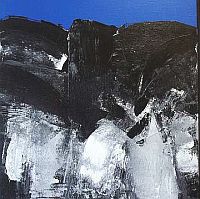 |
Discordant contrast: Crashing waves set against a calm blue sky. |
Coming to terms with the inherent duality of the tsunami resulted in a solo exhibition, Tsunami 2004-2005, currently on display at Valentine Willie Fine Art gallery in Kuala Lumpur. Given that Shanmughalingam has tackled complex and painful subjects like environmental destruction, apartheid, disenfranchisement and child abuse, focusing on the tsunami would have placed her on familiar ground. But this was not the case, she said.
“The subject matter of my previous works was more about man-made sufferings and devastation. With the tsunami, it was more about powerful elements that could never be controlled by humans. Here, humans were made vulnerable and I needed a new means to visualise this.”
She decided on an expressionistic approach, for its simplicity and impact. Eyewitness accounts of the tsunami, especially Kohila’s descriptions, guided Shanmughalingam through her explorations of a disaster caused by capricious Nature or some inscrutable divine power.
“Survivors from the different parts of Asia described the tsunami waves in different but remarkably similar ways.
Kohila explained it in a very powerful
way – she saw the sea as grey ash, which quickly built up against a calm sky with bright sunlight.”
The discordant image of looming waves against an uncannily still sky stayed within Shanmughalingam. Her focus on this singular image picks up on her idea that a single mark on the canvas can be loaded with emotions and symbolic meanings. She previously explored this idea in her Virgin Spring installation of 2003, which had the theme of raped innocence.
However, she kept to a minimum other strategies like using news images, texts and photographs as silkscreen and collage, which have worked compelling as evidence and commentary, and derived emotional responses to her previous works.
“I kept the collages to a minimum because the disaster affected so many people on a large scale and I did not want this experience to just be associated with a specific person, race, tribe or country,” said Shanmughalingam. Consequently, her over 30 acrylic painted canvases explore the idea of a singular mark/image in myriad ways. The constant is the smooth roller-brushed blue sky that reflects otherworldly calm and beauty.
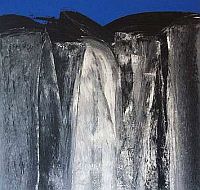 |
The artist used wide brush and palette knife to create the effect of looming waves. |
Nothing quite prepares the viewer for the sheer beauty and cruelty of the waves that she has painted. Wide brush strokes and the deployment of the palette knife describe churning, flowing, smashing, crashing, rising waves that compel him to cringe in fearful awe over mankind’s vulnerability in the face of such an inscrutable force.
But there is also a strange comfort in beholding these forceful movements against a smooth Cerulean blue sky that seems to move across the canvas. In fact, once the viewer enters the gallery, the replication of the Cerulean blue in all the canvases, together with the different forms of waves, make it seem as if the exhibition hall contains contained one long movement of waves going in a cycle.
For Shanmughalingam, the strange comfort of these powerfully-executed waves stems from the inherent duality of the tsunami itself.
“Remember that the tsunami was an act of divine power. There was destructiveness, but as with the Sanders’ experience, there is also a divine power that rests on faith, hope and miraculous escape. Hopefully, people will realise this duality because life itself is like that.”
Part of the proceeds from Tsunami 2004-2005, on till Jan 14, will be donated to Microseed, a non-profit group that supports entrepreneurship by those most hard-hit by the tsunami.
Valentine Willie Fine Art is located at 17, Jalan Telawi 3, Bangsar Baru, KL. For more information, call 03-2284 2348.
Already a subscriber? Log in
Get 20% OFF The Star Digital Access
Cancel anytime. Ad-free. Unlimited access with perks.
