Uphill battle: Spain's wine growers adapt to climate change


By AGENCY
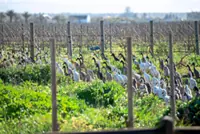
Employees caring for grapevines at the Torres vineyard at a 950m altitude in Tremp near Lleida in the Catalan Pyrenees. Photos: Josep Lago/AFP

For over a century, Joaquin Gay de Montella Estany's family produced wine in Spain's Mediterranean region of Catalonia but the effects of climate change have pushed them to seek higher ground.

Now their Torre del Veguer winery also has vineyards at the foot of the Pyrenees mountains – at an altitude of nearly 1,200m (3,900ft) – where temperatures are cooler.

It's one of the ways in which Spain's wine producers are trying to adapt, as a warmer climate advances the harvest season and makes the need for more heat-tolerant grape varieties greater.

In searing August heat, farm workers pick the white grapes by hand at a vineyard with sea views in Penedes, about 40km south of the city of Barcelona.

Wine producers in Spain, which has the largest vineyard area in the world, are trying to adapt to a warmer climate that is bringing forward the harvest season and forcing them to use more heat-tolerant grape varieties.

Higher temperatures have brought the grape harvest forward by 10 to 15 days over the past decade, said De Montella Estany, who owns the ecological winery.

"We have to harvest at the start of August when the heat is the most intense," he told AFP.

So in 2008, the company moved part of its production to Bolvir, a village in the Pyrenees near the French border.

Speedy ripening

With a total of 961,000ha of vines, Spain has the largest area of vineyards in the world, the International Organisation of Vine and Wine says. It is the third biggest wine producer behind Italy and France.

Over the past 60 years, average temperatures in Spain have risen by 1.3°C, according to the national weather office, Aemet.

Grapevines growing at the Torres vineyard in Tremp near Lleida in the Catalan Pyrenees.

And wine producers have seen an impact, as the timing of the harvest is crucial.

Higher average temperatures speed up the ripening of the grapes, which leads to lower acidity and increased sugars in the fruit.

This yields higher alcohol levels in the wine and also alters other compounds in grapes that affect aroma and flavour.

Grapes must be picked quickly to avoid an excessive alcohol content.

"Essentially these grapes have not fully ripened in the right way," said Fernando Zamora, a professor in the oenology department at Rovira I Virgili University in Tarragona.

Ancient grape varieties are treated in vitro at the Torres vineyard lab in Vilafranca del Penedes near Barcelona.

The Familia Torres winery, one of Spain's largest producers, embraced higher elevation more than 20 years ago, despite facing scepticism at the time.

The company, which has grown from a small family business in the late 19th century, began planting grapes in Tremp, 160km northeast of its Vilafranca de Penedes base, in 1998.

Grapes for making wine had never been grown before at higher altitudes in this region in the foothills of the Pyrenees.

"Farmers in the area thought it was absurd. They thought grapes would not mature," said Xavier Admella, who is in charge of the farm located at an altitude of 950m.

"Climate change has proven us right," he added, as workers set up nets to protect the vines from hail which is much more common along mountain ranges.

Grape pickers working in the grape harvest in the Torre del Veguer vineyard in Sant Pere de Ribes, near Barcelona.

New techniques

In Tremp, temperatures are almost 10°C cooler than at sea level, Miguel A. Torres, president of the Familia Torres winery, said.

That makes it possible to grow grape varieties to produce white wines "that still have very good acidity levels", he added.

The company, which exports to 150 countries, also has a laboratory where it revives grape strains that have almost disappeared.

One of them which performs well at high altitudes has already been planted in Tremp.

But the fight to adapt has a stiff price tag.

"The future is complicated," Torres said, adding the wine sector had asked for aid from both the Spanish government and European Union.

De Montella Estany agrees. He predicts that Spain's wine sector will have to go on planting at higher altitudes and "look for grape varieties that ripen later" to survive.

He does not rule out that some parts of the country, especially in the south, will one day no longer be suitable for wine production.

Not everyone is as pessimistic, though.

"Climate change is leading many wineries to get their act together and learn how to make wine, not like our grandparents did, but by looking for new techniques," Zamora said.

"And wines are now much better than they were a few years ago." – AFP Relaxnews

Get 20% OFF The Star Digital Access

Monthly Plan

RM 13.90/month

RM 11.12/month

Billed as RM 11.12 for the 1st month, RM 13.90 thereafter.

Best Value

Annual Plan

RM 12.33/month

RM 9.87/month

Billed as RM 118.40 for the 1st year, RM 148 thereafter.

Follow us on our official WhatsApp channel for breaking news alerts and key updates!
wine , wine growers , Spain , climate change

Next In Living

Heart And Soul: Hit film 'Dear You' evokes an overwhelming emotional response
Lonely end for race track: 132-year-old Aqueduct runs its last race
How this Malaysian couple helps clean up hoarder homes
Why hoarding disorder deserves more understanding in Malaysia
This mental trick may help you get more exercise
China's bull wrestlers fight to keep the centuries-old tradition alive
How to spot hidden price increases or 'shrinkflation'
Feeling drowsy at your desk? A 5 minute stroll will perk you up
What’s in your dog’s food? How to make sure your pet is getting quality meals
'Dutch sashimi': Getting the young to swallow herring

Others Also Read