
Before the 20th century, someone with severe arthritis of the hip or knee faced a bleak future.
The pain could be relentless, and it often left people immobile – even bedbound – and dependent on others for the simplest tasks.
That began to change with the modern hip replacement, pioneered by English orthopaedic surgeon Sir John Charnley in the 1960s, and the total knee replacement that followed in the 1970s.
People who had been trapped by their joints could walk again.
Hip replacement has since been called the “Operation of the Century”, and with good reason.
Excitement, then reality
Since then, surgeons have tried countless ways to improve the implants and the technique.
Most follow a familiar pattern: a new idea arrives to great excitement, everyone rushes in, reality tempers the enthusiasm, and eventually it settles into its proper place, helping the particular patients it genuinely suits.
A few changes were transformative, like tougher, longer- lasting implant materials.
A few went badly wrong, and some were even recalled after causing real harm.
The most notorious of the latter in living memory was the “metal-on-metal” hip replacements of the 2000s.
On paper, they read as longer-lasting, and were promoted for younger, more active patients.
In practice, a significant number shed microscopic metal particles as they wore out, harming the surrounding tissues and releasing metal into the bloodstream.
One particular design was recalled worldwide, with large numbers of implants needing to be redone.
Others simply failed to deliver, e.g. the early switch to Teflon-bearing surfaces, smoother on paper compared to conventional plastic, and certain specially-coated implants meant to reduce friction.
Both ended up shortening the life of the joint rather than extending it.
Telling the genuine advance from the passing fashion patiently and honestly is a big part of the job.
Today, much of our work is about perfecting an already good operation.
ALSO READ: What to expect for knee or hip replacement surgery
Modern replacements are excellent, but not immortal; they can eventually fail through infection, loosening, instability, fracture or lingering pain.
Placing the implant more precisely should help reduce some of these, although we will only know for certain once we have followed enough patients for five to 10 years.
And that is the promise robots are meant to deliver.
How the robot works
So how does a robotic surgical system actually work?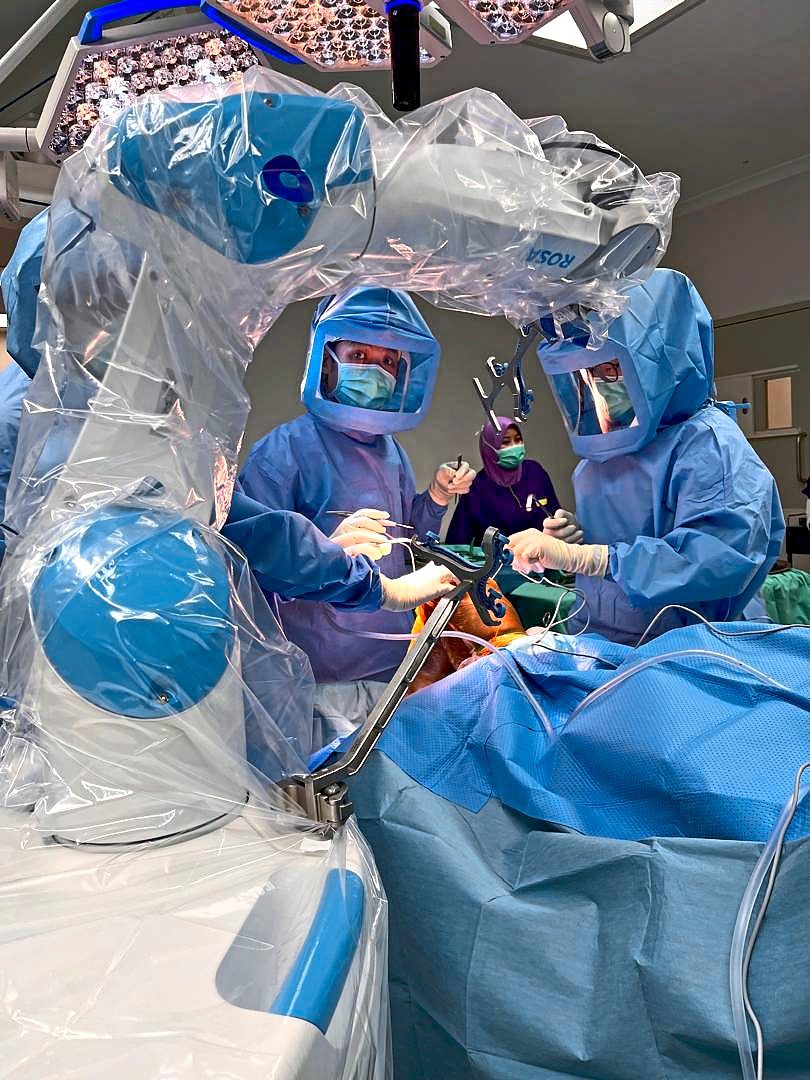
For many systems, it starts with a scan of your joint before surgery.
This scan is turned into a precise 3D model of your own anatomy.
On that model, the surgeon plans exactly where the new joint should sit and how much bone to remove.
In the operating theatre, small markers are attached to the bones so that the system always knows its exact position in real time – think of it as GPS for your knee or hip.
As the surgeon finetunes the plan, the screen shows how each adjustment changes the balance and alignment of the joint.
The clever part comes during the cutting.
The surgeon holds and guides the tool, but the robot keeps it within the planned boundary: stray outside the safe zone and the instrument simply stops.
This allows accuracy down to a fraction of a millimetre while protecting the surrounding tissues.
The robot is not an autopilot; it is more like a smart, guided power tool.
The surgeon still performs the operation from start to finish.
Commonly confused
It is worth clearing up a common mix-up here.
Many people have heard of “robotic surgery” for prostate, gynaecological or abdominal operations.
This usually involves the da Vinci Surgical System.
That is a very different machine doing a very different job.
With the da Vinci, the surgeon sits at a console a few feet from the patient, and the robot faithfully copies their hand movements, operating through tiny keyhole incisions.
It is essentially a set of remote-controlled, extra-steady hands for delicate soft-tissue work, and it never moves on its own.
An orthopaedic robotic surgical system is not like that.
The surgeon stands right at the operating table, hands on the tool.
The robot’s job is to hold the surgeon to the 3D plan and keep every cut precisely within it.
The former system works on soft tissue by copying the surgeon’s movements; the latter one works on bone by keeping the surgeon to a pre-set plan.
What they share is the point that matters the most: a human surgeon is fully in control, neither system involves a robot operating by itself.
Not all are alike
Even among joint-replacement robots there is real variety, and it helps to understand them.
The very first, decades ago, actually did the bone-cutting itself – i.e. it was genuinely automated – but it was slow and fell out of use.
Today’s robotic systems assist and guide, rather than cut on their own, yet they still differ in ways that matter.
Some plan from a CT (computed tomography) scan taken beforehand, giving a highly personalised map of your joint at the cost of a little extra radiation.
Others are “imageless”, mapping the joint during surgery from its own anatomical landmarks, with no scan needed.
Some use a robotic arm holding a saw that stays within set limits.
Others position a cutting guide, or use a small handheld device with a burr that retracts the instant the surgeon strays.
Some are built around one manufacturer’s implants, others work with several.
A number of these systems, spanning the different types, are now in use in Malaysian hospitals.
The endgame is the patient
For you as a patient, the message is simple: the word “robotic” on its own tells you very little. What matters is which kind is being used, why it suits your particular case, and as always, the experience of the surgeon guiding it.
There is a quieter benefit too.
Because these systems record precise measurements from every operation, they build a store of information that ordinary surgery never captures as reliably, and over time, studying this data may reveal which small choices in the operating theatre truly affect how long a joint lasts and how well patients do.
Robotic surgery in joint replacement is here to stay.
Whether it becomes routine for everyone or remains a tool for particular cases will depend on how well it is understood and how affordable it becomes.
But one thing has not changed: the goal is not the gadget, it is the patient walking comfortably again.
A robot can help perform a well-chosen operation beautifully; it cannot tell you whether you needed the operation in the first place.
That decision still deserves careful thought, and every reasonable non-surgical option before anyone reaches for the scalpel, robotic or otherwise.
ALSO READ: Will everyone need a knee or hip replacement eventually?
Dr Khairul Anwar Ayob is a consultant orthopaedic surgeon. For more information, email starhealth@thestar.com.my. The information provided is for educational and communication purposes only, and should not be considered as medical advice. The Star does not give any warranty on accuracy, completeness, functionality, usefulness or other assurances as to the content appearing in this article. The Star disclaims all responsibility for any losses, damage to property or personal injury suffered directly or indirectly from reliance on such information.