
Head and neck cancers affect parts of the body we use every day to speak, eat, swallow and breathe, yet, they are often less familiar than breast, lung or colorectal cancers.
Hospital Canselor Tuanku Muhriz (HCTM) UKM consultant otorhinolaryngologist-head and neck surgeon Prof Dr Mohd Razif Mohamad Yunus says the region may appear small, but contains many important structures and functions.
“Most of these functions make it easy for us to access our lungs.
"So, this area is actually very important – even though the structures are small, but they involve a lot of very significant areas.”
He says head and neck cancer includes cancers arising from sites such as the thyroid, lips, larynx, salivary glands and oral cavity.
These cancers are usually reported separately, but when combined, head and neck cancer ranks second in Malaysia after breast cancer and ahead of colorectal cancer, according to the National Cancer Registry Report 2007.
Because the cancers can develop in different parts of the head and neck, the first signs can vary a lot.
For three survivors, their cancer began with symptoms they initially thought were nothing unusual.
‘Just an infection’
For months, Khadija Ainaa Rauof Al-Samarraie thought she was battling nothing more than a lingering fever and sore throat.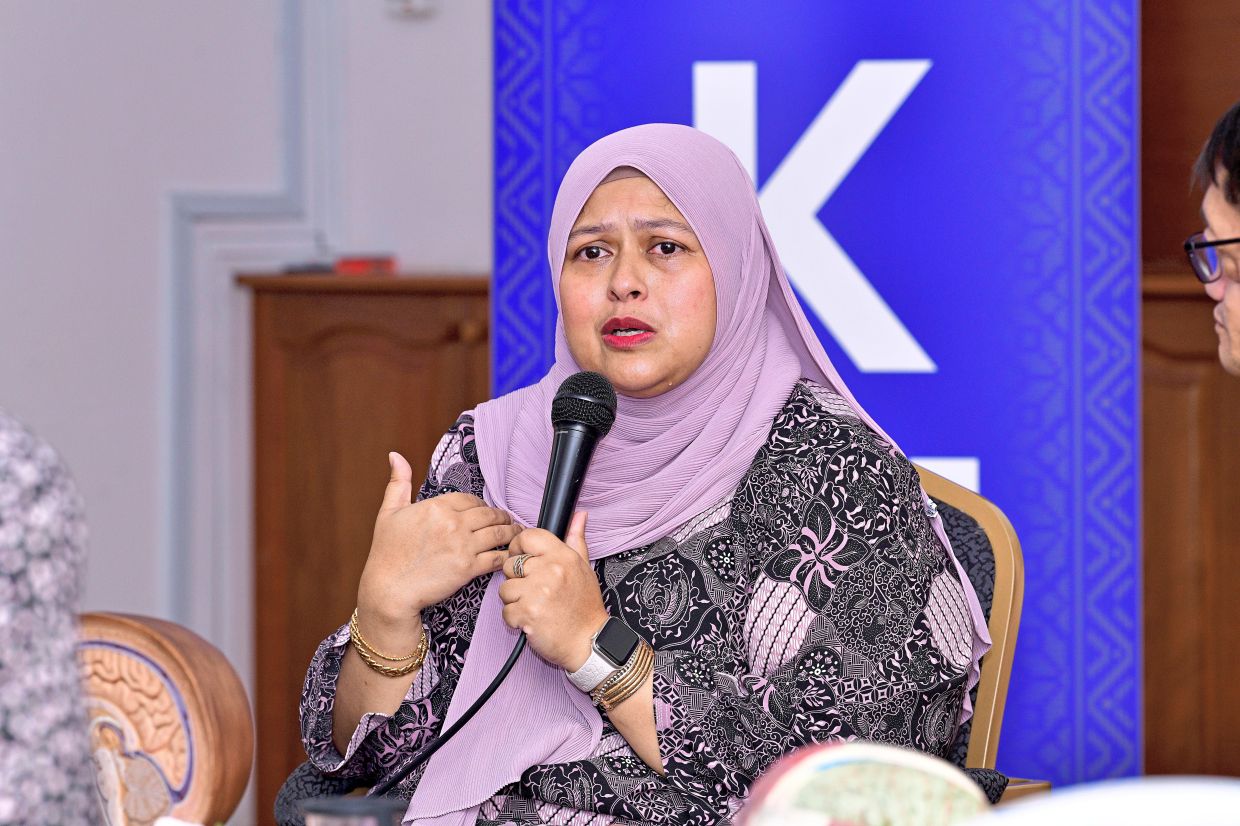
The 43-year-old was working as a lecturer when she fell ill after returning from a trip in 2019.
She initially thought it was a regular infection, but the fever persisted despite repeated treatment.
When the symptoms eventually disappeared, Khadija thought she was well and almost skipped her final follow-up appointment.
“I didn’t want to go because the symptoms were gone.”
However, she eventually decided to go for the appointment because she had already cancelled her class in preparation for attending the follow-up.
The initial check-up appeared normal, but before discharging her, the doctor referred her to an ear, nose and throat (ENT) specialist.
An endoscope examination revealed a tumour.
“The doctor came in with a camera.
“He looked inside and said, ‘Oh, this is cancer’,” Khadija shares.
A tissue sample was taken for biopsy, and two weeks later, the diagnosis was confirmed – she had nasopharyngeal cancer (NPC).
She was stunned and cried for months.
But there was some good news: the cancer was caught at stage 1.
HCTM UKM consultant otorhinolaryngologist-head and neck surgeon Dr Lum Sai Guan, who treats Khadija, explains that NPC is difficult to detect because it grows on the inside of the nasopharynx.
He adds that NPC is often mistaken for an infection, just like in Khadija’s case.
According to him, NPC is more prevalent among Chinese and males, particularly those aged 40 to 50.
Smoking and family history of similar cancers may also increase the risk.
Khadija, however, has none of these risk factors, demonstrating that anyone can be at risk of developing this cancer.
Dr Lum wanted her to begin radiotherapy as soon as possible.
But she had one request: to teach her first class of the semester so that her students would understand why she would be away afterwards.
“At that time, I asked the doctor, ‘Can I postpone it?’,” she shares.
Dr Lum agreed and gave her one session of chemotherapy over three weeks to control the tumour while she arranged her work responsibilities and prepared for radiotherapy.
Khadija eventually underwent 33 radiotherapy sessions over seven weeks as her main treatment.
It took a heavy toll, causing mouth ulcers, thick saliva and a swollen throat that made eating and drinking difficult.
She also lost 30kg and can no longer tolerate spicy food.
After radiotherapy, a spinal disc pressing on her nerves temporarily left her unable to walk.
Surgery and months of physiotherapy followed before she could move on her own again.
“There was a point when I thought, ‘I don’t want to do this any more. It’s okay. I’ll just accept it. If I die, it’s okay.’
“But I showed up and I did it.
“People say, ‘Oh, you’re so much stronger.’
“Yes, but I cried every single day,” she shares.
She adds: “But the battle inside you – the part that says, ‘I don’t want to go for treatment, I don’t want to do this’ – you have to fight that.”
Today, Khadija is in remission and continues to teach law part-time, having found that she can no longer commit to full-time teaching.
Persistent hoarseness
A change in his voice was the first sign that something was not quite right for former paper processing plant supervisor Ang Boon Kok.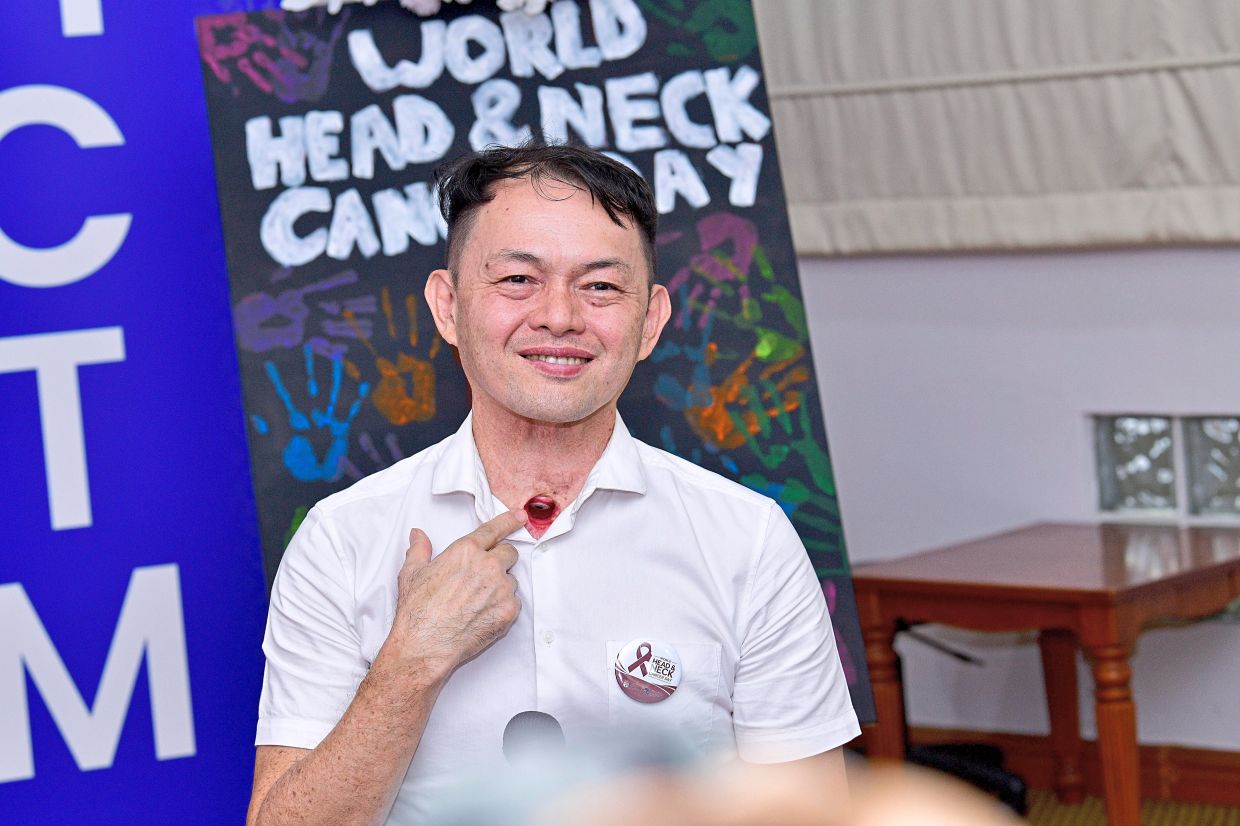
Now 51 and retired, Ang was initially concerned about his worsening hoarseness, but an examination at an ENT specialist clinic found nothing unusual.
“Initially, I was very concerned about my voice.
“My voice started to change and I became hoarse, but when I saw a doctor, they didn’t detect anything,” he says.
He was later referred to HCTM UKM, where an endoscope detected a tumour and a biopsy confirmed stage 3 cancer affecting the larynx, or voice box.
Ang underwent 33 to 35 sessions of radiotherapy over six months, but the cancer returned, leaving surgery as the next option.
He faced a life-changing decision, as undergoing a total laryngectomy to remove his larynx and the tumour would leave him unable to speak, breathe through his nose or smell.
Before the surgery, Ang was referred to the Malaysia Laryngectomee Association (MLA), where meeting fellow laryngectomy patients helped prepare him for life after the procedure.
Dr Lum says that patients can still communicate after having their voice box removed.
“We can see the outcome and effect of the surgery, they can still talk even if we remove the voice box after the surgery.”
The road to recovery was challenging as Ang had to relearn how to communicate using a surgically-implanted voice prosthesis – a small one-way valve that redirects air from his lungs to create a new voice.
Initially, he experienced redness, leakage and saliva coming from the area, but these problems eventually subsided.
His voice can be difficult for strangers to understand, but his friends and family have no trouble following him.
“If they’re a stranger and don’t know me personally, it could be hard for them to understand me.
“But if it’s my friend or someone close to me, they usually would be able to understand.”
Now retired, Ang has resumed his daily activities and enjoys travelling.
His experience with cancer also influenced his family, with his son deciding to become a doctor.
A growing bump
Tan Chee Beng, now 51 and retired, was working as a sales assistant when he noticed a small bump on his left cheek that slowly grew bigger.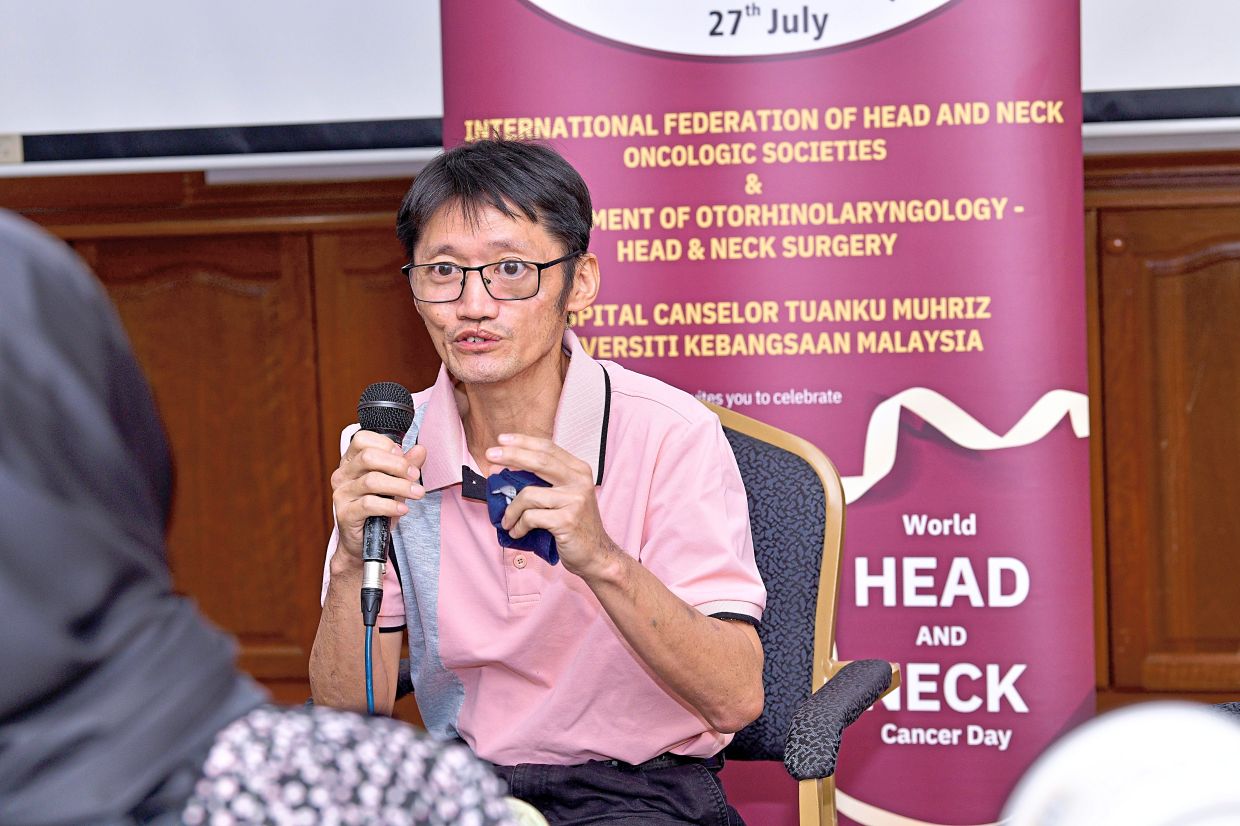
“At first, I didn’t know that it was cancer, so I brushed it off, assuming it was just acne.”
The growth did not affect his daily life and work at first, but when it persisted for two months, he became concerned.
Tan eventually visited a clinic in Melaka, where doctors considered it high risk and referred him to a nearby hospital.
He was later referred to HCTM UKM after a doctor at the Melaka hospital recommended the centre and connected him with a specialist there.
An endoscopic examination revealed a tumour, while a biopsy confirmed cancer of the maxillary sinus.
A computed tomography (CT) scan determined its exact location and guided the surgery.
Tan was diagnosed with Stage 4 cancer because the tumour had grown significantly.
Dr Lum explains that the maxilla is the bone of the upper jaw and forms part of the area around the maxillary sinus.
Because the maxilla is close to the eye, tumours in the area can threaten vision if they grow into the eye socket.
Fortunately, Tan’s tumour did not directly involve the eye, but its location meant radiotherapy carried a risk to his vision.
With time running out, his treatment required a multidisciplinary team involving ENT, oral and maxillofacial, plastic and oncology specialists.
He underwent a complex subtotal maxillectomy to remove the tumour and save his eye.
Part of the facial bone, including some supporting the eye, had to be removed, with a mesh and plate placed underneath for support.
The surgery changed his appearance and affected his ability to eat, but he gradually regained the ability to eat comfortably.
“Last time, I couldn’t even eat properly.
“I could only open my mouth halfway, but now I can eat with ease.
“Thankfully, I have no pain at all,” he shares.
His condition continues to be monitored.
Dr Lum says symptoms of head and neck cancer can sometimes be subtle.
Patients may mistake them for common problems, such as a sinus infection, and continue with their daily lives without seeking further investigation.
He advises patients to see an ENT specialist if symptoms persist for two weeks or more, so that they can undergo an endoscopic examination, and if necessary, further tests.
“When we detect cancer early and start treatment, the survival rate is higher.
“But when cancer is detected at a later stage, the treatment is more intensive and the risk of the cancer returning is higher,” he says.
The three survivors, Dr Lum and Prof Mohd Razif shared their experiences and insights at a recent World Head and Neck Cancer Day event organised by HCTM UKM in Kuala Lumpur.