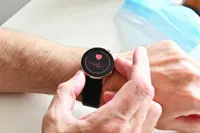
Wearable technologies could help detect Covid-19 symptoms earlier than traditional methods of diagnosis, research suggests.
The new study from the United States highlights the advantages of such devices when it comes to meeting health needs during a pandemic.
Researchers at the Mount Sinai Hospital in New York City found that wearables like the Apple Watch were able to identify cases of Covid-19 earlier than traditional diagnostic methods.
The news may sound surprising, but the findings are based on a scientific study involving several hundred participants, namely, healthcare workers recruited throughout the Mount Sinai Health System.
The study was conducted between last April and September during the midst of the ongoing pandemic.
Each participant wore an Apple Watch and answered daily questions via a customised app.
The researchers studied changes in participants’ heart rate variability (HRV) to identify and predict whether they were infected with the SARS-CoV02 virus or suffering symptoms of Covid-19.
They also collected other daily symptoms such as fever or chills, tiredness or weakness, body aches, dry cough, sneezing, runny nose, diarrhoea, sore throat, headache, shortness of breath, loss of smell or taste, and itchy eyes.
Published in the Journal of Medical Internet Research, the findings suggest that “subtle changes” in participants’ HRV, measured by the Apple Watch, were able to signal the onset of Covid-19 well before diagnosis by traditional methods.
“This study highlights the future of digital health,” says the study’s corresponding author Dr Robert P. Hirten.
“It shows that we can use these technologies to better address evolving health needs, which will hopefully help us improve the management of disease.
“Our goal is to operationalise these platforms to improve the health of our patients and this study is a significant step in that direction.
“Developing a way to identify people who might be sick even before they know they are infected would be a breakthrough in the management of Covid-19.”
The researchers also observed that the HRV pattern began to normalise between seven and 14 days after Covid-19 diagnosis, and was no longer statistically different from the patterns of those who were not infected.
They suggest that wearables could be used to monitor patients remotely and intervene if or when necessary – a useful approach during periods of restricted movement and physical contact.
The next step for the study is to analyse biometric indicators like HRV, sleep disruption and physical activity to identify which healthcare workers could be at risk of the psychological effects of the pandemic. – AFP Relaxnews
Already a subscriber? Log in
Get 20% OFF The Star Digital Access
Cancel anytime. Ad-free. Unlimited access with perks.