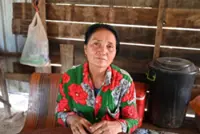
When single mother Christine Wong had a hard time finding a suitable school for her daughter Amanda who has Down Syndrome, she took the bull by the horns; she set up a centre for people with special needs despite having limited resources.
Together with Shirley Chan, who also has a child with the congenital chromosomal disorder that causes varying degrees of physical and mental limitations in different people, Wong founded the Special Children Society of Ampang (SCSOA) in Selangor.
That was 12 years ago.
“I started the society because special children had nowhere to go then after they turned six years old. Special kids need to pass an assessment before being accepted into special classes in mainstream schools, which were my first choice for Amanda. However, the students have to be toilet-trained and compliant, but Amanda was neither, then,” the SCSOA president recalls.
The determined mother then visited several private centres but these did not provide the kind of environment she desired for Amanda, her firstborn.
Wong, a piano teacher, was 29 when she had Amanda. “I was depressed for a long time,” she shares candidly.
She coped with her despair and the situation with much-needed support from her mother and sister although it was very difficult for her husband and mother-in-law to accept Amanda’s condition.
Amanda, now 21, also had difficulty feeding and was allergic to various brands of milk.
“She had a bad temper and would hit her head against furniture, walls or the floor when she was unable to communicate her needs. She would also run aimlessly around and we had to practically watch over her 24 hours a day.
“Sometimes, she would just stay in one spot for hours. There were other behavioural issues like biting her peers in kindergarten and pulling their hair,” Wong relates.
Naturally, it was a constant challenge taking care of Amanda.
Thoughts of giving up would cross Wong's mind when Amanda refused to sleep or displayed bizarre behaviour in public or at home.
A single mother who also has a son aged 15, Wong says: “Without the help of a loving dad for my children, life was even harder.”
To keep going, Wong drew strength from religion and her family and friends.
Wong was also encouraged by the small breakthroughs achieved by Amanda.
“To see her reaching milestones like learning to walk at 22 months, sucking from a straw, interacting with me and learning new words spurred me on,” she adds.
However, Amanda, who has delayed mental development, still needs constant care.
“My son loves Amanda unconditionally. He is my hope for the future. But I hope to live a long and healthy life to be able to take care of Amanda without putting a burden on anyone,” says Wong.
Concrete milestone
The inception of SCSOA has considerably helped not only Amanda but many others as well.
“This centre was set up for children like Amanda. Here, we teach them to crawl, walk and learn self-help skills like combing their hair, buttoning their shirt and tying shoelaces.
“Our goal is to help the kids be independent and integrate into regular kindergartens and special classes in mainstream schools,” adds Wong.
The non-profit organisation started out in 1999 from a rented terrace house in Ampang, with three children. Enrolment gradually grew, and so did the need for bigger premises and more funds. However, Wong and her team weathered the difficulties and continued to oversee the growth of the society.
Today, SCSOA provides special care and education to 60 children with disabilities, such as autism, cerebral palsy, Down Syndrome, epilepsy and global developmental delay. The students range in age, from three to 36 years.
Besides reading, writing and counting, the centre conducts early intervention programmes, practical living skills training and activities like music, swimming, horseback riding, cooking, arts and crafts, and sports. The centre also features a Snoezelen facility - a special multisensory therapy room.
The society, whose members and elected committee members must be parents of special children, now employs 15 full-time staff members, including three physiotherapists. It is also aided by some 15 volunteers.
But it can be said that SCSOA’s biggest pride came in January when, after more than a decade of operating from rented premises, it finally moved into its permanent home – a 557sq m land with a built-up area of 297sq m. The RM1.4mil centre in Taman Ampang Utama was the result of tireless fund-raising campaigns that began in 2005.
A huge milestone for the society, the building – which was officially opened by Selangor’s Sultan Sharafuddin Idris Shah last month – also represents the trust and confidence that various individuals, organisations and corporations have in the centre and its work.
“We are very proud of our building. It’s a big moment in our history. We started the society with nothing. I even had to borrow chairs from Shirley !” recalls Wong.
Shirley Chan, 72, co-founder and SCSOA treasurer, says: “Our aim is to reach out to more mothers with special needs children.”
(Maria Chow, another key person in the society’s establishment, was instrumental in drawing up the centre’s educational and intervention programmes. She left SCSOA two years after its inception when she migrated to Australia.)
“The kind of service provided by our centre is necessary for special needs children and their parents,” says Chan, who was looking for a nurturing place for her son Wong Wei Yuen, a Down Syndrome child, when she decided to form SCSOA with Wong and Chow.
Independent living
Wei Yuen was also born with an imperforate anus – a congenital defect where the rectum is malformed. Subsequently, he had a colostomy – a procedure which allows the intestine to drain stools into a bag attached to the abdomen. The colostomy was followed by two other surgeries.
“He was such a champion about it,” Chan says, adding that today, Wei Yuen, 32, still has intermittent problems with his bowels.
“My husband and I never shared our innermost feelings (about Wei Yuen's future). I think, we didn't want to allow ourselves to feel sad, sorry or defeated. We were definitely afraid to discuss his future.”
The homemaker adds that some friends had suggested they send Wei Yuen to a centre for spastic children but she did not agree that an institution was the right environment for her child.
“I am proud that he is toilet-trained, extremely clean and has good table manners. The fact that he has good social skills is a bonus. He has, many a time, helped me out of sticky situations.
“He does not give us any trouble or worries. He is not a fussy eater and takes part in activities like swimming and playing computer games.”
Already a subscriber? Log in
The Star Festive Promo: Get 35% OFF Digital Access
Cancel anytime. Ad-free. Unlimited access with perks.