



Before the pandemic, Arifin Ajib was preparing to make his first feature after raising RM3mil for the project.
But when the pandemic hit, the investors – who had stayed on for about six months – pulled out as the cinema market deteriorated.
The 37-year-old described the setback as a turning point.
“We had to rebuild from 2021,” he said in an interview with StarLifestyle.
“That was when we started looking at how we could achieve high production quality with limited resources.
“We spent about two years experimenting with different cameras, lenses and techniques.
“It became two years of research and development, basically sharpening our filmmaking techniques,” he added.
That experience became the foundation for his directorial debut, Mimpi Kita: Kota Di Atas Awan (aka Mimpi Kita: Castle In The Air), a Malaysian sci-fi fantasy produced by Anti Gravity Euphoria, Da Huang Pictures (under New Wave pioneer Tan Chui Mui) and Kotodama Lab.
The film has a total budget of under RM2mil, including for post-production and some pre-marketing.
“For a sci-fi fantasy film, under RM2mil is almost unheard of. You probably need RM8mil to RM10mil. Even RM5mil would already be considered as cost-cutting,” the director said.
“But when people saw the trailer and teaser of Mimpi Kita, they asked, ‘How did you do it?’
“And it all came from the two years we spent on research and development,” he stated.
For Arifin, the process was not about cutting corners but finding smarter ways to work.
“Filmmaking is not the time to show off. You have to be practical and achieve your goal without wastage.”
That approach has taken Mimpi Kita a long way, but it’s not quite across the finish line.
The film is currently about 70% complete. Arifin shot the completed portion with a team of 18 crew members in December 2023 and is now seeking funding to complete the remaining 30%.
He said: “Financing remains the biggest challenge as what we have built is basically not funded by industry players.
“We still have another 30% to shoot, which we are targeting for the fourth quarter of this year.”
When asked about continuity factor, Arifin said he’s not concerned as the remaining scenes take place in different locations and in what he describes as a dream world.
“The story is structured in a way that the protagonist goes from one location to another and meets different characters along the way.”
Arifin – who also goes by the moniker aaaaafin – explained Mimpi Kita grew out of his interest in family, memory and honouring the past.
The story is set in an alternate version of 1960s Malaysia, where a planetary event wipes out everything on Earth.
Before the apocalyptic event, a group of scientists build an ark orbiting the Earth to save humanity. The children are sent to the ark and placed in cryosleep.
But because their minds still need to develop, the scientists create a dream world (think The Matrix) where they can continue growing up with their families.
“At its heart, the story is about memory. Our family and friends hold our memories. They help define who we are.
“If everyone who knows you disappears, in a way, your identity disappears with them.
“So the children in this film have to learn to let go of the past while still honouring it,” Arifin explained.
The film’s Malaysian identity is also central to its world-building.
According to executive producer Foo Hui Yin of Kotodama Lab, Mimpi Kita places a “high-concept sci-fi premise against a deeply localised backdrop”, incorporating the regional Nogori dialect from Negeri Sembilan while weaving principles of Adat Perpatih, or customary law, into its narrative.
Arifin elaborated: “It came about through my research into Ibu Soko, which is part of the traditional leadership structure in Negri Sembilan.”
Negri Sembilan has a matrilineal system, and the Ibu Soko are pillars of the Adat Perpatih in Negri Sembilan society, he said.
“What interested me is that this system is still practised today. It is something that is uniquely Malaysian, and I wanted to show that element in the film.
“It also goes back to the central idea of the film. If you have people who know how to nurture, they can create a healthy community,” added Arifin, who was brought up by a single mum.

Beyond the film
As challenging as choosing sci-fi fantasy for his first feature, Arifin is also using Mimpi Kita to experiment with a more sustainable business model for filmmaking and marketing.
“We are looking at an alternative model involving community-building,” he said.
Using analytics tools, they hope to find and grow online groups attracted to the film’s genre and themes before the film’s release.
The model is partly inspired by American independent film company A24, which has built strong communities around films through unconventional marketing and audience engagement.
Its recent successes include this year’s Backrooms and Everything Everywhere All At Once (2022).
Arifin believes this approach could be particularly useful for independent Malaysian filmmakers working with limited budgets.
“Film marketing in Malaysia is very tight. Usually, you have about a month before a film’s cinema release to market it.
“If you have a big budget, you can spend heavily on media, influencers and events. But for an independent filmmaker with RM500,000 or RM1mil, that is difficult,” he lamented.
“You don’t have enough time to build word of mouth. After one or two weekends, your film can already be out of cinemas.
“We want audiences to know our film in advance, so the interest is longer,” Arifin added.
He points to A24’s strategy of engaging audiences around a film’s subject matter even before the film itself is heavily promoted.
“A24 engages its community way before a film is released. Sometimes they don’t even mention the film.
“They engage people around the subject matter and get the community excited.
“We want to experiment with something similar – finding the specific audience for each film rather than using the same marketing template for every film,” he said.
The Mimpi Kita team has already begun testing that approach.
On Aug 14, it held a fundraising event in Negri Sembilan in partnership with the Nine Arts Festival.
The intimate event targeted potential equity funders, as well as the launch of its original soundtrack, Hilang Dalam Kebahagiaan by Rina-Hime, also the film’s lead actress.
The team plans to hold two larger public events closer to the film’s planned 2027 release.
“The first listening event was held on Aug 14 with about 30 people.
“The next one will be much bigger, and we are targeting around 2,000 to 3,000 people.
“Eventually, the third listening event will happen around the film’s release, potentially in a mall where there could be 10,000 or more people passing through.
“We will also launch our online publicity around the second event. Then, we will fully engage the audience towards the film’s release,” the director said.
A step forward
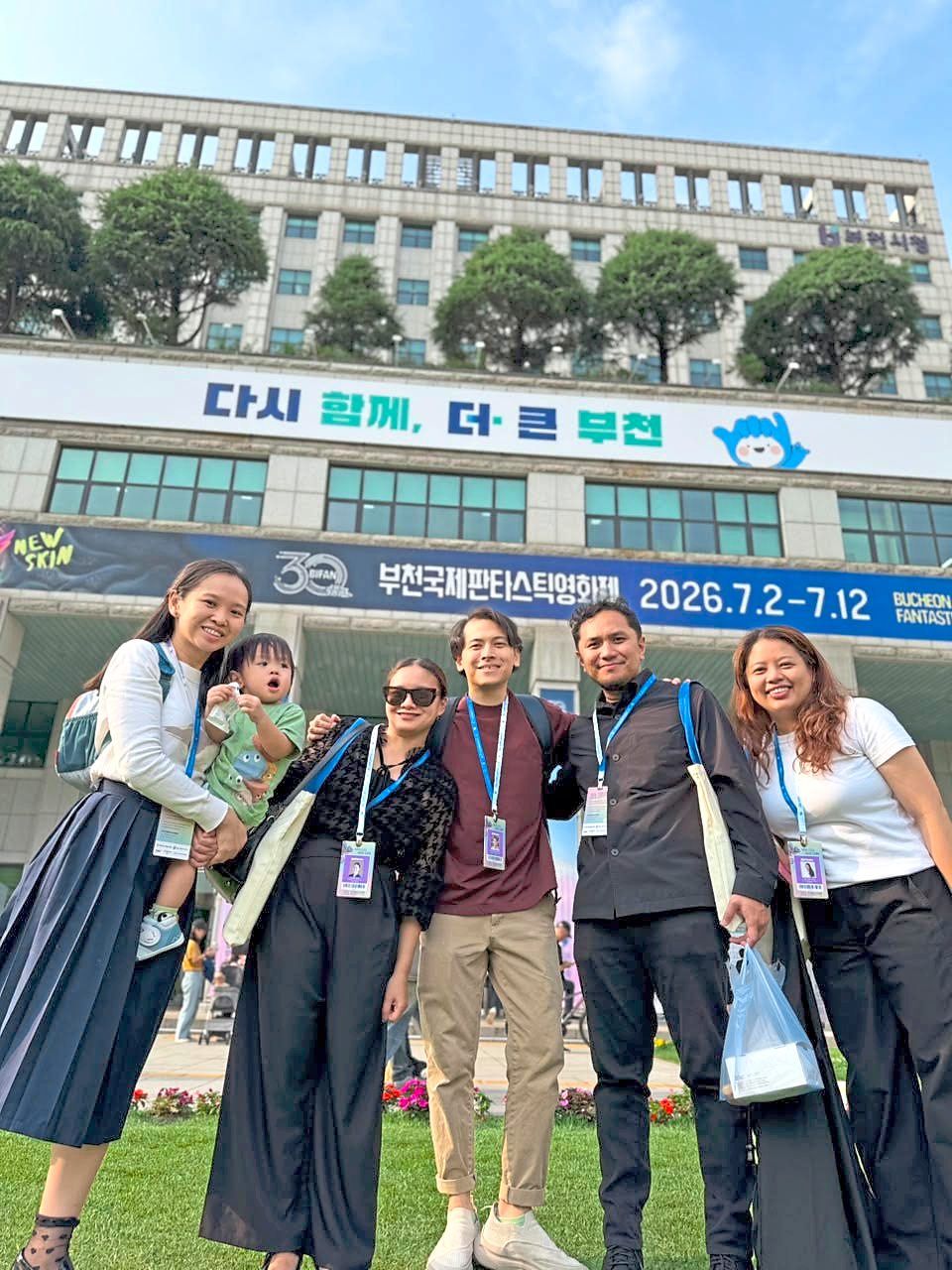
Mimpi Kita has already taken a step towards building that wider audience after being selected for the NAFF IT Project Market at the Bucheon International Fantastic Film Festival in South Korea.
The project has also secured theatrical distribution rights for Malaysia and Brunei through Malaysian distributor Abnormal Studios, known for films including How To Make Millions Before Grandma Dies and Twilight Of The Warriors: Walled In.
For Arifin, the international recognition offers encouragement even as he continues to face the challenge of completing his debut feature.
Ultimately, he hopes audiences will see a message of hope in Mimpi Kita.
“Our world is very unstable now, and some people have become apathetic because they think things are going to get worse anyway.
“My own authorial voice is that the only way the world can move towards a healthier place is if we know how to love somebody and care for somebody.
“In a way, this film is also for my wife and my son. Whatever my wife and I are doing for our son, he won’t know now. But it’s there.
“Then he will grow up and do something of his own, right? So that’s the future,” he said.
For more information, go to kotodama.tokyo, check out @kotodamalab on Instagram or e-mail Foo Hui Yin at hello@kotodama.tokyo.
