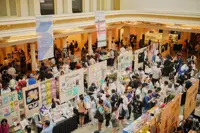
The Malaysia Art Ecosystem Fair (MAEF), which opened yesterday, brings together commercial galleries, artists, art studios, collectives, visual arts associations, museums, educational institutions, publishers and other industry players in one of the country's largest gatherings of the visual arts sector.
It also gives art lovers a major platform to explore the breadth of Malaysia's art ecosystem and discover the people and organisations shaping its development.
Organised by the National Art Gallery, the second edition of MAEF runs at the World Trade Centre Kuala Lumpur (WTCKL) until Nov 29.
With 47 exhibitors, the free-admission fair is occupying two main spaces, Dewan Tun Razak 3 (TR3) and Dewan Tun Razak 4 (TR4).
The inaugural edition was held in 2021, focusing on the visual arts industry's recovery following the Covid-19 pandemic. This year's fair marks a shift towards examining its subsequent growth and development.
Muhammad Hazrin Abdul Malek, curator at the National Art Gallery and head of MAEF 2026, says the five-year interval has provided an opportunity to assess how the country's art ecosystem has evolved.
"In the five-year period after the first edition in 2021, we wanted to observe the development of the art industry, as we were still in the recovery phase coming out of the pandemic. We have collected a lot of data since then about how the ecosystem has naturally evolved, which the public can view via 'Jejak Seni Malaysia', an extension of MAEF," says Hazrin in a recent interview.
Among the National Art Gallery's highlights is a mini exhibition space featuring a print copy of L'Écuyère et Les Clowns (The Horsewoman And The Clowns), a 1961 colour lithograph by Pablo Picasso linked to the 1Malaysia Development Berhad (1MDB) case.
Displayed beside the Jejak Seni area in TR4, the work raises questions about its future, including whether it should remain in the National Art Gallery's collection, be sold or loaned to other institutions.
"There will be a lot more discussions with the relevant authorities on its future. But while it's under our care, we treat it as a national asset, and we hope it can benefit as many people as possible – through research, international exposure and education. Once MAEF concludes, this artwork, along with the others, will be showcased in a special exhibition to be announced at a later date," he adds.
Visitors familiar with the Klang Valley's gallery circuit will recognise exhibitors such as Chetak 17, Galeri Puteh, Galeri Sasha and G 13 Gallery, alongside a mini GMBB showcase.
Not all art belongs on canvas. Bike Tattoo Arts from Sentul, KL, led by a mechanic and motorcycle enthusiast, presents welded motifs on machinery.
However, some of the more unexpected discoveries come from collectives and independent art spaces based beyond the capital.
Among them is Alor Setar's Angkatan Pelukis Kedah, an art collective founded by school art teachers in 1977. The Malaysian Watercolour Society will also hold demonstrations throughout the fair.
Perak-based Kapallorek Artspace brings an interactive installation, Rehat Dan Rawat, by Tumbuktikus Collective, comprising Shahrul Hisham, Haris Abadi and Fadly Sabran. With a playful nod to the physical demands of art fairs, the work addresses aching feet from prolonged standing and visual fatigue from taking in too many artworks.
Borneo's grassroots creative scene is also represented through Berkumpul Borneo, curated by Bengkel Borneo and Pangrok Sulap. The showcase brings together 25 artists, cultural practitioners and producers from Sarawak, Sabah, Kalimantan and Brunei.
Such regional representation highlights MAEF's role as a meeting point for the wider art community, creating opportunities for exchange and future collaborations.
"It is split in a way which showcases commercial galleries and grassroots collectives. The former, we know, is market-oriented and contributes a lot to the Orange Economy, hence the presence of collectors and trading from the respective galleries," says Hazrin.
"Meanwhile, the grassroots, emerging art collectives, including higher learning institutions, entrepreneurs and other service providers, have the opportunity to interact with each other and potentially collaborate in the future," he concludes.