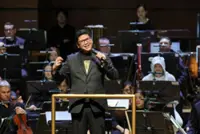
Herbert von Karajan never suffered fools gladly, and accepted nothing less than immaculate performances from his musicians.
The 20th century’s greatest conductor was a notorious stickler for detail. And it was against this backdrop of perfection that Hungarian conductor László Makláry found himself privy to a rehearsal of Verdi’s Don Carlos at the Salzburger Festspiele in Austria.
On that fateful day some time in the 1970s, Karajan walked away from the orchestra, sat himself down and let the ensemble play the second finale – a tricky passage of music incorporating multiple singers and a split choir – on its own.
The troupe, comprising world-famous opera singers and the Vienna Philharmonics, managed to perform it flawlessly, yet, when it was over, Karajan walked back to his place, reprimanded everyone for what he considered to be a sonic train wreck and got the musicians to play it immaculately.
According to Makláry, technically, it was completely identical to the conductor-less version – the notes were the same, the pace was the same, and yet, the music was completely different.
“It was a cathartic experience, a transcendental, magical thing. That was when I understood the real function of a conductor – to fill the entire performance with the power of their personality, and to lift it up,” he reveals in an e-mail interview.
Makláry has learnt the art of the conductor himself, applying it in a variety of settings, from the time he graduated from the Liszt Ferenc Academy of Music to his current role conducting the Budapest Operetta and Musical Theatre.
Hungary’s oldest and most successful orchestra plays Dewan Filharmonik Petronas in Kuala Lumpur on Oct 19, courtesy of Toyota Classics, an initiative now in its 26th year, which presents the best from the classical music idiom.


Since its inception, the operetta has travelled the world and impressed all who have been treated to its sights and sounds, but Makláry claims no individual plaudit, choosing to lavish praise on the team’s efforts instead ... with a little tongue in cheek.
“Like all performers, I am glad of our success, and I love to be welcomed with applause. But our success didn’t come easy, it is the result of 40 years of hard work, by collaborating with Kero (Miklós-Gábor Kerényi), the theatre’s artistic director, our excellent orchestra and our cast of soloists,” he says.
Given the Budapest Operetta and Musical Theatre’s age-old existence, contemporising can easily be a double-edged sword. Makláry reckons that staying true to the original may only present something “dry and dusty” while modernisation could desecrate the sanctity of the art, insisting instead that balance is of the essence.
“It is a difficult task to keep the aspects of the original that work, and change the ones that have become obsolete. The text itself has to be rewritten regularly to make it ring true to a contemporary audience, but the romantic, sweeping music is ageless and requires little change," explains the 65-year-old.
"The aspects that give an engaging momentum to the performance, such as the humorous dialogues and slapstick acrobatics associated with the soubrette and buffa, always have to be young and brand new,”he adds.
The musical’s home base in the Metropolitan Operetta Theatre in Budapest stages 500 shows a year, with an average audience of 400,000, where music enthusiasts are served the fiery temper, virtuoso dances and enchanting visuals of the musicals.
Today, the orchestra functions as a musical theatre with two divisions: Hungarian operettas and their modern descendants, encompassing Hungarian musicals on its programme on the one hand, and musicals, based on literary or historical topics, aimed at a younger generation on the other.
Toyota Classics and Budapest Operetta and Musical Theatre have seen a decade-long partnership. However, back then, Makláry was saddled with more in-house duties and didn’t get to tour with the troupe, though that scenario has now changed with the conductor making his way here.
The musical has been awarded the title “Superbrands” for its excellent achievements in 2012, 2013 and 2014 and he reckons staying true to the operetta style is what earned the accolade.
“Currently the greatest success of our brand is the most classic, most Hungarian operetta, The Gipsy Princess, that just turned 100 years old, as well as the musical based on Disney, Beauty And The Beast,” Makláry says.
The “Music That Moves Lives” theme of the automotive multinational is achieved by providing a dynamic and engaging performance, which not only includes perfect delivery of the music and singing, but the movements as well.
“Operettas are never static, their key components are acrobatic dance movements and emotional, dynamic acting. The operetta genre offers two and a half hours of happiness and passion, and our goal is to move the audience as much as possible. We move the heart, the mind, and also the body – we hope that by the time we get to the finale, all viewers will feel their pulses beat faster,” he adds.

When the musical hits Dewan Filharmonik Petronas, audiences here can expect a “greatest hits” performance of both the operetta and musical genres, steeped in the rich tradition of the most well-known French, Hungarian and Austrian operettas. Makláry drew on his experience as a conductor to choose songs both from operettas and musicals that have iconic, world-famous tunes, and tried and tested audience favourites.
“Our programme will be enjoyable to long-time operetta fans, since it offers the very best of the genre. But it will also be a great introduction to the genre for those who encounter operetta for the first time,” says the conductor who was weaned on classical and Hungarian folk music.
He cites composers from the romantic genre as his favourites, the likes of Brahms and Tchaikovsky topping his list.
“I believe that a musician who has a solid grounding in classical music can repurpose that experience to play other genres of music as well. I myself have used my classical training in my work with operettas and musicals,” Makláry says.
While he’s crossed paths with a multitude of great musicians and learnt plenty from them, the one who’s left an indelible impression on him is American composer and conductor, Leonard Bernstein.
“Bernstein taught me that the dividing line isn’t between classical music and popular music, it’s between good music and bad music. All music is valuable, if it is played with care and attention. I met Bernstein once, and in the six hours we spent talking and drinking whiskey, I learned more about music than I could have learned otherwise,” says Makláry, who has little interest in popular music.
The piano, violin and woodwind-schooled conductor sussed out early in his career that conducting isn’t something to be rehearsed in front of a mirror – to become a real conductor, you have to work with a real orchestra.
“In Szeged, I learnt that while a conductor can be a tyrant, it’s much more rewarding to pay attention to the singers and musicians, to let them make their own choices. Conducting shouldn’t be defined by aggression, but by the joy of playing music together,” he says.
Only the best make the cut to be bona fide conductors, and Makláry offered this profound advice for aspirants: “You have to pay attention to each other, pay attention to your fellow musicians. Our opinion isn’t always infallible, we should listen to others and learn from them. Don’t start working in an orchestra looking only for individual success, you have to try and find the opportunity to create something together.”
Catch The Budapest Operetta and Musical Theatre - presented by Toyota Classics 2015 - at Dewan Filharmonik Petronas, KLCC in Kuala Lumpur on Oct 19. Tickets are priced between RM106 and RM265. For details, visit toyotaclassics.asia.
Already a subscriber? Log in
Get 20% OFF The Star Digital Access
Cancel anytime. Ad-free. Unlimited access with perks.