


Say ‘Mamak’ and most Malaysians think: Indian Muslim. Say ‘Penang’, and they will think nasi kandar, roti canai, mee goreng and teh tarik. PREMILLA MOHANLALL gives us insight into this community living in Penang.
| |
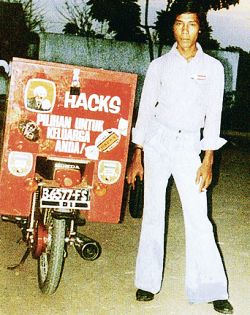
Hacks mobile — the selling point was that itoffered quick service and was easy to park. |
What is a mamak? Is the term derogatory?” I asked Najmudeen Kader, the president of the Penang Indian Muslim League.
“No, the term is not derogatory,” he clarified.
I was relieved.
“It is actually derived from the Tamil word mama which means ‘uncle’. It is really a polite form of address,” Najmudeen continued.
“Then why do some people consider it derogatory?” I persisted.
He gave a perplexed look and refused to be drawn in.
The term “mamak” generally refers to the Muslims from Tamil Nadu. They first arrived here as sepoys, the “native” section of the East India Company troops stationed in colonial Penang.
The growth of Penang as a trading centre in turn attracted more Indian Muslims, this time the mariners and merchants. They settled near the port in what is now Little India.
To this day, there is a thriving Indian Muslim quarter in Little India, centred around two places of worship – the Nagore Shrine and the Kapitan Kling Mosque. Many of the inhabitants run traditional businesses dating back to the days of the British empire. They are the goldsmiths, tailors, money changers and cloth merchants.
These are trades that are disappearing from modern Malaysia. But not so in Penang, which is trying to preserve Little India in its bid to become a World Heritage Site.
Najmudeen, who is 40-something, is a third-generation Malaysian. The family owned palm oil and cocoa plantations, and made the most of opportunities for trade between British Malaya and India. Najmudeen is continuing the family business, though he has adapted with the times: he has an MBA from an American university, and his companies are involved in IT and building restoration.
“We are a close knit Indian Muslim community in Penang,” says Najmudeen.
“We have adapted to and assimilated the Malaysian way of life. Some of us more than others. Religion is important and so when we marry, it has to be to a Muslim. Not surprisingly, when the Indian Muslim marries out, he chooses to marry a Malay. This is especially so with the second and third generation, and they have assimilated the Malay culture.
| |
Gold and precious stones — a match made in heaven. The business is booming in theGold Bazaar of Penang. |
“Others are proudly Malaysian and also proud of their Indian Muslim heritage. They speak Tamil at home, the womenfolk are clad in sari and marriages are often arranged, with parents heading back to India to find a suitable match with someone from their village – mainly from Thanjavur and Ramanadapuram districts in Tamil Nadu.’’
| |
A 1957 picture of getting into the spirit of Merdeka. (Top) Hacks mobile —the selling point was that it offered quick service and was easy to park. |
Jeweller Mydin Gani, 70, arrived here as a 17-year-old and went back to his village to get married. The marriages of his children were also arranged with families from the same area. He remembers the early days when he arrived in Penang in 1952.
“Most of us Indian Muslims were money changers, jewellers, stevedores or in the textile and grocery business. Some of us even built roads,” he recalled.
The first coastal road from Jalan Masjid Kapitan Keling (formerly Pitt Street ) to Batu Feringgi was built mainly by Indian Muslims from his village. Mydin began life here as a rice trader. Then he became a money changer, and later a diamond merchant. He travelled to Belgium to work and learn about the diamond industry.
Thirty years later, he handed the reins over to his son, just like his 80-year-old brother-in-law Habib Mohamed of Habib Jewels has done.
Abubacker sent his son Barkath Ali to the UK to study all aspects of manufacturing and marketing Hacks. The rest is history. Today the store has grown into a group of companies that manufactures and exports food products to Australia, Japan, Europe and the US.
Then there are the Indian Muslims in the mamak food business.
Najeeb Ibrahim of the Craven A Café, a Penang landmark located at the corner of Macalister and Dato’ Kramat Road, runs one of the earliest 24-hour mamak restaurants in the country.
“My grandfather started it in the 1920s. He came here with my grandma, who was a good cook. They started as pushcart vendors, then opened a shop. For a name, they just adopted the billboard on the roof – the cigarette Craven A. The name stuck,’’ says Najeeb.
“When the cigarette company went bankrupt, we were asked by the British company to bring the sign down. We did and we are now officially known as Craven Café.’’
| |
Bread vendor. |
In the heyday in the 1950s, it was a meeting point of Royal Australian Air Force soldiers and locals. Beer was freely sold and it went down well with the spicy food. But it did not go down well with tempers. There were drunken brawls with tables and chairs flying. It was bad for business. In 1976, they stopped selling liquor.
“The shop was run by relatives – sisters, brothers, uncles and nephews – from our village in India. Almost 90% of the people in my village have immigrated to join their family in different businesses in Penang,” says Najeeb, who is the only son in the food business.
“The rest of my brothers are professionals.”
Najeeb has set up his own outlet as well – Craven Café Nasi Kandar Bistro in the seaside suburb of Tanjung Bungah. The look and feel of the restaurant is a far cry from the original in town.
But some traditions remain. It is still a family business and, as in his grandfather’s and father’s days, the women rule the kitchen.
Najeeb’s wife, who is of Indian Muslim-Chinese parentage, uses her mother-in-law’s recipes as well as her own, like duck and goose curry.
| |
Convenience store. |
As with all family businesses, there are stories of family feuds and bankruptcies. Ghani Biryani Restaurant in Penang Road thrived in the days of stand-alone cinemas but is no more. Dawood Restaurant, the leader in wedding dinners, remains under lock and key. Why? No one is telling.
It is a close-knit community, after all. But the mamaks are not a close-minded people. They have moved on . . . to other parts of the country. And the world.
Several are captains of industry, leading the way with business acumen nurtured over generations. W
Related stories:The gold bazaarBig businessWhat does “mamak” mean to you?My kinda Starbucks
Already a subscriber? Log in
Get 20% OFF The Star Digital Access
Cancel anytime. Ad-free. Unlimited access with perks.
