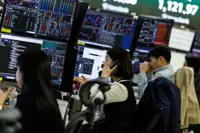
Taiwanese and South Korean equities surged on Tuesday, putting Asian stocks on track for their strongest session since July, as Jensen Huang's return as Nvidia CEO triggered a relief rally in battered AI-linked stocks.
The rally reversed some of last week's heavy losses, when Taiwan recorded its worst weekly decline since 1990 and South Korea shed 8%.
Huang's return to Nvidia reassured investors, who viewed it as a stabilising development given the chipmaker's central role in financing and supplying the global AI infrastructure buildout.
Support from the US administration also eased some of the regulatory uncertainty weighing on the sector following the Democrats' sweep in the US midterm elections.
"Huang's return is a significant relief for Asian markets, particularly Taiwan and South Korea," said Charu Chanana, chief investment strategist at Saxo in Singapore.
The MSCI emerging market equities index for Asia surged as much as 5.3% and was on track for its best day since July 31.
Taiwan's benchmark stock index, heavily weighted towards semiconductor stocks, rallied as much as 9.2% and was headed for its strongest session since April 2025.
TSMC, the world's largest contract chipmaker and a key Nvidia supplier, gained nearly 10%, while Powerchip Semiconductor Manufacturing surged 9.9%.
South Korea's KOSPI jumped as much as 7.6% and was on course for its best session since July.
"Taiwan is arguably the biggest beneficiary, given TSMC's central role in Nvidia's chip production and the broader ecosystem of semiconductor suppliers," said Chanana.
"South Korea's memory giants should also benefit as confidence in AI infrastructure demand recovers." The relief rally spread across Southeast Asia, with benchmark indexes in Singapore and Malaysia rising about 1% each.
Shares of Malaysian data centre infrastructure firms MN Holdings and Critical Holdings surged 4.6% and 5.4%, respectively, while YTL Power, an Nvidia partner on AI infrastructure, rose over 12%.
Singapore's Frencken, a supplier to Dutch chip-equipment maker ASML, rose 6.4%, while semiconductor testing company AEM, which works with Intel, added over 13%.
Indonesian stocks rose as much as 1.9% before paring gains to 0.5%. Index provider MSCI said it had not decided on its proposal to downgrade Indonesia's market status, following a Bloomberg report that suggested it was considering alternatives.
Regional currencies were comparatively subdued, with most trading in narrow ranges as the revival in equity risk appetite failed to trigger a broad foreign-exchange rally.
The Malaysian ringgit strengthened modestly, while the South Korean won and Taiwan's dollar slipped 0.2% each.
The Indonesian rupiah was up 0.2% after hitting a record low in the previous session.
The Singapore dollar was flat. The city-state upgraded its 2026 economic growth forecast to around 6.0% after posting a third-quarter expansion of 6.1% from a year earlier, with growth driven by an AI boost to the wholesale trade and manufacturing sectors. Indian markets were closed for a holiday. - Reuters