FRANKFURT: Europe’s push to limit imports of hybrid cars will slow but not stop China’s expansion in the region, with automakers led by BYD Co expected to speed up their plans for local production instead.
Capping hybrid shipments to the European Union (EU) at 350,000 units – well below their expected sales this year – will hurt Chinese automakers’ growth more than the tariffs that failed to stop their fully electric vehicles, Bloomberg Intelligence (BI) analysts said yesterday. Tapping EU factories will help, they said.
“Automakers that localise output in Europe more quickly should be better positioned to mitigate these risks,” BI’s Joanna Chen and Jason Zhao said in a note.
China’s rapid hybrid gains in Europe have increased the pressure on local manufacturers struggling with waning demand for petrol cars, restructuring costs and intensifying price competition.
Brands including BYD and Chery captured around 26% of Western Europe’s plug-in-hybrid market in the second quarter, up from just 2.2% two years earlier, according to Schmidt Automotive Research.
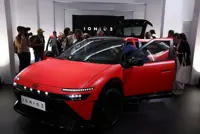
At the Paris car show this week, Chinese automakers will show off a wealth of new plug-in hybrid models, underscoring how entrenched they’re becoming in the European market.
BYD is showcasing the Dolphin G DM-i compact model catered to local city drivers. Stellantis NV’s Chinese partner Zhejiang Leapmotor Technology Co is unveiling its D19 range-extender that offers over 300km of electric-only driving.
Geely Automobile Holdings Ltd, Guangzhou Automobile Group Co’s Aion brand and Chery Automobile Co are also bringing new hybrids to France.
The models will have to vie for what’s poised to become a smaller market. Chinese hybrid sales in the EU will jump to an estimated 435,000 units this year, Jefferies analysts said last Sunday.
That’s well above the reported cap and based on roughly 290,000 sales through August. Many of the Chinese-made hybrids are larger SUVs that are among the more profitable models, said Li Yanwei, who advises the China Automobile Dealers Association.
A cap may weigh on companies’ profits, he added. “This will speed up Chinese carmakers’ localisation of manufacturing in Europe for sure”
Chinese brands have focused on hybrid cars in part because they were not affected when the EU slapped import tariffs on their EVs in 2024. Those duties have done little to stop China’s growth in Europe, prompting them to instead lay down manufacturing roots in the region.
Leapmotor is due to start shipping cars from a Stellantis factory in Spain this month, while BYD plans to start output at its new plant in Hungary. Local rivals including Volkswagen AG said they’re open to sharing underused factories.
The Chinese winners “will be the ones with the deepest operating footprint in Europe,” Jefferies analysts including Xiaoyi Lei said in their note, adding that manufacturing is just the first step. — Bloomberg