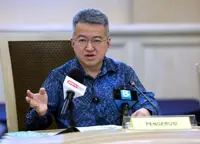
PETALING JAYA: Kuala Kepong Bhd (KLK) plunged into a significant loss in the third quarter (3Q26) ended June 30, 2026, for the financial year ending September (FY26), after it recognised a RM1.6bil non-cash impairment on its investment in overseas associate Synthomer plc.
The impairment, which KLK described as non-operational, was the main reason the group recorded a pre-tax loss of RM1.13bil for the quarter, compared with a pre-tax profit of RM525.4mil a year earlier.
Attributable net loss stood at RM1.34bil, against a net profit of RM346.6mil previously.
KLK stressed that excluding the impairment and its share of Synthomer's losses, the group would have posted an improved profit after tax and minority interest (PATAMI) of 43% to RM1.12bil from RM785.1mil.
“For 3Q26, the group’s loss after tax and minority interest stood at RM1.34bil compared to a PATAMI of RM346.6mil in the same quarter year-on-year.
“Excluding the one-off impairment of Synthomer and its share of losses, the group would have remained profitable, with a PATAMI of RM444.8mil compared to RM347.1mil same quarter year-on-year,” KLK explained in a filing to Bursa Malaysia.
It added that the impairment followed a prolonged decline in Synthomer's market value and slower-than-expected recovery in its earnings.
As at June 30, Synthomer's market value was RM190.1mil, significantly below KLK's carrying amount of RM1.811bil, prompting the group to reassess the recoverable value of the investment.
KLK said the adjustment was accounting in nature and would not affect its operating cash flow, liquidity, ability to service borrowings or dividend-paying capacity.
For the nine months to June, KLK recorded a pre-tax loss of RM121.9mil, compared with a profit of RM1.22bil previously. However, excluding the Synthomer impairment, it would have recorded a pre-tax profit of RM1.5bil, while revenue increased 6.6% to RM19.95bil.
The underlying performance was supported by stronger contributions from its plantation and manufacturing businesses.
Plantation profit rose 6.6% year-on-year to RM660.8mil in 3Q26, helped by firmer palm kernel prices, higher crude palm oil (CPO) and palm kernel sales volumes, as well as larger fair-value gains from derivatives and unharvested fresh fruit bunches.
These gains more than offset the softer realised CPO price of RM3,756 a tonne, compared with RM3,912 a tonne previously.
On a sequential basis, plantation profit surged 84.3% from RM358.5mil in 2Q26, with realised CPO and palm kernel prices improving to RM3,756 and RM3,488 a tonne respectively. Lower CPO production costs and favourable fair-value movements also supported the quarter.
For the nine-month period ended June, manufacturing swung to a pre-tax profit of RM100.2mil from a loss of RM64.6mil previously, while plantation profit was broadly stable at RM1.65bil. Property development, however, saw profit fall 37.1% to RM12.6mil on lower revenue.
KLK expects the operational momentum to continue, with CPO prices supported by supply and demand fundamentals including Indonesia's biodiesel programme, El Niño weather developments and geopolitical instability in the Middle East.
The plantation division is expected to remain strong on healthy production and favourable palm product prices, although operating costs are expected to stay elevated.
The group also expects improving conditions in oleochemicals to support manufacturing, particularly amid supply disruptions in the global petrochemical industry that have enhanced the competitiveness of palm-based products. However, its refinery and kernel-crushing operations are expected to remain challenging because of industry overcapacity and continued margin pressure.
KLK chief operating officer Lee Jia Zhang said: “To remove the overhang that distorts the group’s continued strong fundamental performance, it is important that we provide certainty and clarity to our stakeholders by the decisive move to impair Synthomer.”
“Our upstream demonstrated sustained strong yields attributable to focused and effective management practices while downstream has shown operational and commercial improvements across all operating regions.”