WASHINGTON: US Federal Reserve (Fed) officials have left interest rates unchanged and are split over whether they expect to raise rates this year.
Policymakers’ new projections indicated nine officials foresee at least one quarter-point hike this year, with six anticipating at least two. Another nine expected no move or a cut.
Notably, only 18 officials out of 19 entered their projections for rates at end-2026.
The absence of an entry suggests new chairman Kevin Warsh, who has been critical of so-called forward guidance, declined to submit a rate forecast.
In its first gathering under Warsh’s leadership, the Federal Open Market Committee voted unanimously on Wednesday to hold its benchmark federal funds rate in a range of 3.5% to 3.75%.
Treasuries sold off, the dollar rallied and stocks fell after the decision was announced.
The decision marked the fourth straight time officials held rates in place as they continue to shift their concerns from the labour market to inflation, driven in part by the impact of the Iran war on energy prices.
In their post-meeting statement, officials said inflation remained elevated and vowed to deliver price stability.
They continued to characterise growth as “solid”.
Officials also described productivity growth and capital investment as strong.
The statement was also shorter than recent post-meeting releases. Its brevity could be a sign of things to come under Warsh, who has promised to shake up the central bank’s communication strategy.
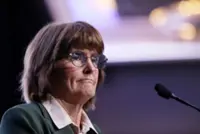
Warsh arrived at the Fed last month promising “regime change”.
In the opening remarks of his first press conference, he announced the creation of multiple task forces aimed at examining five areas with an eye toward proposing changes to the way the Fed operates.
The task forces will address communications, the balance sheet, the Fed’s “use and reliance on existing data sources,” productivity and jobs and the central bank’s “inflation frameworks”.
Responding to questions, Warsh ruled out re-examining the Fed’s 2% inflation target.
“I see no reason, until we have reestablished our commitment and ability to deliver on the 2% inflation objective, to revisit that,” he said.
Policymakers made several adjustments to the economic forecasts they issued in March, soon after the Middle East conflict began.
Policymakers’ median forecast for inflation this year jumped to 3.6% from 2.7%. Their forecast for 2026 core inflation –which excludes volatile food and energy categories – increased, as well, to 3.3% from 2.7%.
Officials lowered their median outlook for growth in 2026 to 2.2%, from the 2.4% they forecast in March. Their median unemployment forecast for the end of 2026 fell to 4.3% from 4.4%.
The economic backdrop for policymakers has shifted dramatically from the beginning of the year when fragility in the labour market and a more benign outlook for inflation made additional rate cuts in 2026 plausible to many Fed officials.
Since then, strong jobs data has suggested the labour market is pulling clear of a long period of weak hiring growth.
Job creation topped all forecasts in May and the unemployment rate held steady at 4.3%.
At the same time, an April report on prices showed the Fed’s preferred measure of inflation hit 3.8% from a year earlier, the largest increase since 2023.
Separate measures of consumer and producer prices also rose in May at the fastest pace in more than three years.
That’s driven not only by the Iran war but also by price pressures spilling over from the surge of investment by companies building out the infrastructure for artificial intelligence.
Still, news of a preliminary peace deal between the United States and Iran has sent oil prices tumbling.
If the agreement holds, that could take substantial pressure off of energy costs and inflation.
At the start of the year investors had been betting on a resumption of Fed rate cuts this year.
But heading into the June meeting, pricing in federal funds futures pointed to a quarter percentage point increase in rates by end-2026. — Bloomberg