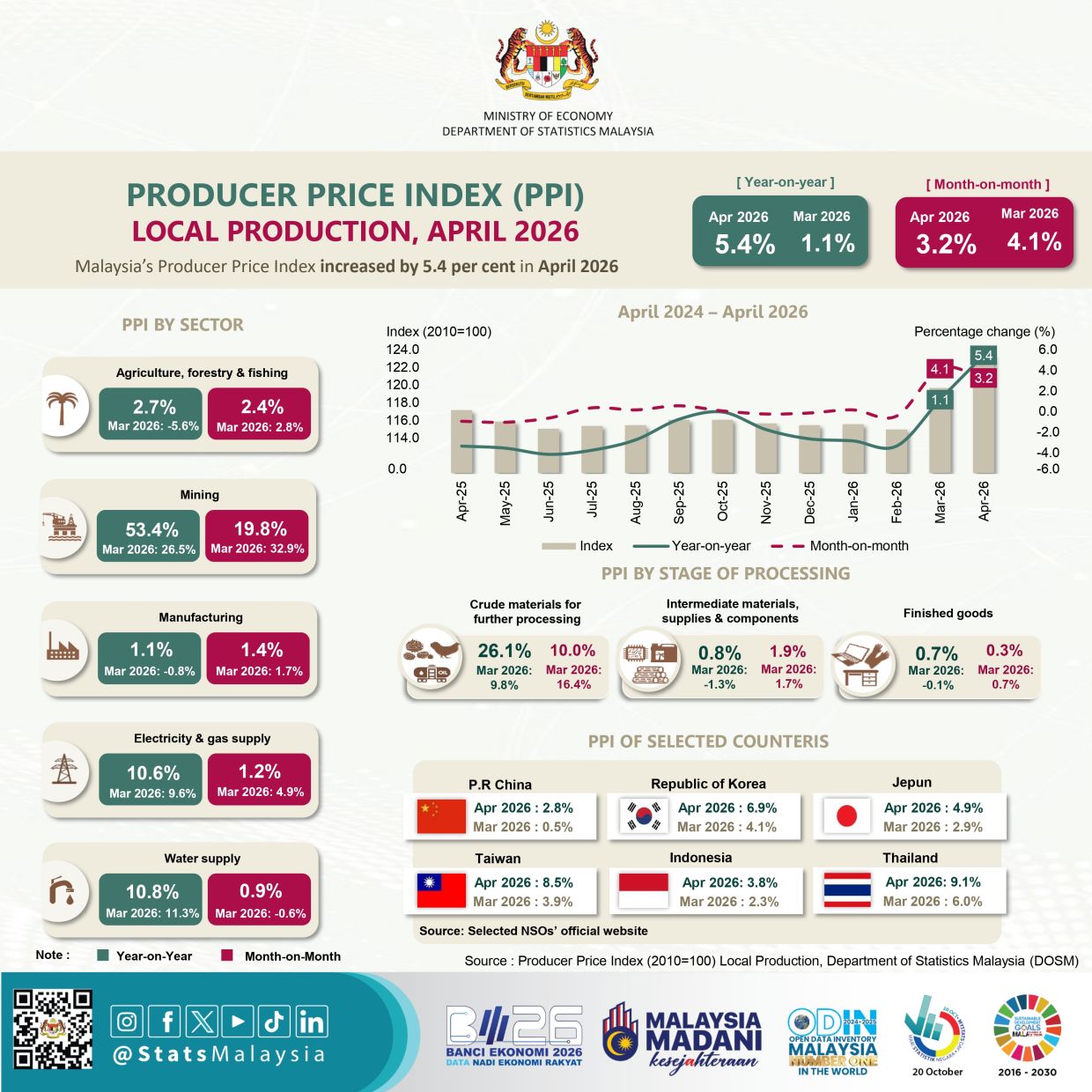
KUALA LUMPUR: Malaysia’s Producer Price Index (PPI) rises 5.4 per cent in April 2026 against 1.1 per cent in the previous month, the highest increase since August 2022, mainly driven by higher crude oil and petroleum-related product prices, said the Statistics Department (DOSM).
In a statement today, chief statistician Datuk Seri Dr Mohd Uzir Mahidin said all sectors recorded an increase during April 2026, with the mining sector registering a significant increase of 53.4 per cent, up from 26.5 per cent in March 2026, mainly driven by the extraction of crude petroleum index, which surged by 74.5 per cent.
In its PPI Local Production, April 2026, report, DOSM revealed that the agriculture, forestry and fishing sector rose by 2.7 per cent, rebounding from a 5.6 per cent decline in the previous month, supported by the fishing (17.5 per cent) and growing of perennial crops (1.4 per cent) indices.
The manufacturing sector also increased by 1.1 per cent, compared with a 0.8 per cent decline in March 2026, due to increases in the indices for the manufacture of computer, electronic and optical products (3.8 per cent) and the manufacture of coke and refined petroleum products (3.0 per cent).
"Meanwhile, the water supply and electricity and gas supply sector went up by 10.8 per cent and 10.6 per cent, respectively,” said Mohd Uzir.
On a month-on-month basis, the chief statistician said the PPI local production continues to increase by 3.2 per cent, following a 4.1 per cent increase in the previous month.
The mining sector recorded a double-digit increase of 19.8 per cent (March 2026: 32.9 per cent), supported by increases in both the extraction of crude petroleum (21.4 per cent) and the extraction of natural gas (12.0 per cent) indices.
The agriculture, forestry and fishing sector went up by 2.4 per cent (March 2026: 2.8 per cent), mainly due to the Growing of perennial crops (4.6 per cent) index.
The manufacturing sector also increased by 1.4 per cent (March 2026: 1.7 per cent), attributed to the manufacture of coke and refined petroleum products (4.9 per cent).
For the utility sectors, the electricity and gas supply and water supply indices rose by 1.2 per cent and 0.9 per cent, respectively.
By stage of processing, Mohd Uzir said the crude materials for further processing index increased by 26.1 per cent (March 2026: 9.8 per cent), supported by non-food materials (31.2 per cent).
At the same time, the intermediate materials, supplies and components index edged up by 0.8 per cent (March 2026: -1.3 per cent), mainly due to materials and components for construction (5.9 per cent).
"Meanwhile, the finished good index rose by 0.7 per cent (March 2026: -0.1 per cent) driven by the capital equipment (0.8 per cent),” he said.
On a month-on-month basis, all stages of processing recorded increases in April 2026, with the crude materials for further processing index increasing by 10.0 per cent.
Similarly, he said that intermediate materials, supplies and components and finished goods index rose by 1.9 per cent and 0.3 per cent in this month, respectively.
A comparison across selected economies indicated similar upward trends in the PPI in April 2026, mainly driven by higher global energy and commodity prices, supply chain disruptions and rising production costs.
In the United States, the PPI increased by 6.0 per cent, up from a 4.3 per cent rise in the previous month, supported by higher energy and manufacturing costs.
Japan recorded a 4.9 per cent increase, from 2.9 per cent in March 2026, largely attributed to rising import costs for fuel and raw materials.
Meanwhile, China registered a 2.8 per cent increase, up from 0.5 per cent in the previous month.
Thailand’s PPI rose sharply to 9.1 per cent, from a 6.0 per cent increase in the previous month, mainly driven by higher prices in the energy and food-related sectors. - Bernama