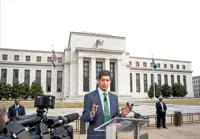
Emerging Asian equities steadied on Tuesday after U.S. President Donald Trump's pick of Kevin Warsh as Federal Reserve chair rattled markets a day earlier, while a long-awaited trade deal with the U.S. buoyed Indian shares.
Currency markets held ground while the dollar index was little changed at 97.50, after a two-day advance.
The MSCI index of emerging market currencies was up 0.5%, while MSCI's gauge of Asian emerging market equities advanced 2.3%.
A broader index of Asia-Pacific shares outside Japan touched its highest level since mid-October last year.
Emerging Asian equities had sold off sharply in the previous session, with South Korean and Indonesian benchmarks falling more than 5% as investors reassessed risk amid concerns over Warsh's monetary policy stance.
"Dip-buying in tech and export-linked stocks, alongside steadier global yields and improving regional sentiment, helped support the recovery from yesterday's sell-off," said Glenn Yin, director of research at ACCM.
South Korean stocks surged over 5%, led by gains in heavyweight chipmakers. Samsung Electronics rose 7.5%, while SK Hynix gained 8.7%.
Taiwanese equities followed suit, rising 1.8%, with the world's largest contract chipmaker TSMC up 2.6%.
Singapore shares rose to just shy of the 5,000 mark, advancing 1.1% to a record high, supported by bank stocks including DBS Group and Oversea-Chinese Banking Corp which were up 0.9% and 1.6% respectively.
"Investors are rotating into defensive, dividend-rich markets amid regional volatility. Strong bank earnings, a stabilising REIT sector and policy predictability continue to position Singapore as a preferred low-beta play in Asia," added Yin.
Meanwhile, India's equity benchmark rose 5% at the open, about 100 points shy of its January record high, and the rupee climbed 1.3%, after the Asian country finalised a trade deal with the U.S. that slashed tariffs to 18%, lifting expectations of renewed foreign inflows.
Indonesian stocks pared early losses to gain 1.1% after a tumultuous week, during which an MSCI warning over transparency concerns triggered an $80 billion rout and prompted the resignation of the country's top financial regulators.
MSCI said it would not comment on individual discussions, a day after meeting Indonesian officials to address market transparency concerns.
"We currently sense a wait-and-see approach among foreign investors," said Ari Jahja, Head of Indonesia Research at Macquarie Capital.
"Structural reforms, improved policy execution, and signs of macro uptick would be crucial to boost confidence," Jahja said.
The rupiah was largely unchanged.
HIGHLIGHTS:
** Australia's central bank raises rates for first time in two years
** Philippine lawmakers weigh impeachment for President Marcos
** Vietnam to impose temporary anti-dumping tariffs on colourless float glass from Indonesia, Malaysia - Reuters