
AS Malaysia navigates the aftermath of a potential miss in its targeted gross domestic product (GDP) growth for 2023, economists offer a mixed outlook on GDP for this year.
While some are optimistic, pointing to the strong recovery of private consumption and investment with government policies boosting economic activities, others recognise challenges like macroeconomic uncertainties that may hinder robust economic growth in 2024.
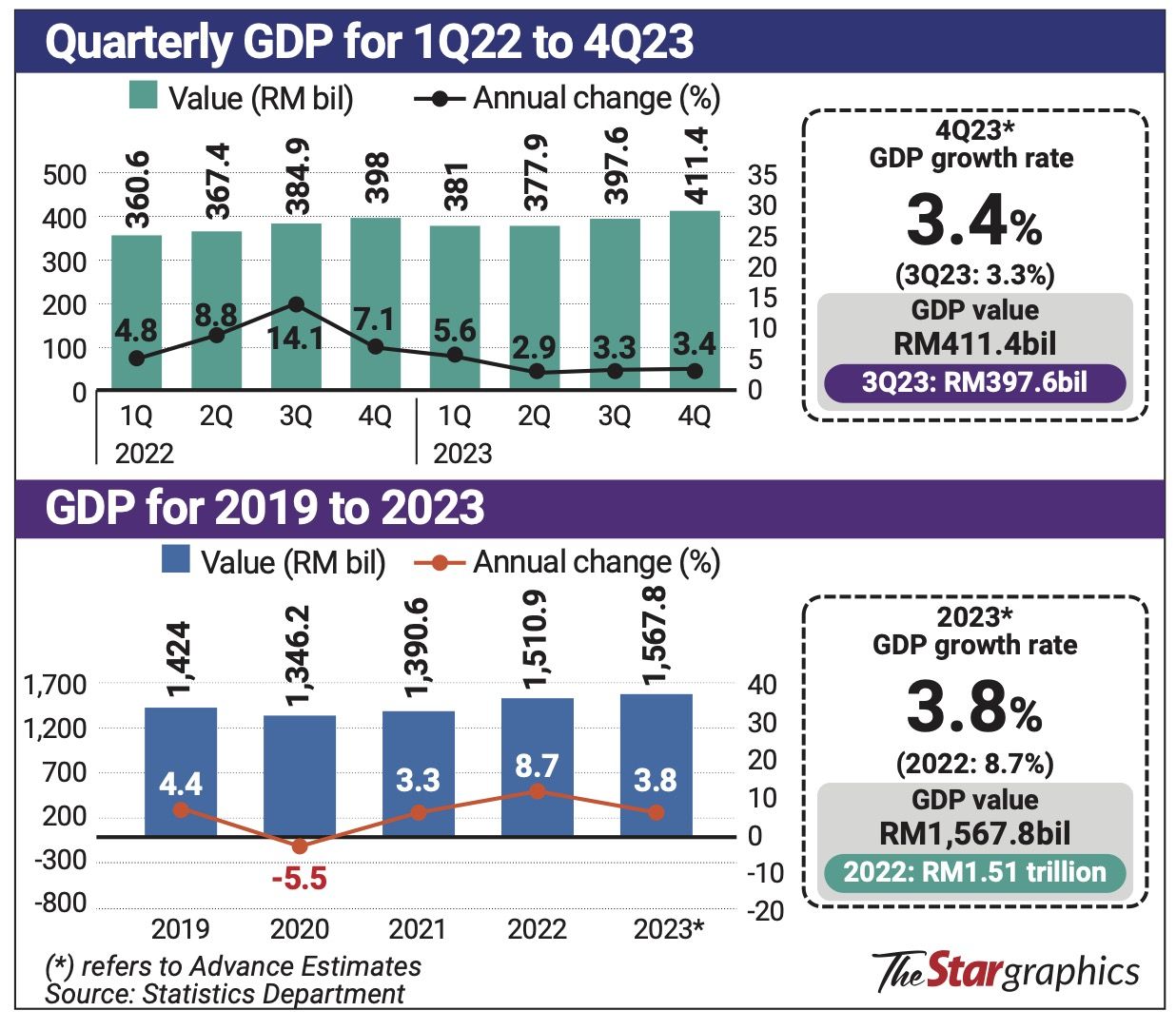
In light of the Statistics Department’s advanced GDP estimates released on Jan 19, the country’s GDP is projected to come in at 3.4% for the fourth quarter of 2023 (4Q23), culminating in a 3.8% growth for the entire year.
Notably, this performance falls short of the government’s initial 2023 GDP growth target of between 4% and 5%.
The government’s 2023 GDP growth forecast has since been revised down to around 4%.
For 2024, the government expects GDP to expand between 4% and 5%.
Malaysia University of Science and Technology economics professor Geoffrey Williams suggests that official forecasts were overly optimistic, relying on anticipated growth in external demand and a robust recovery from domestic demand, which did not meet expectations.
“The official forecast also anticipated that the economy would revert to trend growth rates seen in the past.
“However, we believe that the new underlying trend potential growth rate is lower than in the past due to the damage done by the Covid-19 lockdowns and bad policy decisions made during that period,” he explains to StarBizWeek.

UCSI University finance associate professor Liew Chee Yoong, on the other hand, attributes the deviation to macroeconomic uncertainties due to the war in Ukraine, as well as the crisis in the Middle East which reduces the global demand for exports including those from Malaysia.
Similarly, AmBank (M) Bhd chief economist Firdaos Rosli points out that lower net export growth and sluggish industrial production were major contributors to the lower GDP growth in 2023.
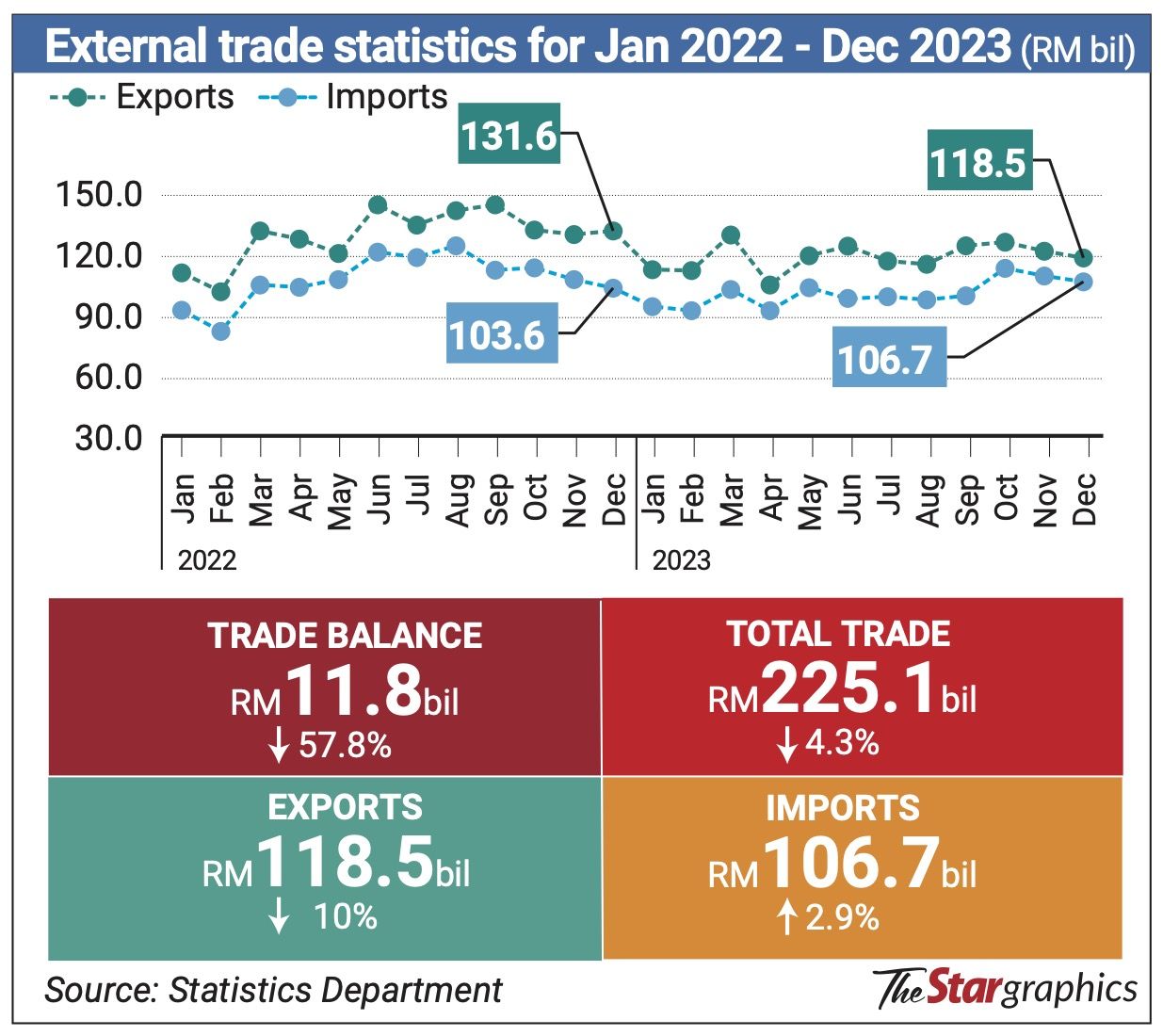
“Trade in goods was down 16.4% year-on-year, and considering that Malaysia is a net services importer, the external sector is the biggest culprit to the country’s growth in 2023,” he says.
Firdaos adds that on a quarterly basis, the industrial production index (IPI) has been on a downtrend since 4Q22, with two consecutive quarters of contraction in 2Q23 and 3Q23 at 0.3% and 0.05%, respectively.
“The IPI reading grew 0.96% in 4Q23 but was not strong enough to support growth in the year,” he notes.
Challenging prospects
Looking ahead, however, Firdaos expects a “rebound” in the country’s 2024 GDP to 4.5%, citing improvements in the external sector driven by the trade in goods, excluding any supply shocks.
He predicts that net exports should rebound to a 5.1% growth this year.
“Semiconductor shipments had bottomed out in February 2023 and a higher global semiconductor trade will support Malaysia’s trade in goods growth, and subsequently GDP in 2024,” he says.
As a result, Firdaos expresses confidence in Malaysia’s IPI, anticipating it to strengthen in the coming months, with the 4Q23 reading moving into positive territory after two quarters of contraction.
Furthermore, he outlines expectations for private consumption growth at 5.7% in 2024, as the ongoing review of the civil service pay scheme, set to be announced soon, is anticipated to bolster private consumption growth.
He believes that as Malaysia’s unemployment rate gradually returns to pre-pandemic levels, it ensures solid domestic demand this year.
“However, the planned subsidy rationalisation and sales and service tax (SST) revision may pressure inflation to inch up higher, and inevitably put a cap to private consumption growth prospects in 2024,” he says.
Williams, in contrast, says that achieving GDP growth within the 4% to 5% range in 2024 remains a challenging prospect.
He believes the driving factors are pretty much similar to last year, with domestic demand pushing growth, while slower external demand and geopolitical risks are always on the horizon.
“The difference for 2024 is that we have stable monetary policy with no changes in the overnight policy rate (OPR) expected. Inflation is slowing and will continue to slow down.
“Fiscal policy is more conservative and stable, so the overall domestic environment should be stable.
“This will make things better but GDP of between 4% and 5% is still challenging,” he notes.
Williams foresees GDP growth in 2024 to fall within the range of 3% to 4%, with a likelihood of around 3.5%.
Geopolitical tensions
Recognising geopolitical tensions around the world, Liew projects GDP growth in the country to grow in a range of between 1% and 3% in 2024.
In particular, he points to the escalating tensions between the United States and Iran which could see a rally in global oil prices.
Liew says the Iranian-backed Houthi militia’s continued attacks on international ships in the Red Sea raise concerns about the potential impact on global oil prices.
“With the death of American soldiers in Iraq recently as a result of the attack by Iranian-backed terrorists, there is a likelihood that the United States may launch air strikes against Iranian targets inside Iran.
“If this does occur, global oil prices may quadruple and this may increase global inflation risk which runs the risk of creating global stagflation,” he says.
This, in turn, is expected to impact Malaysia’s GDP growth significantly.
On a more positive note, Liew says the primary drivers for the expected improvement in the domestic economic performance in 2024 include a robust recovery in private consumption and investment.
He also expects government policies and measures aimed at stimulating economic activities and attracting foreign investments to play a crucial role.
When asked which sectors are expected to play a leading role in driving economic growth this year, Liew believes the manufacturing sector, particularly in the electrical and electronics segment, will thrive due to the global tech demand.
Furthermore, he anticipates that sectors such as palm oil, tourism and digital services will also reap the benefits of the global economic recovery following the Covid-19 pandemic and the ongoing worldwide trend of digital transformation.
Williams points to consistent growth sectors like oil and gas, palm oil, electronics, tourism, Islamic finance and the halal business to drive the economy this year.
Firdaos, expressing optimism, foresees positive developments in Malaysia’s tourism sector for 2024.
“The visa-free arrangement between Malaysia and China, and later between Singapore and China, will nudge more tourist arrivals from the world’s second-largest economy,” he notes.
However, he emphasises that success depends on the connectivity between Malaysia and China, particularly to China’s tier-two and tier-three cities, which should have at least returned to pre-pandemic levels.
Despite the cautious outlook from multilateral development banks, Firdaos remains hopeful about China’s growth prospects in 2024.
Moreover, he sees a favourable outlook for the construction sector this year, anticipating a growth of 6.8% supported by both ongoing multi-year projects and new planned initiatives.

Investment shifts
Shifting the focus to foreign direct investment (FDI), Firdaos highlights the common expectation that foreign funds will flow into emerging markets once there is a clear signal from major central banks, such as the US Federal Reserve, to cut their policy rates.
However, he notes that despite this expectation, it seems the US labour market is still holding strong.
“Thus, we believe that the central bank may not feel any immediate urgency to shift its monetary policy stance, and may instead delay it for as long as possible,” he notes.
With that being said, Firdaos expresses uncertainty about the extent of the expected rate cut, suggesting a likely 25-basis-point reduction per meeting if there is no clear danger to the US economy.
Additionally, he highlights the assumption that Malaysia would be a primary beneficiary of foreign funds flowing into emerging markets.
“But this may not necessarily be the case.
“There are other Asean economies that seem to be experiencing much stronger growth in the post-pandemic era,” he notes.
In any case, Firdaos believes that foreign government bond holdings will increase in the event of a US rate cut, and he projects the US dollar and ringgit pair to end the year at RM4.50.
Healthy numbers
Regarding approved manufacturing and services investments, he expects the numbers to remain healthy in 2024.
With the New Industrial Master Plan (NIMP 2030) announced last year, Firdaos anticipates increased promotional activities by the Malaysian Investment Development Authority or Mida and other relevant investment authorities to encourage more FDI into Malaysia.
“It all boils down to the time frame these approved investments turn into realised investments in the coming months and quarters.
“This outlook is contingent upon various factors and not from government approvals alone,” he adds.
Similarly, Williams notes a surge in FDI approvals, but highlights a gap in the commencement of these investments.
He attributes the spike in FDI to international engagements that garner attention and interest from potential investors, but doubts about this trend persisting into 2024.
Actual investments
“We need to look at actual investments and domestic investment to increase,” he adds.
Firdaos suggests the government further integrate the country’s major plans into policies, considering that investors may not fully understand how these plans would impact their existing and future investments in terms of the overall cost of doing business.
Furthermore, he believes it is too early to conclude whether these plans could strategically position Malaysia’s investment attractiveness higher than its peers.
While anticipating the continuation of FDI momentum in 2024, Liew expresses concerns about potential extreme volatility, owing to external conditions coupled with the competition for FDI investments from neighbouring countries.
He says this volatility may stem from the possible slowdown in global economic conditions, driven by the potential expansion of the crisis in the Middle East and economic policy uncertainties surrounding the United States’ election outcome.
However, Liew remains optimistic, pointing out that Malaysia’s strategic initiatives aimed at enhancing its investment climate could act as a mitigating factor and help sustain FDI inflow despite the challenging external factors.
Main drivers
When asked if 2024 will be driven by domestic demand once again, Liew affirms it.
He notes that 2024 is likely to be propelled by private spending and investment.
He believes this will be supported by government policies aimed at improving disposable income, employment rates and overall economic confidence.
“However, substantial headwinds exist which if materialises may have a huge negative influence on the GDP of the country,” he adds.
While Williams believes economic growth in 2024 will continue to be based on domestic factors and structural reforms, Firdaos says it may be influenced by a combination of both domestic and external demand, unlike the situation in 2023.
Bank Negara is set to release the 2023 fourth-quarter and full-year GDP figures on Feb 16, 2024.
Already a subscriber? Log in
Get 20% OFF The Star Digital Access
Cancel anytime. Ad-free. Unlimited access with perks.