
HIBISCUS Petroleum Bhd has come a long way since its listing more than a decade ago, surviving the 2014 oil price crash and breaking the scepticism that investors had on special-purpose acquisition companies (SPACs).
It was the first SPAC to be listed on Bursa Malaysia back in 2011, and it completed its qualifying acquisition (QA) in less than a year after listing.
A SPAC has no commercial operations, only set up by investors to raise capital through an initial public offering, which is then used to acquire one or more existing target companies.
Following Hibiscus, four more SPACs were listed, but all of them –except Reach Energy Bhd – were eventually liquidated for failing to make a QA.
Today, Hibiscus is the only profitable company that came from the SPAC path, and it has interests in several concessions in the United Kingdom and Australia, and several production-sharing contracts (PSCs) in Malaysia and Vietnam.
Its cash reserves have grown more than 18-fold since 2016 and currently stands at RM532mil.
Going forward, the oil and gas (O&G) exploration and production company aims to turbo-boost its production capacity by between 84% and 163% within the next four years.
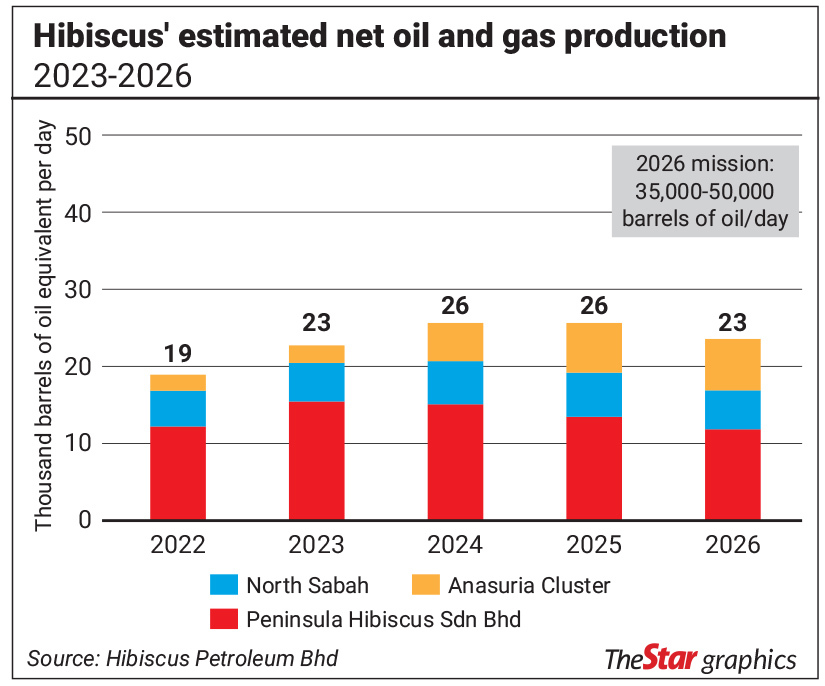
By 2026, Hibiscus targets to achieve 35,000 to 50,000 barrels of oil equivalent (boe) per day, as compared to just 19,000 boe last year.
In the Investor Day 2023 organised two weeks earlier, Hibiscus said its existing assets could achieve the 2026 production target without “aggressive acquisitions”.
The group is looking to spend about US$345mil (RM1.52bil) in capital expenditure (capex) by 2025, funded from the cashflow from operations, existing cash balance and the existing debt facility of US$149mil (RM657.5mil).
The US$345mil capex is expected to raise the production capacity to 26,000 boe per day by 2025, but this leaves a gap of about 10,000 boe a day to achieve the 2026 target.
Managing director Kenneth Gerard Pereira says that the gap could be fulfilled, depending on the development of Hibiscus’ Marigold asset, any future acquisition or the development of opportunities in its existing PSCs.
The Marigold cluster, located in the North Sea of the UK, contains the Sunflower, Crown and Kildrummy prospects, and is estimated to contain around 60 million boe.
Hibiscus’ subsidiary, Anasuria Hibiscus UK Ltd, and Ithaca Oil and Gas Ltd have developed a joint economic model to enable the development of the Marigold Area via a tieback to the Piper Bravo platform.
“It is planned that the joint economic models and overall development plan are updated and an agreement reached on the way forward by the end of March 2023,” according to Hibiscus.
Pereira says the group and Ithaca are still “trying to understand” the development concept for the Marigold cluster.
“Once we do that, we will look at how we structure the financing for it,” he says. Pereira also notes that South-East Asia is an “area of focus” for Hibiscus. In particular, the group looks at Vietnam as a key market for growth.
“We see Vietnam as a place with a lot of opportunities and untapped resources,” he adds.
It is noteworthy that Hibiscus entered the Vietnam market in 2022 following the completion of the acquisition of Spanish energy major Repsol Exploración, SA’s upstream assets in Malaysia and Vietnam for a cash consideration of US$212.5mil (RM937.7mil).
The acquisition, made via Hibiscus’s indirect wholly-owned subsidiary Peninsula Hibiscus Sdn Bhd, comprises five PSCs, one of which is in Vietnam.
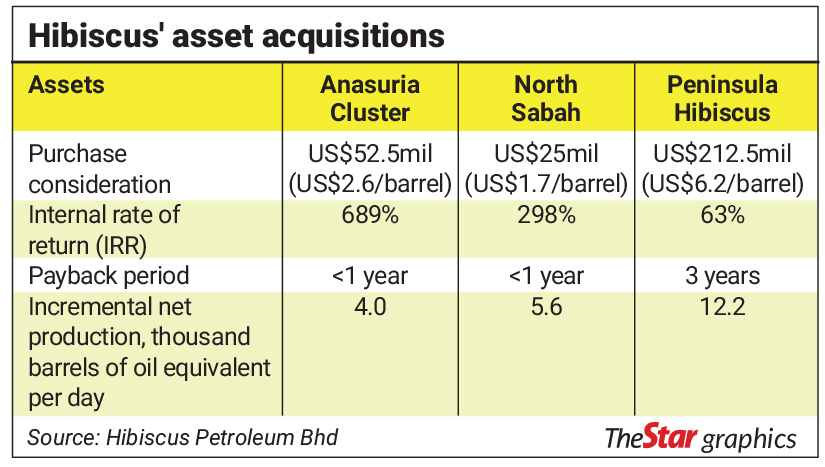
To date, Hibiscus has acquired three assets for a total price of US$290mil (RM1.28bil). These assets are the Anasuria Cluster; North Sabah’ and Peninsula Hibiscus, which is the largest production contributor for the group.
According to the group, these three assets have generated a normalised profit of tax of US$294mil (RM1.3bil) in total.
The Anasuria Cluster has an internal rate of return (IRR) of 689%, while the North Sabah and Peninsula Hibiscus assets also have strong IRRs of 298% and 63%, respectively.
Pereira says that the fluctuation in crude oil prices “does not really affect” the operations of these assets.
“We have a fixed expenditure for the year. We have certain programmes that we are doing. Our cost structure is in the range of US$30 (RM132) per barrel for some assets, US$25 (RM110) per barrel for some assets.
“In between the current unit cost per barrel and the current oil price, there is a resonable headroom. We will still continue with our programme. We are working hard to catch up on all our maintenance activities for Peninsula Hibiscus.
“For North Sabah, we have always been up-to-date,” according to him.
Nevertheless, Pereira acknowledges that crude oil prices are the “most impactful driver” for Hibiscus’ financial results.
It is generally expected that crude oil prices will moderate this year, after Brent grade crude oil averaged at US$101.32 per barrel in 2022.
This month, Petroliam Nasional Bhd (PETRONAS) president and group CEO Datuk Tengku Muhammad Taufik Tengku Aziz predicted that crude oil prices to hover in the US$70 to US$80 per barrel range over the next five years.
“But, this year, we would be at the lower bound of that (price range),” he said.
In a note, PublicInvest Research has voiced its confidence on Hibiscus’ growth strategy.
It also mentioned that Hibiscus’ production target for 2026 is realistic, based on its strong acquisition track record and healthy balance sheet for enhancing existing production to support both organic and inorganic growth.
Nevertheless, the research house maintained its “neutral” call on Hibiscus with a target price of RM1.18 per share.
“(This is because) we see elevated global recession risks currently weighing on sentiment of Brent crude oil price over the near term,” it said.
Regardless of market volatility, Hibiscus says it is working towards building a sustainable business that also extends into green energy options.
In the near-term, Pereira says that the group will be consolidating and integrating its Malaysian business units to complement its existing portfolio.
Hibiscus will also develop projects with a focus on increasing production in the UK and in Malaysia.
Meanwhile, in the medium term, Hibiscus aims to achieve proven and probable (2P) reserves of 10 million boe by 2026.
This is in addition to its 35,000 to 50,000 boe target.
As part of its medium term goals, the group is also working towards improving its environmental, social and governance (ESG) profile and to become a net zero emission producer by 2050.
Hibiscus is in the midst of transitioning into a more gas-weighted company and it is explore more gas opportunities within its PSCs and the region.
It pointed out that gas, as a transitional fuel, can replace coal and bridge the intermittency of variable renewable energy.
It is worth noting that the acquisition of Peninsula Hibiscus’ assets increased Hibiscus’s portfolio of gas assets to 35%.
In order to reduce its carbon footprint, Hibiscus is implementing decarbonisation initiatives within its existing assets.
This includes fuel switching to solar and mini wind turbine hybrids, as well as performing leak detection and repair works for the assets.
The primary focus will be on Peninsula Hibiscus’ assets as they emit 90% of Hibiscus’ total emissions.
In addition, Pereira says that the group will be undertaking high-impact low carbon investments.
Pereira points out that the group has evaluated over 40 business opportunities in the clean energy space, but adds that the opportunities were not attractive from a business perspective.
“But, these opportunities were not cash-generative in a strong way. We are a company driven by cashflow, so we can’t keep putting money in projects that take a long time to pay back.
“We need to recycle capital,” he says.
Hibiscus has been recognised for its ESG efforts over the years, with a 4-stars rating from FTSE Russell.
This has repeatedly placed the group in the top 25% by ESG ratings among public listed companies in the FBM EMAS Index.
Already a subscriber? Log in
Get 20% OFF The Star Digital Access
Cancel anytime. Ad-free. Unlimited access with perks.