
VERY often, investors and market observers lament about how Bursa Malaysia no longer enjoys the lustre it had decades ago.
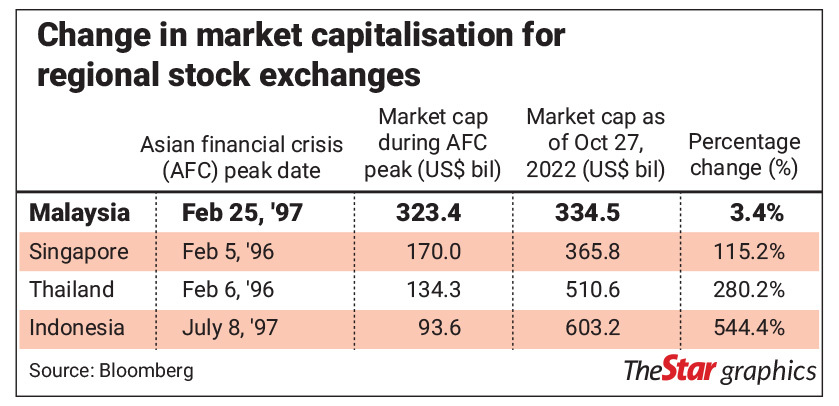
From what used to be Asia’s third largest bourse prior to the 1997 Asian Financial Crisis (AFC), the Malaysian stock market has now fallen behind regional peers, including Thailand and Indonesia.
There are many reasons why this has happened:
Lack of liquidity – very few mega initial public offerings (IPOs) and the inability to attract foreign companies to list here.
One may also argue that Bursa Malaysia is falling behind in terms of wealth creation, judging by the growth in total market capitalisation.
Post-AFC, Bloomberg data shows that the market capitalisation of stock exchanges in Singapore, Indonesia and Thailand have surged by leaps and bounds (see table), outshining Bursa Malaysia.For comparison, the market capitalisation of Thailand’s stock exchange is valued at US$603.2bil (RM2.8 trillion) as of Oct 27, a far cry from Bursa Malaysia’s US$334.5bil (RM1.6 trillion).
Maybank IBG Research points out that the historical average “20% price-to-earnings multiple” premium the Malaysian market used to command over regional peers is no longer obvious.
It says the local market’s gradual structural de-rating is attributable to a combination of factors, including sustained foreign selling as Bursa Malaysia’s weightage in benchmark global indices continues to decline.
In addition, there is an erosion of Malaysia’s historical policy and political stability premium, as well as an uncertain medium-long term growth outlook.
“Current improving sentiment towards the FBM KLCI as a defensive draw, underpinned by its aforementioned heavy ‘old economy’ financials and commodities weightings, has seen the performance gap vis-a-vis Asean peers narrow.
“However, without deeper structural economic reforms to facilitate new growth drivers, this narrowing is likely to be transient,” says Maybank IBG Research in an earlier note.
To be fair, it is not all doom and gloom for the Malaysian stock market.
Bursa Malaysia is undeniably one of the most well-regulated markets in Asia and it continues to be a diversified exchange with huge opportunities for investors.
It is also Asean’s second most active exchange in terms of new listings in the first nine months of 2022, even as the region’s IPO market plummeted in the same period.
According to Ernst & Young, there were 25 IPOs in Malaysia that raised US$700mil (RM3.3bil).
Indonesia, which was ranked first, had 45 IPOs raising US$1.5bil (RM7.1bil).
In comparison, there were only six IPOs in Singapore valued at US$33mil (RM155.8mil) cumulatively.
But, despite these new listings, one could not deny the fact that Bursa Malaysia is losing out to other foreign stock exchanges.
In the past several months, more Malaysia-based home-grown companies are choosing to list in foreign markets.
Grab, whose one of the earliest funders was Malaysia’s Cradle Fund, opted for Nasdaq over Bursa Malaysia.
Carsome, the country’s first unicorn, is also thinking of a dual listing on Nasdaq and Singapore Stock Exchange.
Another big Malaysian food and beverage company, according to sources, is also exploring the possibility of listing abroad.
Every time a high-potential and home-grown company decides to do its IPO abroad, it is a major lost opportunity for Malaysia.
To add salt into injury, while more Malaysian companies are going after foreign exchanges, Bursa Malaysia is unable to attract foreign companies to do their IPO here.
Bursa Malaysia did try to bring in a number of China-based companies to list in Malaysia, but many of them are now delisted – with a common issue being the failure to meet Bursa Malaysia’s directives and regulations.
In the last five years, the number of companies listed on Bursa Malaysia has not changed much.
As of end-2017, there were 921 companies on Main and ACE Markets combined. By September, the number only increased by 17 companies to 938.
For comparison, Bursa Malaysia used to have 1,027 listed companies back in 2006.
Not too late for Bursa
TradeView Capital chief executive officer Ng Zhu Hann says it is “not too late” for Bursa Malaysia to play catch-up with other regional stock exchanges.
“We need to start developing local champions, especially by leveraging on our competitive advantages.
“In sectors like plantation, semiconductor and oil and gas, where we have a strong presence, the government needs to encourage more companies to move up the value chain.
“For example, instead of just focusing on plantations and mills, companies must be encouraged to produce the by-products of the sector that carry higher value.
“Eventually, these companies can be listed on the local bourse and foreign investors will also be attracted to invest locally,” he says.
Ng acknowledges that Malaysia is falling behind Singapore, Thailand and Indonesia, particularly, in terms of the market capitalisation of the bourses.
Management-related entities
Comparing Singapore with Malaysia, he notes that the city-state enjoys a low tax regime, liberalised market regulations and most importantly, a strong capital base domestically.
“For example, Singapore has close to 1,000 fund management-related entities, including about 700 family offices.
“In contrast, Malaysia has only about 80 to 90 fund management-related entities. When you have fewer of such entities, naturally the domestic capital base will be lower and not much of the capital base will flow into the stock market,” he says.
As for Thailand and Indonesia, Ng says these countries have the advantage of a huge local population.
Both countries are also increasingly having investor-friendly policies, hence attracting foreign investments including into the capital market.
Looking ahead, Ng suggests the government come up with policies that attract private wealth to build the domestic capital base.
This includes the introduction of a favourable policy for the establishment of family offices.
A family office is a private wealth management advisory firm that focuses on managing the financial and investment needs of ultra-high-net-worth individuals.
“We need a structure under the law focusing on family offices. If we have that, perhaps someone affluent from Hong Kong may set up a family office in Malaysia and part of the private wealth would flow into the Malaysian stock market.
“The government also needs to loosen up rules related to fund management activities in Malaysia to further build our capital base,” he says.
Increased competition
Rakuten Trade head of equity sales Vincent Lau also concurs that Bursa Malaysia is facing increased competition from other regional stock exchanges.
In particular, he says that many investors prefer countries like Thailand, Vietnam and Indonesia due to the size of the local market.
For example, Indonesia had a population of over 270 million in 2021, as compared to Malaysia’s 32 million.
“We can’t fight on this (factor), but we should focus on other areas. For instance, we can have a more favourable tax regime for the investors to attract foreign companies.
“We can also reduce the cost of trading shares. At the moment, the cost of trading on Bursa Malaysia is one of the highest in the region,” he says.
Lau also points out that it is crucial for the relevant authorities to strengthen the level of retail investor participation on Bursa Malaysia.
“This will help boost our market liquidity and create more vibrant trading activities. This is important, especially considering that foreign funds have generally been net sellers on an annual basis,” he adds.
Already a subscriber? Log in
Get 20% OFF The Star Digital Access
Cancel anytime. Ad-free. Unlimited access with perks.