
BUDGET 2023, which was tabled last Friday, has now become almost a redundant document as it will need to be re-tabled when the first meeting of the first session of the 15th Parliamentary convenes.
The tabling of the budget too was full of drama as rumours were strong that the Parliament might be dissolved either on the day itself or the day before following the Prime Minister’s audience with the Yang di-Pertuan Agong Al-Sultan Abdullah Ri’ayatuddin Al-Mustafa Billah Shah.
However, as the dissolution of Parliament was effected on Monday, we will likely see the Election Commission fix the nomination and polling day soon, with the possible polling day for the 15th General Election (GE15) on Nov 12, and hopefully well before the start of the monsoon season.
Another record year
Budget 2023 was another record of a sort with a huge expansionary budget, after normalising the expenditure figures based on this year’s massive subsidy allocation. Budget 2023 also saw a jumbo development expenditure (DE) of RM95bil although if one were to look into greater detail, that figure itself is misleading as it includes the redemption of the US$3bil (RM13.2bil based on RM4.40 exchange rate) 1MDB bond that matures next year, and an estimated RM8.3bil for Public-Private Partnership (PPP)/Public Finance Incentives (PFI) commitments. Excluding those, the DE is at about RM73.5bil, which is higher by 4.7% from this year’s expected DE of RM70.2bil, after taking into consideration PPP/PFI commitments amounting to about RM1.6bil.
Hence, one of the reasons for the high DE for 2023 is due to the significant increase in PPP/PFI payments as well as the 1MDB US dollar debt and not necessarily an outsized DE as it is made out to be.
However, as our DE is funded via debt, we are in essence borrowing new monies to pay off old debts or commitments.
A case in point is the 1MDB debts as well as the PPP/PFI commitments, which were originally off-balance sheet debts or liabilities of the government and now sit as an expense item under the official budget.
On operating expenditure (OE), Budget 2023 sets a new record on a “normalised” basis. The overall OE of RM272.3bil for 2023 from RM284.7bil envisaged for this year, although down by RM12.4bil on a year-on-year (y-o-y) basis, is in fact an increase, as next year’s budget has lowered the subsidy allocation by RM16.9bil.
In addition, the Covid-19 fund expenditure is expected to drop to just RM5bil from RM28.8bil this year. Hence, taking adjusting for the two items, and comparing light with light, the OE is higher by more than 11% year-on-year (y-o-y. Interestingly, even the electricity subsidy of RM5.8bil this year was lumped into the Covid-19 fund, which was originally targeted at RM23bil.
Investing for the future?
Annual budgets presented by the government should showcase the government’s effort to lift the standard of living via investments for the future.
For example, the budget has highlighted key DE which includes RM16.5bil on infrastructure, and 1,700 projects worth RM13.7bil.
However, allocation to the health ministry and education ministry, which totalled some RM106.8bil, sees only RM14.1bil as DE (RM9.5bil for education ministry and RM4.6bil for healthcare), while RM92.7bil is OE, with a massive RM61.2bil for education and RM31.5bil for healthcare.
As a percentage of allocation, the health ministry’s DE allocation is barely 12.8% of the total allocation for the ministry and only 6.3% of the total actual adjusted DE of RM73.5bil. For the education ministry, the DE is some 13.4% of the ministry’s total allocation and this represents about 12.9% of the adjusted DE.
For the health ministry, within the DE allocation, some 55% is related to service and supplies while only RM2.1bil (inclusive of RM113mil defined under OE) is for the acquisition of assets.
Hence, despite the pandemic situation and clogged hospitals or clinics, we are not seeing significant investment in the future in terms of infrastructure.
But the icing on the cake goes to the Ministry of Finance (MoF) with a total allocation of RM67.2bil, of which some RM42.7bil are OE and RM24.6bil are related to DE. A significant 2.5 times increase was seen in the DE as this is likely related to the US$3bil (RM13.2bil) 1MDB debt due next year as well as other capital injection that is lumped together under this allocation. An interesting expenditure under the MoF is an allocation of RM37bil (2022: RM10.6bil) under other OE for the treasury, with RM28.7bil (2022: RM5.3bil) related to subsidies and cash transfers.
Lack of revenue strategy
As Budget 2023 was the final budget before GE15, one can say that it would have been a political suicide, well at least in Malaysia and perhaps in other countries too, for the sitting government to take drastic measures to raise revenue via the introduction of new taxes or higher tax rates and widen the low tax revenue base. As can be seen from Figure 1, Malaysia’s tax revenue as a percentage of gross domestic product (GDP) has been on a downtrend for a longest time and very few efforts are made to address the shortcomings.
Having said that, we do know that the government does intend to introduce the Fiscal Responsibility Act (FRA) as well as the Medium-Term Revenue Strategy (MTRS) to improve tax collections.
Hence, what is needed is the political will to do, and to do that the Finance Minister needs to be bold and brave while the government itself needs to explain its reason to introduce new taxes, widening the narrow tax base as well as addressing Malaysia’s generous tax reliefs, which excludes the majority of working population from taxes.
As it is, Malaysia has time and again resorted to Petroliam Nasional Bhd (PETRONAS) to the rescue as the nation is constrained by limited fiscal space as evident this year when the national oil corporation stepped up and increased its dividend payout to the government to RM50bil, doubling the earlier estimated dividend.

Taken together, petroleum-related revenue for this year itself surged 80% to RM77.8bil, mainly due to the higher crude oil prices, representing 27.3% of the government’s revenue. For next year, with the crude oil price estimated at US$90/barrel, the government foresees revenue falling to RM58.9bil or 21.6% of the total revenue, inclusive of RM35bil dividend from PETRONAS. Malaysia needs to move away from being dependent on the national oil corporation to support the government’s finances as it is not only unsustainable but oil and gas revenue are also seen to be less compliant with the sustainable agenda that the government champions.
Subsidies – Time to Move On
Despite the government recognising that the rich enjoy most of the subsidies and has been championing targeted subsidies, the government was rather silent on the matter in this budget, which perhaps reflects the government’s concern about its impact especially now that the Parliament has been dissolved and GE15 is just around the corner. As for fuel, we should be taxing fuel and not just pricing it at market price or worse subsidies. A RM1 tax per litre, assuming RON95 at RM4.80 to RM5 per litre (which is what other South-East Asian nations are pricing) will go a long way to curb wastage, encourage public transport and collect at least RM20bil to RM25bil in indirect taxes. The government can then easily provide about RM8bil to RM10bil for targeted groups that require subsidies via direct cash transfers.
It Is All Piling Up – In Debts
One day before the Budget 2023 was tabled the auditor-general himself alluded that borrowing almost RM100bil a year is not sustainable and in the budget itself, we see the government will again borrow close to RM100bil. Hence, between 2021 and 2023, the government is borrowing close to RM300bil and this will see our total debts ballooning to RM1.178 trillion or 64.9% of nominal GDP from 63.0% this year, while statutory debt rising to 62.3% in 2023 from 60.2% this year. The lower ratio is also due to the higher denominator as nominal GDP is expected to grow by 10.8% this year and 6% next year.
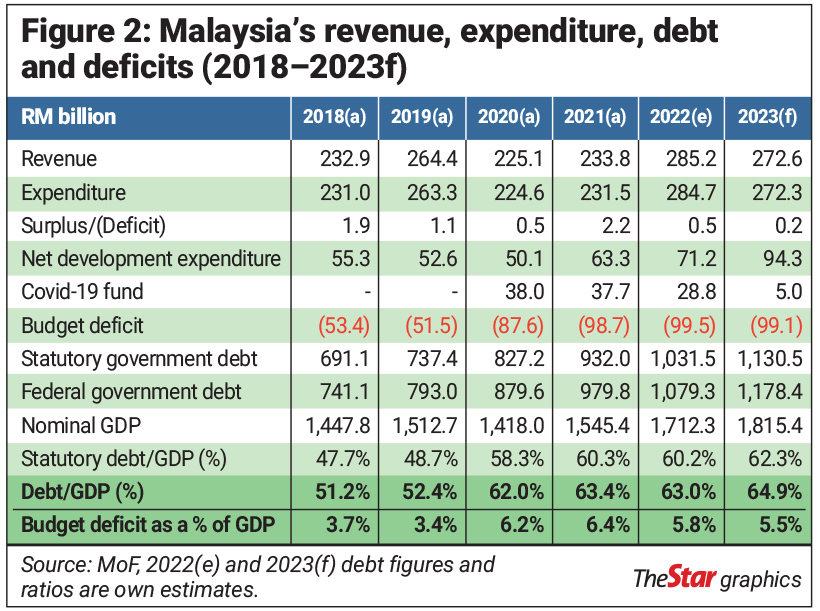
As seen in Figure 2, other than direct federal government debts, the government also carries the burden of debts that were previously assumed off-balance sheet, and this include based on what has been reported committed guarantees of almost RM200bil, the balance of 1MDB debt of almost RM26bil and liabilities defined under PPP/PFI of RM149.6bil. Taken together, the total government debt this year will increase to RM1.455 trillion, or 85% of nominal GDP, and rise to RM1.541 trillion next year, or 84.9% of 2023 nominal GDP.
To address our debt problem, it is a simple equation of either boosting our revenue (via higher or new taxes) and cutting down on OE via leakages so we not only achieve a balanced budget but a surplus budget. While this may not be achievable in the immediate future but at least it should be what the government intends to achieve in time to come with a cleverly structured medium-term plan over the next few years. Without new taxes or higher tax rates introduced in this budget, the government is simply kicking the can down the road and delaying the inevitable to a later date and time. Although the budget deficit is expected to be lower at 5.5% in 2023, it is only due to growth in the denominator as the budget deficit for next year remains largely unchanged from this year in absolute terms. Without a proper strategy to increase government revenue and lower OE, the fiscal deficit target of 3.5% by 2025 will be tough to meet as it will require the government to take drastic actions, post-GE15.
The higher debt level also means higher debt service charges and for 2023, this is expected to increase to RM46.1bil or 16.9% of revenue, well above the acceptable international standard of 15%. With government debts expected to continue to increase, the government needs to raise revenue stream via new taxes, higher tax rates, and not necessarily the much-talked-about Goods and Service Tax (GST), which is seen as a regressive tax and hurts the lower-income group even more.
A Bullish GDP Growth Forecast
For 2022 the 6.5% to 7% growth is given and is in line with the median consensus estimate of a 6.5% growth as the 3Q22 GDP growth is expected to be strong, rising perhaps at 9%to 10% even but for the 4Q this year, growth will likely slow down considerably when we compare on a y-o-y basis. For 2023, the growth forecast of 4% to 5% is decent but perhaps on the upper end given the slowing global economy, persistently high inflation, and rising interest rate environment. Perhaps a more palatable growth estimate for 2023 would be 3% to 4%, at best, given the economic headwinds ahead as well as whether we will achieve political stability post-GE15. Hence, the projected growth of 5% from the services sector as well as 6.3% growth in private consumption is rather optimistic.
What next?
As the budget will be re-tabled post GE15, there is a strong likelihood that it will be the same budget as what was presented by the Minister last Friday. Having said that, there is also a possibility that some of the budget proposals may be amended. However, should there be a change in government, there are strong indications that the Budget 2023 proposals may be altered significantly, depending on the winning party/coalition’s stance on the government’s finances, the well-being of the people, and revenue and expenditure strategies. For now, the Budget 2023 that was presented on Oct 7 remains on record as the budget for next year.
Pankaj is a long time entrepreneur. The views expressed here are the writer’s own.
Already a subscriber? Log in
Get 20% OFF The Star Digital Access
Cancel anytime. Ad-free. Unlimited access with perks.