

AS global markets remain volatile and investors are uncomfortable in investing in traditional asset classes like equities or fixed income, investors are seen to be looking at alternative options to not only protect real returns but to ensure capital values are preserved.
While alternative investments like cryptocurrencies remain opaque and unregulated, and other options such as private equity or hedge funds likely out of bounds to the ordinary investor, what are the other investment options available to an investor that he/she does not lose sleep over it?
Rising rates a boon for depositors
As we are aware, with the higher overnight policy rate (OPR) by 75 basis points (bps) so far this year, local ringgit-term deposits too have seen a similar uptick in deposit rate with the 12-month fixed-deposit (FD) rate as high as 2.7% for certain choice banks from below 2% early this year.
Having said that, as Bank Negara is likely to raise the OPR again by another 25 bps in its November meeting to 2.75%, it is also likely that we will see one-year FD rates rise to 2.95%.
That’s not the end of domestic rate hikes and if one were to believe that OPR will be raised by another 25 bps to 50 bps next year, the corresponding 12-month FD rate will also increase to 3.20%-3.45%.
For depositors, the higher nominal rate provides some comfort as they will be able to enjoy a better return on their capital at a time when markets are volatile and uncertain.
However, with year-to-date headline inflation running at 3.1% up to August 2022, depositors are still not getting positive real returns and are seeing the real purchasing value of their cash hoard deteriorating.
Even if 12-month FD rates are expected to increase, that will likely be on a premise of an elevated inflation print, making real returns still stuck in negative territory.
Alternative option – foreign currency deposits
With negative real returns, investors perhaps may want to consider it as a means of diversifying away from not only ringgit-based assets but to get a pick up in yield, as many central banks have been in a tightening mode to the extent that foreign currency deposits (FCD) into some of these currencies looks much more appealing than ringgit deposits.
As seen in the table, FCD has been gaining popularity among Malaysians as a percentage of total deposits have increased from a mere RM20bil and representing less than 3% of total system deposit back in 2007 to RM213.7bil as at end of August 2022, representing 9.3% of total banking sector deposits.
With the recent 50 bps hike in its official cash rate to 3.50%, the Reserve Bank of New Zealand (RBNZ) is the most aggressive among major central banks and has raised its benchmark rate by a massive 325 bps.
This is followed by the US Federal Reserve and Bank of Canada, which have raised their benchmark rates by 300 bps so far, while the Reserve Bank of Australia (RBA) and the Philippine central bank have raised by 250 bps and 225 bps, respectively.
The Bank of England (BoE), Bank of Korea and Reserve Bank of India are hot on the heels too, with rate hikes of 215 bps, 200 bps and 190 bps, respectively.
Of course, choosing the right currency is also another factor to consider as typically an individual investor venturing into FCD needs to weigh the currency risk associated with a high-yielding FCD.
This is similar to investing in a particular stock for a dividend but the capital loss may end up larger than the dividend yield, resulting in a negative total return.
Hence, how does one view the best FCD to invest in? From the perspective of a ringgit investor, for the best potential total returns, one would likely choose a currency that has weakened against the ringgit and provides a pick-up in yield. Why so?
Although the ringgit has dropped by more than 11% year-to-date and is trading at levels not seen since the 1998 Asian Financial Crisis, other currencies have declined even more than the ringgit when measured against the US dollar.
The dollar itself is trading at a 20-year high and although it may continue to strengthen, the risk-reward against a potential capital loss in the form of realised foreign transaction loss is much higher at maturity of an FCD in dollar, especially for a 12-month FCD.
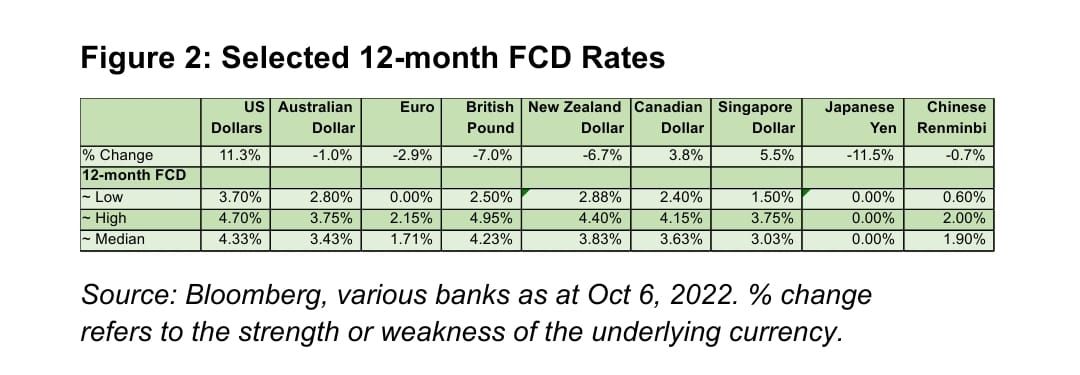
With the BoE expected to pursue an aggressive monetary policy following the drastic drop in the local currency as well as to fend off the elevated inflation prints, the pound is seen recouping the losses it has suffered against the greenback.
The accompanying table summarises the current 12-month FCD taking the average selected local and foreign banks in some key currencies.
FCD in pound sterling looks attractive
As the pound has fallen significantly more against the dollar as well as the ringgit, and with a 12-month FCD rate at a high of 4.95% offered by one of the leading banks, investment in the pound sounds logical for now.
Although the pound may weaken a little bit more, given that the BoE is expected to raise benchmark rates by at least another 75 bps only in November and 50 bps in December, the pound has likely seen its major bottom.
The second and third choices based on the above table would be the New Zealand and the Australian dollar, which has also weakened against the ringgit so far this year while both currencies provide a decent 12-month FCD rate of up to 4.40% and 3.75% respectively.
The RBNZ and RBA are still on a rate hike path, with both central banks expected to raise rates by 50 bps and 25 bps each respectively in their next meeting in November, having raised their cash rates by the same quantum earlier this week.
Yen – simply too cheap to ignore
With the currency down by 11.5% against the ringgit and trading near its 24-year low of 145 to the dollar, the yen too looks attractive on pure currency play as the yen does not provide any income for the time being due to Bank of Japan’s short-term rate policy of minus 0.1%.
However, given the sharp depreciation of the yen, the currency provides a potential capital gain in ringgit terms. As the yield on the currency is zero, investors could just keep the hard currency under the pillow and sleep on it!
Pankaj C. Kumar is a long-time investment analyst. The views expressed here are the writer’s own.
Already a subscriber? Log in
Get 20% OFF The Star Digital Access
Cancel anytime. Ad-free. Unlimited access with perks.