



ARK Inc., a Japan-based aquaculture technology company, will formalise a strategic partnership with the National Institutes of Biotechnology Malaysia (NIBM), a research institution under Malaysia’s Ministry of Science, Technology and Innovation (MOSTI).
The Memorandum of Understanding (MoU) will establish a framework for collaboration in land-based aquaculture research and technology development, fisheries-sector talent development, and business expansion across the Asia-Pacific (APAC) region, beginning in Malaysia.
The official MoU exchange ceremony was held on November 28, 2026, at the Hyper Interdisciplinary Conference (HIC) Malaysia 2026, organized by Leave a Nest Malaysia at Universiti Teknologi MARA (UiTM), Puncak Alam. Representatives from MOSTI will be present.
Guided by its founding concept, “LET THE OCEAN REST, CREATE YOUR OWN,” ARK aims to make land-based aquaculture accessible anywhere, helping create alternative pathways for sustainable seafood production, reduce pressure on marine ecosystems, and contribute to global food security.
As part of its regional expansion, ARK’s Malaysian subsidiary, ARK Asia Pacific Sdn. Bhd. (ARK APAC), has established an R&D base at the Agro-Biotechnology Institute Malaysia (ABI), an institute under NIBM, and commenced local operations.
Growing global demand for seafood is intensifying the need for aquaculture technologies that use resources efficiently and support resilient food supply chains. The partnership combines NIBM’s biotechnology research capabilities with ARK’s experience developing and commercializing modular recirculating aquaculture systems (RAS).
In line with Malaysia’s National Biotechnology Policy, NIBM supports research, innovation and commercialization in agricultural, industrial and healthcare biotechnology through three research institutes: ABI, the Institute of Pharmaceuticals and Nutraceuticals Malaysia (IPHARM), and the Malaysia Genome and Vaccine Institute (MGVI).
By combining Japanese aquaculture technology with Malaysia’s biotechnology expertise and research ecosystem, the partners aim to develop solutions tailored to local conditions and relevant to markets across the region. The collaboration is also intended to strengthen Malaysia’s capabilities in advanced aquaculture, enable international knowledge and technology transfer, and open opportunities for researchers, businesses and local communities.
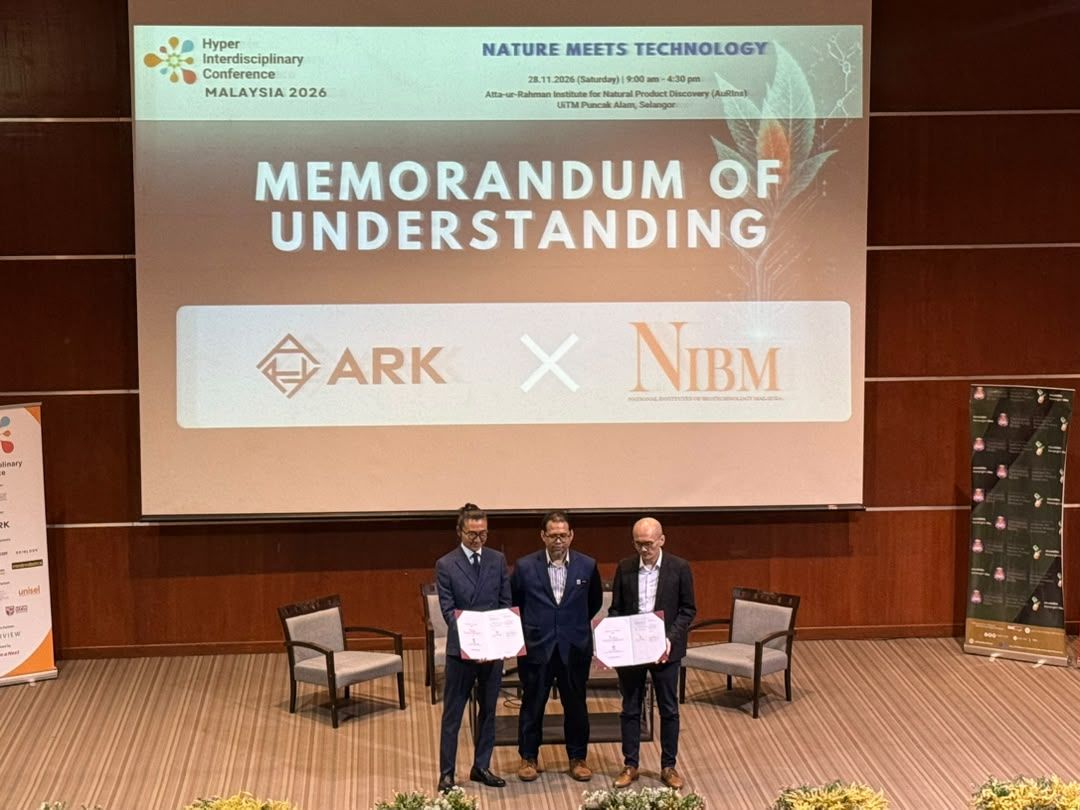
Key areas of cooperation - The MoU outlines four areas of collaboration:
* Research and technology development: Joint R&D to optimize RAS and integrate biotechnology-based approaches that improve productivity, resource efficiency and environmental sustainability.
* Talent development and knowledge transfer: Exchange of technical knowledge and expertise, alongside capacity-building initiatives for researchers, industry professionals and communities in fisheries and aquaculture.
* Business development and commercialization: Support for bringing research outcomes to market and expanding land-based aquaculture technologies and businesses across APAC, with Malaysia as a strategic base.
* Further collaboration: Exploration of additional opportunities that draw on both organizations’ capabilities to address emerging challenges in aquaculture and biotechnology.
ARK APAC’s dedicated R&D facility at ABI is equipped with RAS for grouper cultivation and equipment to support fish-feed research and development. The facility will provide a platform for technology validation, system optimization, and collaborative research under local environmental and operational conditions.
The initiative is intended to go beyond introducing Japanese technology to Malaysia. It creates an opportunity to co-develop solutions by combining Japanese engineering expertise with Malaysian biotechnology research, scientific talent, and industry knowledge.
Through its collaboration with NIBM, ARK APAC aims to build an integrated research and innovation ecosystem, connecting scientific discovery with practical industry applications and commercialization. The company plans to develop further partnerships with Malaysian research institutions, universities, industry players, and government stakeholders.
By positioning Malaysia as its regional research and business development hub, ARK hopes to develop scalable approaches to shared APAC challenges—including food security and sustainable seafood production—while supporting a stronger aquaculture ecosystem through talent development, knowledge transfer, commercialization, and new business opportunities.

