MIDDLE EAST (Bloomberg/Reuters): Iran targeted Bahrain for the second time in three days, the first spate of direct attacks on the Persian Gulf state in weeks, even as it reiterated that a path to ending its conflict with the US remains open.
The Islamic Revolutionary Guard Corps said Sunday it launched six drones at the radar of a US air defense site at the Riffa base in Bahrain. It described it as a response to the "blatant aggression of the US military.” The IRGC reported a "successful impact,” while Bahrain said its air defenses intercepted several Iranian aerial attacks and destroyed the projectiles.
US forces shot down two drones launched by Iran toward Bahrain on Friday, the American military said. The attacks on Bahrain were the first since early September, when Iranian drones also sought to hit a US base in the United Arab Emirates.
Tensions remain high over Iranian shipping attacks in the Strait of Hormuz, even as US President Donald Trump indicated he was considering holding off on attacking the Islamic Republic in the absence of new provocations, Reuters reported.
Iranian Parliament Speaker Mohammad Bagher Ghalibaf said the path to ending the conflict, now in its ninth month, is open if the US meets Tehran’s "logical conditions,” according to the semi-official Fars news agency.
Ghalibaf, a senior negotiator in talks with the US, added Iran won’t remain in a state of "neither war nor peace” and warned its armed forces would "determine the geography of battle” if Washington resumes strikes.
While Trump has indicated he sees no immediate return to mass attacks, he has kept that option on the table. The USS Theodore Roosevelt aircraft carrier strike group is due to arrive in the region imminently and join two other carriers in the Middle East, the New York Times reported Sunday, citing an unnamed US military official.
Before this year’s operations against Iran, the last time the US had three carrier strike groups in the Middle East was in 2003, when they supported the early phase of the invasion of Iraq.
An Axios reporter later said the strike group had arrived in the region.
The US has for weeks been planning to deploy the additional aircraft carrier and 10,000 sailors and Marines to the Persian Gulf, bolstering Trump’s hand after the midterm elections if he decides to resume military strikes.
Still, the heavy defeat of Trump’s Republican party underscored how unpopular the Iran war is among Americans, adding to pressure on the president to avoid escalation and seek a diplomatic resolution.
Oil fell slightly on Monday, as traders balanced the fresh attacks in the Middle East against signs of a well-supplied market, with tankers continuing to go through the Strait of Hormuz despite Iranian attacks.
Brent was down 0.5% to $95.30 a barrel, having fallen from above $115 shortly before the midterms.
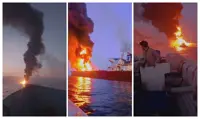
Iranian media reported that at least four oil tankers traveling through the Strait of Hormuz had struck naval mines since Sunday. One vessel was described as a supertanker carrying more than 2 million barrels of crude oil.
While Iran usually claims ships have hit sea mines, groups that monitor attacks - including the British-navy affiliated UKMTO - have attributed most strikes to projectiles.
UKMTO said Indian shipping authorities had reported an attack on a tanker in the Persian Gulf and the crew was safe, although the extent of the damage was unknown.
Iranian Foreign Minister Abbas Araghchi arrived in Islamabad late on Sunday for a meeting of the Economic Cooperation Organization, a Eurasian political and economic grouping. It’s unclear if he’ll discuss the war with leaders from Pakistan, which is a key mediator between the US and Iran.
He reiterated that Iran could fully open up the Strait of Hormuz within two days if the US accepted its conditions. Tehran has previously said the US must end a naval blockade as one of those conditions.
Separately, a spokesman for Iran’s foreign ministry ruled out curbs on nuclear enrichment as a route to reaching a deal with the US. "We are not at that stage at all, and we have not had, and do not, have any discussions regarding nuclear details,” Esmail Baghaei said during a televised press conference.
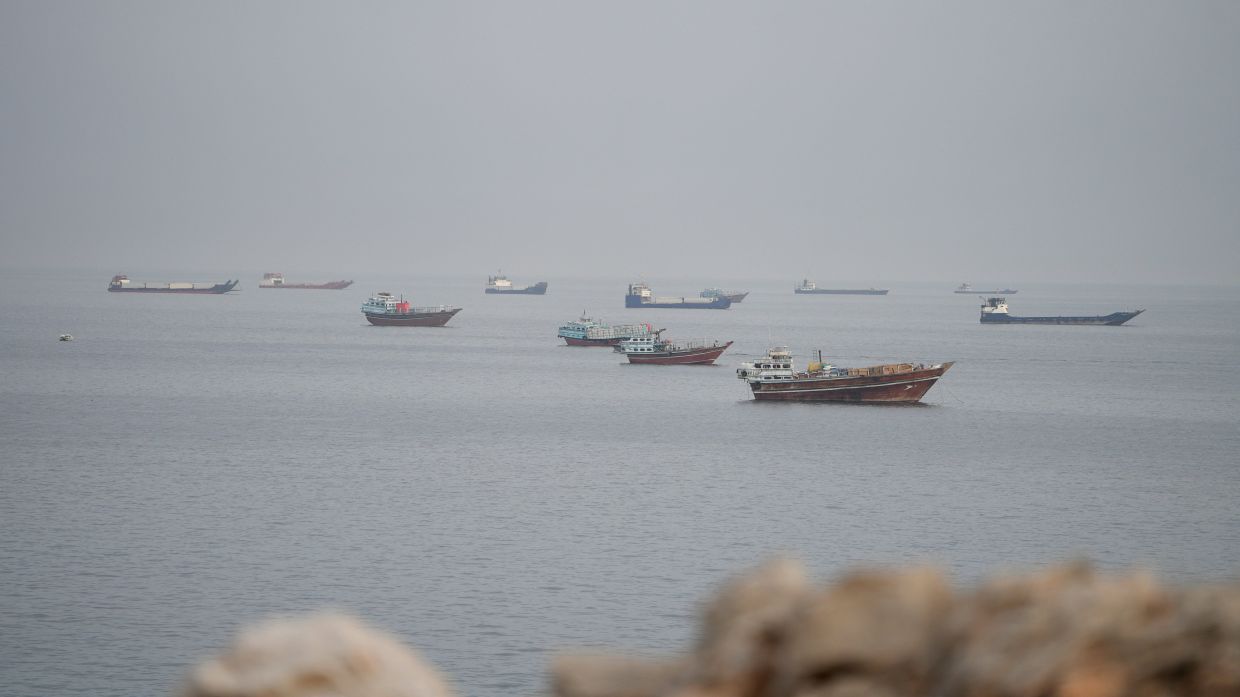
Meanwhile, Reuters reported on Monday that oil prices steadied as signs of recovering oil flows through the Strait of Hormuz reinforced expectations of surplus supply, though fresh tanker incidents underscored risks to Middle East exports.
Brent crude futures fell 52 cents, or 0.5%, to $95.32 a barrel by 1114 GMT. US West Texas Intermediate (WTI) crude dropped 27 cents, or 0.3%, to $88.29.
The global oil market will return to a surplus in the fourth quarter of this year, the International Energy Agency said on Friday, as Middle East exports recover faster than global oil demand despite continued attacks on shipping.
"For the first time since the US-Iran conflict began, traders are actively contemplating the possibility of excess supply rather than persistent tightness," said KCM Trade's chief market analyst, Tim Waterer.
Oil supply will average 105 million barrels per day (bpd) in the fourth quarter, 1.7 million bpd higher than forecast demand, the IEA said. The agency had previously forecast a fourth-quarter supply deficit.
The IEA also gave more details of remaining volumes from a record release of oil reserves pledged by its members in March, saying 71 million barrels would be made available by the end of February, including 15 million barrels of diesel to ease market tightness.
About 15 million bpd of crude oil moved through the Strait of Hormuz in 2025, IEA data shows.
Middle East supply and oil demand have adapted remarkably well to heightened shipping risks and higher prices, Goldman Sachs said in a note on Sunday. Goldman said it expects Brent to average $88 a barrel in 2027 and ease to $78 by the end of 2027 because of a return to surplus supply.
Signs of lower demand in China, the world's second-largest oil consumer, also pressured prices. The latest data from the country's National Bureau of Statistics on Monday showed refinery throughput for October fell 2% from a month earlier and was down 8.1% from a year ago.
The drop in throughput, along with an increase in domestic output and overseas imports, indicated a build in Chinese crude inventories of 492,000 bpd last month, according to Reuters calculations based on government data.
Iran's Revolutionary Guards said on Monday that two oil tankers struck mines in the Strait of Hormuz leading to explosions. Six tankers caught fire in similar incidents on Sunday and Monday, the Revolutionary Guards' statement added. Reuters could not independently verify the report.
The recovery of oil export flows from producer group OPEC+ remains fragile as regional supply remains vulnerable to fresh disruptions, BMI analysts said in a client note.
"As such, physical constraints on production and exports, alongside fluctuations in the geopolitical risk premium, will continue to dominate price action until a settlement is reached between Washington and Tehran." -- Bloomberg/Reuters