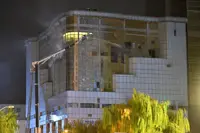
BEIJING: The world's first 4,000-metre-class airborne wind power generation system has successfully completed a test flight in Yueyang, Hunan province, marking a step towards the commercial application of high-altitude wind energy.
The launch marked the system's first trial in an urban setting, demonstrating its potential to harness wind power and supply electricity to densely populated areas to meet growing energy demands.
Measuring 67 metres long, 40 metres wide and 23 metres high, the system has a maximum ascent altitude of 4,000 metres. It delivers an output voltage ranging from 10 to 35 kilovolts and has a designed service life of 20 years, according to its developer, Beijing SAWES TO ONE Technology.
Named the Stratosphere Airborne Wind Energy System, it uses a helium-filled airborne platform to carry lightweight power generation modules several kilometres into the sky. It harnesses steady high-altitude winds to generate electricity continuously, with the power transmitted back to the ground through tether cables.
"The urban test flight assesses whether the system can operate safely and reliably when flown near residents and crowds. Cities are core power consumption areas, and ultimately, we aim to deploy this power supply system in more densely populated regions," said Dun Tianrui, the company's founder and chief executive officer.
The Yueyang launch involved multidimensional verification tests, including assessments of attitude stability control under complex airflow conditions and performance in complex magnetic field environments.
High-altitude wind energy, an untapped frontier in renewable energy that has yet to be developed on a large scale, offers advantages such as higher wind speeds, steady wind directions and high wind energy density. It also occupies no land space and can reduce grid construction costs for ultra-high-voltage transmission channels for renewable energy, Dun said.
The 15th Five-Year Plan (2026-30) for renewable energy development outlines research into efficient and reliable wind power generation equipment technologies. It aims to achieve breakthroughs in manufacturing technologies for key equipment, including highly reliable, low-cost blades, ultra-high towers and innovative floating foundations, while exploring high-altitude wind power and other emerging wind energy technologies.
"Instead of merely serving unmanned zones and other power supply scenarios, the system is designed for direct integration into the main power grid in cities," Dun said.
With its self-power generation capacity and ease of deployment, the system can also supply clean electricity to areas with limited power access and high electricity costs, including remote mountainous regions, islands, mining areas and industrial parks.
The company will continue to upgrade and improve the system's performance to tap wind energy resources at higher altitudes, Dun said.
Cai Rong, a researcher at the Aerospace Information Research Institute of the Chinese Academy of Sciences, told China Central Television News that the urban test flight was primarily aimed at verifying the reliability of the complete airborne system.
It also assessed the feasibility and integrity of engineering delivery under real-world operating conditions around cities, as well as the system's capacity for rapid on-site deployment.
The test provided a strong impetus for the transition of high-altitude wind power equipment from technical validation towards industrial application, he said.
The system also attracted widespread admiration from foreign guests attending the third China-Africa Energy Cooperation Project Promotion Conference in Yueyang earlier this month.
"This city can use technology and AI to produce cheap electricity and energy for the people here. As an African country, we trust the Chinese enterprises, so they are welcome to come to our country," said Abubaker Bensaud, a representative of the Libyan embassy in China.