



PALEMBANG (The Straits Times/ANN): When I walked out of the arrival hall at Sultan Mahmud Badaruddin II international airport, the first thing that struck me was not the acrid smell, but the faces I saw.
Drivers as well as the friends and relatives waiting for those who had landed were chatting, scrolling their phones or waving to the newly arrived.
Only about half of those in the waiting crowd wore masks, even though it was not any other evening, but a day in which the air quality had been flagged as dangerous.
I had arrived in Palembang with my photographer colleague Dimas Ardian on the night of Oct 14. We were on an assignment to find out how residents of South Sumatra’s capital city were coping with the haze.
We were heading to our hotel from the airport in a car, when a fire engine overtook us, with its siren wailing.
None of the teenagers looked up when the fire engine screamed past just a few metres away.
These teenagers and the unmasked crowd at the airport show how ordinary the haze has become to many Indonesians, and this is worrying. To me, these are not signs of resilience, but of the normalisation of the haze.
I don’t blame them. When a danger arrives every year, it stops feeling like danger. It becomes weather. Also, it feels hot to wear a mask, which costs money and can fog up your glasses.
The city of Palembang is not unfamiliar to me.
My mother and my older sister were born here, and as a boy I came here every Hari Raya to visit my grandparents and a great-grandmother who lived past 100.
Palembang residents talk about years in which the haze was bad, the way families elsewhere talk about floods. Palembang’s worst recorded episodes of haze were in 1997, 2015 and 2019.
This year’s haze season is likely one for locals to remember too.
Residents and firefighters told me that the morning of Oct 15, my very first in Palembang on this trip, was the haziest since 2015. That morning, the pollution level was the highest so far of the fire season, which runs from July to October.
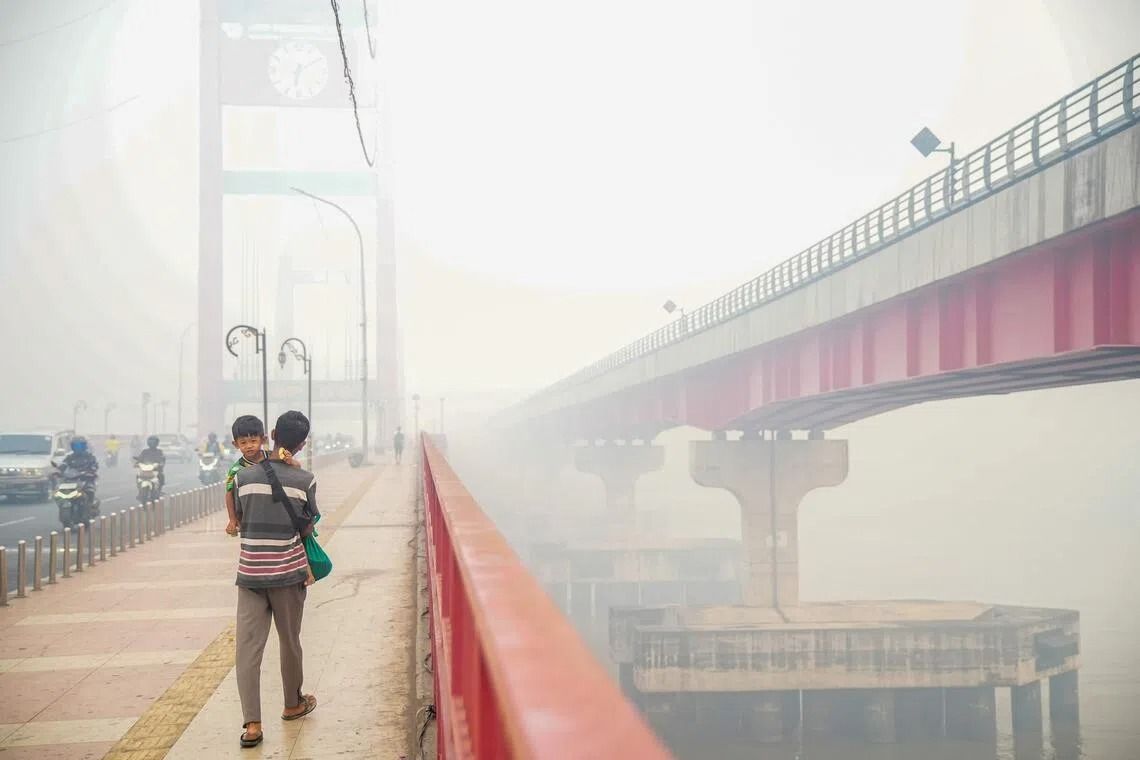
At 2am on Oct 15, fine particulate matter (PM2.5) reached 1,134.5 micrograms per cubic metre, according to the Meteorology, Climatology and Geophysics Agency (BMKG), about five times what the US scale classifies as hazardous. At 6am that day, the PM2.5 reading went down to 816 micrograms per cubic metre - still three times what the US scale considers hazardous.
Visibility in parts of the city fell to about 50m, made worse by the morning mist. Flights between Singapore and Palembang were cancelled. Our car fell in behind the fire engine as it swung through residential areas, past palm-oil smallholdings and stretches of scrubland, towards a column of smoke rising from the peat.
The fire engine passed an open-air futsal court, where more than 10 teenagers in mismatched jerseys were chasing a ball across cracked concrete, shouting and laughing. None wore a mask.
Yet the streets looked normal, with motorcyclists crawling through the grey in the morning rush, workers queuing for coffee, food sellers manning their stalls, a few men smoking cigarettes by the roadside.
The clearest sign that something is wrong is the absence of children. Schools in Palembang have shut their gates and moved lessons online.
After weeks of grey skies, the effort of staying alarmed can feel heavier than the air itself. The people paid to stay alarmed are the firefighters, and they do not have the luxury of getting used to it.
Palembang-based firefighter Rake Sandi, 39, has two children, aged 11 and eight. The older one asks him what the fires are like and whether his job is dangerous.
“I tell him honestly, ‘Yes, it’s dangerous’”, he said.
Then he explains that the work is about helping people, that he and his colleagues are trained and know what they are doing, and that, God willing, they will go home safely.
At night in Palembang, the city’s lights dissolved into a dirty orange glow. People were out, as they always were, eating, shopping and riding home. Most did not wear a mask.
I kept thinking about the firefighter’s son. In a city where adults have learnt to breathe the haze without comment, an 11 year old is asking the right question: Is this dangerous?
The answer, as his father tells him, is “Yes”. The danger is that Palembang has stopped asking. -- The Straits Times/Asia News Network

