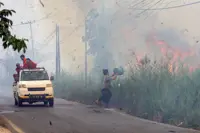
JAKARTA: Smoke from forest and land fires in Kalimantan has been detected in the atmosphere above Jakarta, though it has not yet reached ground level, the Meteorology, Climatology and Geophysics Agency (BMKG) said on Friday, as firefighting efforts struggle to contain blazes across the country.
Satellite imagery from Himawari-9 captured at 8am showed smoke spreading across parts of Banten, Jakarta and West Java. The smoke was detected at an altitude of around two to three kilometres above the ground, according to the BMKG.
Alpon Sepriando, head of the agency’s satellite imagery analysis team, said differing wind patterns across atmospheric layers could carry smoke from Kalimantan towards Java.
Winds in the lower atmosphere blew from the east and south-east toward the west and north-west, while winds in the middle and upper atmosphere moved from the north-east toward the south-west.
“The smoke has reached Jakarta, but it remains high in the atmosphere and has yet to reach the ground. If wind speeds weaken, however, it could descend to the surface as a thin layer,” Alpon said.
However, satellite detection alone does not show whether smoke from the fires has increased ground-level pollution or how much it might contribute to Jakarta’s air quality.
The European Union’s Copernicus Atmosphere Monitoring Service (CAMS) said its forecast data since the beginning of October indicated that most smoke from fires in Kalimantan, Papua and Riau had been carried north and west towards the Malay Peninsula and the South China Sea, rather than towards Java.
“It is possible that some traces of the smoke will have reached Java, but due to the higher population density around Jakarta, there are other sources of atmospheric pollution there,” the service said.
The BMKG said further monitoring was needed, including surface measurements of fine particulate matter (PM2.5), as the capital’s pollution also comes from vehicle exhausts, industrial activity, and open burning.
IQAir rated Jakarta’s air quality unhealthy on Friday afternoon, with an Air Quality Index (AQI) of 152. The concentration of PM2.5, the fine particles that can penetrate deep into the lungs, was reported at 11.4 times the World Health Organization’s annual guideline.
Several areas in neighbouring Banten also recorded unhealthy readings, with AQI levels ranging from 151 to 184. It remains unclear how much the fires contributed to these readings.
Rista Virgianto, a climatology expert at the Meteorology, Climatology and Geophysics College (STMKG), said some hotspots on Java could also be linked to agricultural burning during the harvest season.
“Java seems like it has its own hot spots, which I suspect could be coming from farming activities. It is currently harvest season, and many farmers still prefer burning to manage leftover straw,” he said.
Jakarta Governor Pramono Anung said the city had put 31 hospitals and 44 community health centres (Puskesmas) on standby amid concerns about worsening air quality, though he did not directly attribute the pollution to the forest fires.
The fires have continued for a fourth month, with their effects extending beyond Indonesia’s borders.
Independent forest monitoring organisation Nusantara Atlas estimated that 1.47 million hectares had burned nationwide this year as of September, roughly the size of Timor-Leste.
The National Disaster Mitigation Agency (BNPB) said 663.61 hectares across six priority provinces remained under active firefighting as of Oct 13.
The BMKG detected 1,297 high-confidence hotspots nationwide on Oct 14, including 505 in Sumatra, 346 in Kalimantan and 330 across Papua and Maluku.
A prolonged dry spell has been intensified by a strong El Niño and a positive Indian Ocean Dipole, both of which suppress rainfall and raise fire risk.
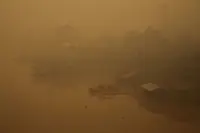
In Palangka Raya, the capital of Central Kalimantan, the AQI has reportedly soared to 1,023 as thick smoke blankets the city and turns the sky a deep yellowish-orange.
More than 7,200 residents have sought treatment for acute respiratory infections since midyear, according to local health data.
Meanwhile, fires have spread across Merauke, Mappi, and Boven Digoel regencies in South Papua, where remote locations have complicated firefighting efforts.
On Oct 15, the BMKG detected 573 hotspots across the province, including 309 classified as high-confidence detections. Mappi accounted for 232 of those hotspots. - Jakarta Post/Ann