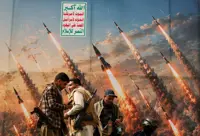
CAIRO (AP): Saudi Arabia on Sunday kept its main international airport closed and moved Riyadh schools online as Yemen's Houthi rebels threatened new strikes across the kingdom, a day after a missile attack killed 12 people and wounded more than 300.
Saturday’s strike on King Khalid International Airport in Riyadh marked a major escalation in the war between Yemen’s Iran-backed Houthis and the kingdom and further complicated sputtering efforts to halt the U.S.-Iran war.
US President Donald Trump said he was considering whether to join Saudi strikes against the rebels, a scenario that could prompt the Houthis to halt shipping through a crucial waterway and further restrict the flow of oil out of the Persian Gulf.
Later Sunday, the Houthi-run health ministry reported that a child was killed and six people wounded in a suspected Saudi airstrike on a house in the Yemeni capital, Sanaa. There was no immediate comment from Saudi authorities.
The ministry says 91 Yemenis have been killed and 168 injured by the Saudi-led coalition in five weeks. It said that 60% of those killed were women and children.
The kingdom said Sunday that schools in the capital would hold classes online until the end of the week. Meanwhile, authorities extended an ongoing airport closure until at least 9 p.m. Sunday, according to Flightradar24.
While the Houthis did not immediately claim responsibility for Saturday's attack, they have acknowledged targeting Saudi airports and oil installations in the past.
Brig. Gen. Yahya Saree, the group's military spokesperson, warned "all airlines, experts, employees, workers and travellers against using Saudi airports and airspace, as they are vulnerable to attack and have become a theatre of operations for our forces." He wrote on X that airports in the holy cities of Mecca and Medina were exempt.
The latest attack on the Saudi airport drew condemnations from Arab countries, including Iraq, Lebanon and Syria, as well as U.N. Secretary-General Antonio Guterres and European Commission President Ursula von der Leyen.
"Attacks by Iran’s proxies are pushing the region into a spiral of violence," von der Leyen wrote Sunday on X. "They are destabilising crucial global transport and energy nodes."
The attack struck an airport complex housing terminals 3 and 4 for domestic flights, a regional official said, speaking on condition of anonymity because they weren’t authorised to speak to the media.
A Saudi statement said the dead included four Saudi citizens, two Bangladeshi nationals, a Palestinian, a U.S. citizen, an Egyptian, a Jordanian, a Syrian and a Sudanese. It said several hospitals were treating the injured.
The Egyptian woman was a flight attendant identified as Azza Ramzy, 28, who worked for the Saudi airline Flynas, according to the Egyptian state-run TV.
The Syrian woman was a widowed mother of four who had been living in Saudi Arabia for five years, a relative told The Associated Press. The Syrian Embassy in Riyadh identified her as Buthaina Ahmad Oweida.
Her niece, Nisreen Oweida, said her aunt was 56 years old, from Syria’s northern Idlib province, and had left during the country’s civil war. She was living in Mecca and had been returning from a visit to her sister in Riyadh when she was killed in the attack on the airport, her niece said.
The attack is expected to increase Saudi pressure on allies, including the United States, to provide military support for the kingdom.
Shortly after the attack, Trump said he was evaluating whether the U.S. should join Saudi strikes against the rebels. "We’re going to look at it,” he said. "We just found out about the recent attack. So we’ll make a decision. We move very quickly.”
Trump said later Saturday he planned to speak with Crown Prince Mohammed bin Salman. Asked if the U.S. might get involved, Trump responded, "We’ll find out.”
A U.S. attack would deepen American involvement in an unpopular regional war that has threatened Trump's Republican party in upcoming American midterm elections. Both Trump and Iran insist the American election calendar does not affect their decisions on how to end the seven-month-old conflict.
The Houthis claimed attacks earlier in the week on King Khalid International Airport that killed three Saudis, including a pilot. The airport has no military facilities.
The surge in attacks, including against other Saudi airports, military facilities and oil infrastructure, has come in the week since a Saudi-led coalition launched a major military offensive against the Houthis.
The latest fighting between Saudi Arabia and the Houthis comes as negotiations between Iran and the U.S. aimed at ending their war appear to be at a standstill.
Until recently, the Houthis had been largely on the sidelines of the Iran war. Now, the rebels are helping Iran to pressure a key U.S. ally. Houthi attacks, along with their control of the Bab el-Mandeb waterway, also threaten to add new disruptions to the flow of oil from the region.
The Saudis and the Houthis began fighting in 2015, when the kingdom entered Yemen’s civil war on behalf of the internationally recognised government.
Relative calm after a 2022 ceasefire ended in July, when the Houthis resumed attacks, saying the Saudis fired on the Sanaa airport as a plane from Iran was trying to land. That revived anger over the Saudi-led blockade that has largely isolated Houthi-run areas.
Now fighting has escalated, with the Saudi-led coalition providing air support for Yemeni government forces attempting to reverse recent Houthi gains along the Red Sea. Those gains gave the rebels better surveillance of shipping through the Bab el-Mandeb, a corridor that is a crucial alternative to the Strait of Hormuz, where Iran has been attacking ships.
Saudi Arabia is running low on missile interceptors and has asked France, Britain, Pakistan and Egypt to deploy air defence support to the region, regional officials told The Associated Press last month, with one noting that the U.S. has seen its own stock dwindle during the war with Iran.
But Ahmed Nagi, the International Crisis Group's senior analyst for Yemen, said the Houthi pressure tactics could backfire. "Rather than pushing Riyadh to step back, attacks on critical Saudi infrastructure could make the Saudis more determined to continue the campaign,” he said. -- AP