NEW DELHI (Bloomberg): Police in India’s capital cracked down on protests against a contentious review of voter rolls, detaining youth leaders and locking down central New Delhi with thousands of security personnel.
Authorities entered an aircraft after it landed in New Delhi from Mumbai and took Cockroach Janta Party founder Abhijeet Dipke and spokespersons Saurav Das and Ashutosh Ranka into custody. The party’s legal head, Ratna Singh, was also detained. The CJP alleged thousands of its supporters have been held to prevent them from joining the demonstration.
"You can see where the nation is heading,” Dipke said in a video recorded as police officers crowded the plane’s aisle.
The protest was called to demand the resignation of Chief Election Commissioner Gyanesh Kumar over his handling of the voter-roll revision launched last year to remove dead, duplicate and ineligible voters. More than 130 million names have been dropped from draft rolls with critics saying eligible voters have also been excluded, potentially affecting election outcomes.
Sweeping restrictions were imposed across the capital, with authorities deploying thousands of police on the streets and asking telecom operators to suspend internet services near the protest site for about 24 hours starting Friday night. As many as 60,000 police and paramilitary personnel were put on standby for deployment, Bloomberg News reported Friday, citing a person familiar with the matter. The Home Affairs Ministry didn’t respond to an email seeking comment on the internet suspension.
Delhi Police told reporters Friday that any CJP gathering would be considered illegal and "proper legal action will be taken against” those who violated the restrictions.
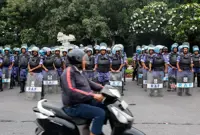
Instead of protest chants, central Delhi, home to key government ministries and Jantar Mantar, a designated site for demonstrations, echoed with prerecorded police warnings against unlawful gatherings. Roads leading to the venue were barricaded, while security personnel heavily outnumbered demonstrators. Those who gathered were taken away in buses to temporary detention centers across the city.
Water cannons, tear-gas launchers and anti-riot vehicles were kept on standby, while railway services were severely restricted. Forty-five Metro stations, closed since Friday for security reasons, will remain shut until 10 p.m. Saturday. Liquor stores across the city were ordered shut to maintain public order.
Opposition leaders and analysts described the security measures as unprecedented and said they raised further questions over the voter roll controversy.
"A government confident in the fairness of its elections would welcome questions about them, whereas one that turns its capital into a fortress to avoid them only deepens the very suspicions it seeks to suppress,” Shashi Tharoor, a lawmaker from the opposition Indian National Congress, said on X.
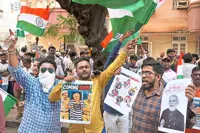
Still, the scale of the security operation did not deter everyone. Small groups of protesters continued to appear on the streets and raise slogans. Manisha Bisht, a 19-year-old student who traveled from north Delhi, said she walked for two hours from Red Fort in Old Delhi, nearest operating metro station from the protest site, only to find the streets largely empty. She said she would do it again. "People are still coming,” she said. "This is our fight, if we don’t stand up, who will?”
The crackdown has extended to opposition figures and activists. Those detained Saturday include Mamata Banerjee, an opposition leader from West Bengal state; Brinda Karat and K.K. Shailaja, leaders of the Communist Party of India (Marxist); Dhruv Rathee, a social media commentator with 19 million Instagram followers; Tushar Gandhi, a great-grandson of Mahatma Gandhi; and student activist Neha Bora. Several lawyers demonstrating outside the Supreme Court were also picked up by the police.
The CJP spearheaded one of India’s biggest student protest movements in years, culminating in the education minister’s resignation in July.
Opposition parties have staged scheduled and unannounced demonstrations throughout the week, with several lawmakers briefly detained. The dispute comes ahead of key state elections, including in Uttar Pradesh, India’s most populous state, raising the political stakes for Prime Minister Narendra Modi’s ruling party and its opponents.
The controversy deepened in late September after The Indian Express reported two election commissioners had raised objections at least 14 times over 10 months to decisions involving voter registrations and deletions. India’s Supreme Court added to the scrutiny this week by questioning changes to a form used to register new voters.
The Election Commission said its decisions were unanimous and that differing views are a normal part of the decision-making process. Modi’s party has dismissed the demonstrations as an attempt by the opposition to discredit democratic institutions after failing to win elections. It has also defended the voter-roll revisions as necessary to remove ineligible voters.
--With assistance from Akriti Sharma, Shruti Mahajan and Diksha Madhok.
(Recasts throughout, adds color and protestor’s comment)
©2026 Bloomberg L.P.