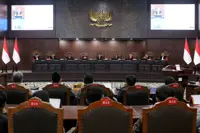
JAKARTA: The House of Representatives passed the employment protection law in a plenary session on Tues (Oct 6), less than two months after lawmakers initiated the bill, with the government confident that the law will balance the rights of workers and employers.
Manpower Minister Yassierli said during the plenary session that the new law had “harmonised standards that were previously scattered and often caused uncertainties”, adding that it had also “fundamentally strengthened labour protections, making them more equitable”.
He outlined several key provisions deemed crucial for labour protection, starting with the guarantees of equal opportunities and treatment across all employment aspects.
“This bill reinforces the principle of nondiscrimination, including in the recruitment process, remuneration, career development and employment relations, so that every worker receives fair and equal treatment in the workplace,” he said.
Secondly, Yassierli said the law aims to strengthen protection for jobseekers by requiring employers to provide transparent labour market information, ensuring equal access while preventing fraudulent practices in the recruitment process.
He added that the law would also provide legal certainty for interns and internship programmes, improve protection in the process of employee placement, promote fair labour relations and workplace safety, as well as impose proportional sanctions on employers who violate workers’ rights.
Yassierli went on to say that the law introduced measures to step up workforce certification and labour oversight, integrate employment data and arrange severance and unemployment protection schemes.
It also ensures protections for workers with disabilities, bans firms from withholding personal documents, expands protections for flexible work, regulates certain foreign workers and strengthens protections for outsourced workers at state-owned enterprises (SOEs) by requiring outsourcing to be handled by subsidiaries.
“Overall, the government sees the labour protection bill as having reflected a balance between the fundamental rights of workers and the sustainability of the business sector,” Yassierli said.
Several labour groups also attended the plenary session on Tuesday, including the Grand Coalition for Indonesian Workersʼ Struggle and the All-Indonesian Workers Union Confederation (KSPSI), who appeared to cheer and support the passage.
Following the plenary session, House Deputy Speaker Sufmi Dasco met with labour unions gathered outside the House, saying the government and President Prabowo Subianto had fulfilled their promise to pass the law.
“This is a gift for all of us and for workers, to keep them motivated to fight for their rights. May cooperation between workers, the government, employers and the House of Representatives continue to run smoothly in the future,” he said, as quoted by Detik.com.
The government hopes to finalise the bill before the end of October, following a Constitutional Court ruling in October 2024 that ordered the establishment of a new employment law separate from the Job Creation Law within two years.
The bill was formally approved as a House initiative proposal during a plenary session on Aug. 27, after which it was submitted to the President, who promptly issued a presidential letter on Sept. 1 to begin joint deliberations.
Since then, the new labour bill has sparked debate among employers and workers. Both sides struggled to resolve some key sticking points, including minimum wage calculations, rules governing outsourcing and fixed-term employment contracts (PKWT), as well as severance pay.
While the final text of the newly passed law has yet to be made public, the circulating bill states that employers are obliged to pay severance, long-service awards and compensation for worker entitlements.
It also limits outsourcing only for five support service categories, including cleaning, catering, security, mining and oil support services, as well as worker transportation.
Additionally, it limits the period of fixed-term employment contracts (PKWT) to two years, with up to two one-year extensions. On the minimum wage formula, the legislation states that it must be set based on recommendations from the National Wage Council through “a transparent process involving the government, employers and workers unions”.
The Confederation of Indonesian Trade Unions (KSPI) previously issued a draft highlighting 10 key points, such as strict limitations on outsourcing and prohibiting fixed-term contracts for full-time positions, which marked a major divergence from the Indonesian Employers Association’s (Apindo) emphasis on operational flexibility.
KSPI also called for a wage increase of between 7.5 percent and 9.5 per cent for both the provincial minimum wage and the city minimum wage this year, as well as tax exemptions for Old-Age Savings, and opposed reducing severance payments to half of the amount required in the previous rule.
Meanwhile, Apindo has urged a balance between business flexibility and worker protection, warning that making a labour regulation more rigid could hamper job creation and investments. Apindo proposes changes to the minimum wage formula and that wages be adjusted every two years instead of annually.
The group also wants flexibility in rules governing outsourcing limits for certain job categories, as well as regulation of fixed-term employment contracts (PKWT), which should be adaptable to different job categories.
On severance pay, said the costs are high and recommended shifting to a prefunded system integrated with the government’s job loss insurance scheme to ensure workers get income while preventing employers from paying double. - The Jakarta Post/ANN